 Add to Chrome
 Add to Firefox
 Add to Edge
HPP: Hierarchical Programmatic Probing for Long Video Understanding by Decoupling Perception and Reasoning
Jun 19, 2026
Understanding long videos requires fine-grained perception and multi-step, higher-order reasoning over complex, long-range spatio-temporal dynamics. Vision-language models (VLMs) encode video frames into visual tokens and attempt to perform both perception and multi-step planning latently, within a single forward pass. This coupled formulation, however, is bottlenecked by the LLM's limited capacity to discover and execute multi-step strategies in its latent representations. To address this bottleneck, we propose Hierarchical Programmatic Probing (HPP), a framework that decouples semantic perception from higher-order temporal reasoning by reformulating long video understanding as iterative, programmatic exploration of a hierarchically segmented video. Specifically, a coding-capable LLM plans and executes a multi-step strategy in an interactive coding environment, probing the video for information and invoking a VLM for localized perception on demand. To make probing tractable over long videos, we introduce three components: information-density-aware hierarchical segmentation, late-interaction semantic retrieval, and structured probing functions for coarse-to-fine temporal localization. We validate HPP on LongVideoBench, which requires both fine-grained perception and long-range relational reasoning, and show that decoupling the two via iterative programmatic probing yields substantial gains. Further results on EgoSchema, VideoMME, and MLVU demonstrate the effectiveness of our approach across diverse long-video benchmarks.

Torch2Chip: An End-to-end Customizable Deep Neural Network Compression and Deployment Toolkit for Prototype Hardware Accelerator Design
May 06, 2024
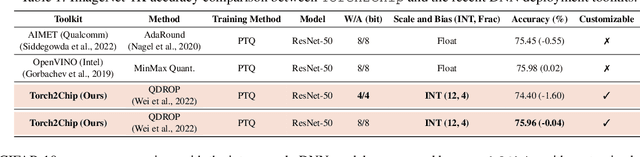
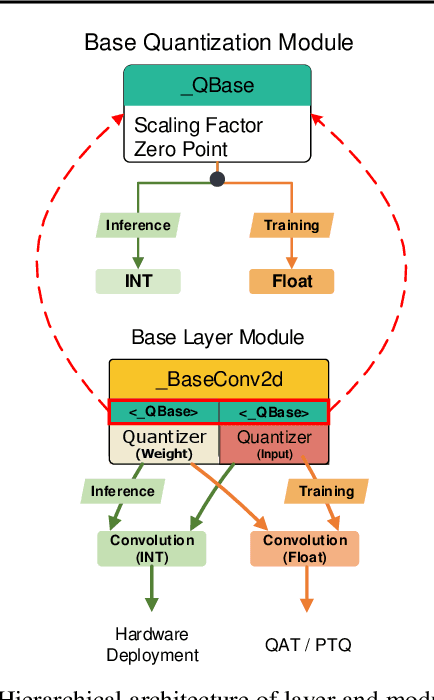
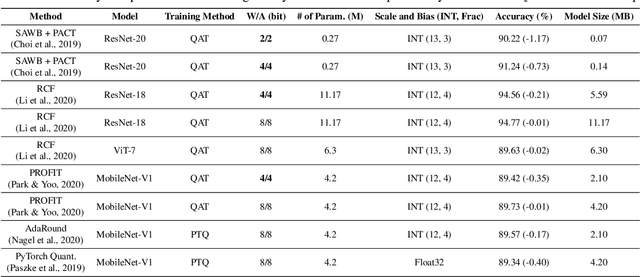
The development of model compression is continuously motivated by the evolution of various neural network accelerators with ASIC or FPGA. On the algorithm side, the ultimate goal of quantization or pruning is accelerating the expensive DNN computations on low-power hardware. However, such a "design-and-deploy" workflow faces under-explored challenges in the current hardware-algorithm co-design community. First, although the state-of-the-art quantization algorithm can achieve low precision with negligible degradation of accuracy, the latest deep learning framework (e.g., PyTorch) can only support non-customizable 8-bit precision, data format, and parameter extraction. Secondly, the objective of quantization is to enable the computation with low-precision data. However, the current SoTA algorithm treats the quantized integer as an intermediate result, while the final output of the quantizer is the "discretized" floating-point values, ignoring the practical needs and adding additional workload to hardware designers for integer parameter extraction and layer fusion. Finally, the compression toolkits designed by the industry are constrained to their in-house product or a handful of algorithms. The limited degree of freedom in the current toolkit and the under-explored customization hinder the prototype ASIC or FPGA-based accelerator design. To resolve these challenges, we propose Torch2Chip, an open-sourced, fully customizable, and high-performance toolkit that supports user-designed compression followed by automatic model fusion and parameter extraction. Torch2Chip incorporates the hierarchical design workflow, and the user-customized compression algorithm will be directly packed into the deployment-ready format for prototype chip verification with either CNN or vision transformer (ViT). The code is available at https://github.com/SeoLabCornell/torch2chip.