 Add to Chrome
 Add to Firefox
 Add to Edge
Benchmarking Deep Learning Approaches for AEC Engineering Drawing Layout Detection and Information Extraction
Jul 21, 2026
Information Extraction (IE) from Architecture, Engineering, and Construction (AEC) drawings remains hindered by manual inefficiency, while Layout Detection, a vital 'middleware' organizing graphical and textual hierarchies, is underexplored. General document layout models, optimized for text-centric content, lack validation on engineering drawings. This study constructs a custom AEC-specific layouts dataset and benchmarks five deep learning architectures. RF-DETR achieves state-of-the-art performance with an $mAP_{50}$ of 0.949, while the Vision-Language Model Qwen3-VL attains a leading F1-score of 0.911. Conversely, models pre-trained on general document datasets suffer from "domain interference", causing performance degradation. This establishes a robust technical foundation for automated IE in AEC.

Title block detection and information extraction for enhanced building drawings search
Apr 11, 2025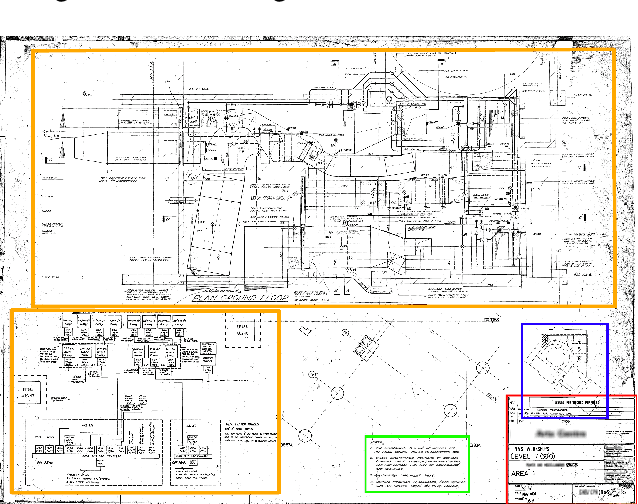
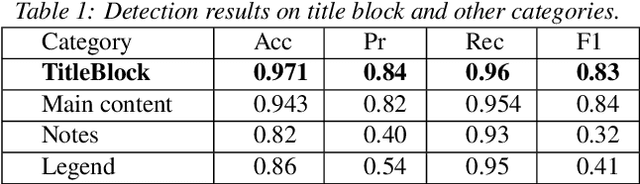
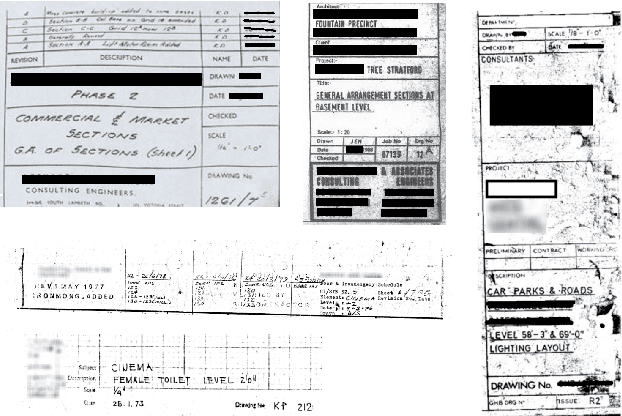
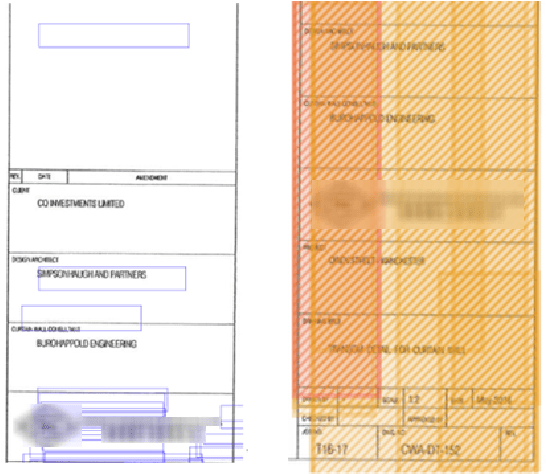
The architecture, engineering, and construction (AEC) industry still heavily relies on information stored in drawings for building construction, maintenance, compliance and error checks. However, information extraction (IE) from building drawings is often time-consuming and costly, especially when dealing with historical buildings. Drawing search can be simplified by leveraging the information stored in the title block portion of the drawing, which can be seen as drawing metadata. However, title block IE can be complex especially when dealing with historical drawings which do not follow existing standards for uniformity. This work performs a comparison of existing methods for this kind of IE task, and then proposes a novel title block detection and IE pipeline which outperforms existing methods, in particular when dealing with complex, noisy historical drawings. The pipeline is obtained by combining a lightweight Convolutional Neural Network and GPT-4o, the proposed inference pipeline detects building engineering title blocks with high accuracy, and then extract structured drawing metadata from the title blocks, which can be used for drawing search, filtering and grouping. The work demonstrates high accuracy and efficiency in IE for both vector (CAD) and hand-drawn (historical) drawings. A user interface (UI) that leverages the extracted metadata for drawing search is established and deployed on real projects, which demonstrates significant time savings. Additionally, an extensible domain-expert-annotated dataset for title block detection is developed, via an efficient AEC-friendly annotation workflow that lays the foundation for future work.