 Add to Chrome
 Add to Firefox
 Add to Edge
LLMs and people both learn to form conventions -- just not with each other
Feb 09, 2026
Humans align to one another in conversation -- adopting shared conventions that ease communication. We test whether LLMs form the same kinds of conventions in a multimodal communication game. Both humans and LLMs display evidence of convention-formation (increasing the accuracy and consistency of their turns while decreasing their length) when communicating in same-type dyads (humans with humans, AI with AI). However, heterogenous human-AI pairs fail -- suggesting differences in communicative tendencies. In Experiment 2, we ask whether LLMs can be induced to behave more like human conversants, by prompting them to produce superficially humanlike behavior. While the length of their messages matches that of human pairs, accuracy and lexical overlap in human-LLM pairs continues to lag behind that of both human-human and AI-AI pairs. These results suggest that conversational alignment requires more than just the ability to mimic previous interactions, but also shared interpretative biases toward the meanings that are conveyed.

Agentività e telicità in GilBERTo: implicazioni cognitive
Jul 06, 2023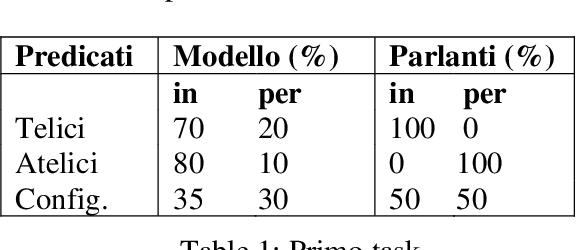
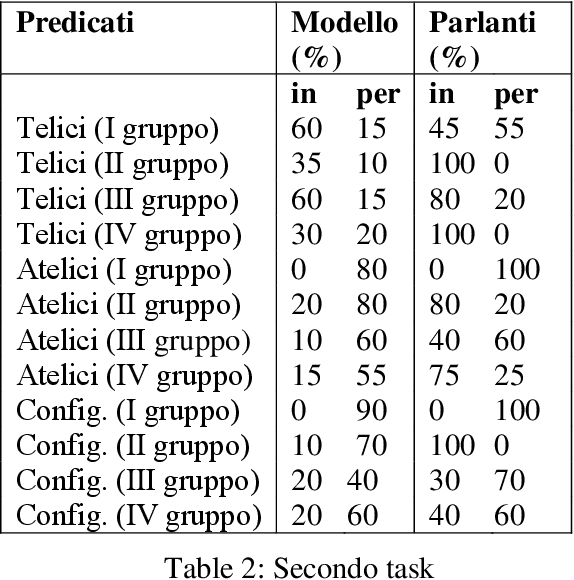
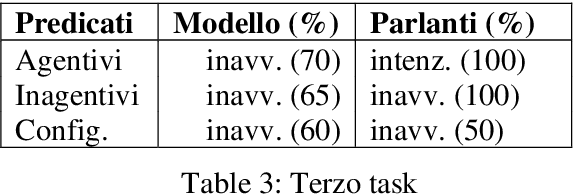
The goal of this study is to investigate whether a Transformer-based neural language model infers lexical semantics and use this information for the completion of morphosyntactic patterns. The semantic properties considered are telicity (also combined with definiteness) and agentivity. Both act at the interface between semantics and morphosyntax: they are semantically determined and syntactically encoded. The tasks were submitted to both the computational model and a group of Italian native speakers. The comparison between the two groups of data allows us to investigate to what extent neural language models capture significant aspects of human semantic competence.