 Add to Chrome
 Add to Firefox
 Add to Edge
Structuring the Space of Perspectives
Aug 12, 2026
The same event can be reported from different perspectives depending on the experiences, background, and beliefs of the writer or speaker. A variety of NLP areas engage with perspectives, spanning from text analysis to algorithm optimization. A wide range of operative concepts (such as stances, sentiment, frames, and arguments) has been used to capture perspectives in texts, however the precise relationships among those concepts remain unclear. Arguably, a deeper theoretical understanding of these concepts would empower more effective research on perspectives. In this paper, we address this gap by reviewing the space of perspectives in NLP and defining a set of properties that help distinguishing perspective-related concepts. Our analysis leads us to posit a hierarchy which organizes these concepts linearly along a single axis. Finally, we show how this principled conceptual hierarchy can help researchers navigate the field and select operationalizations of perspective that align with their specific research objectives.

Fine-grained Fallacy Detection with Human Label Variation
Feb 19, 2025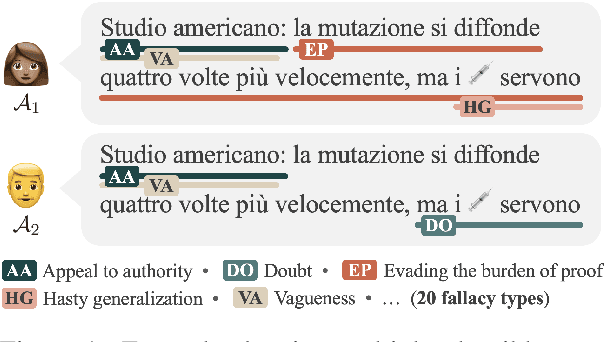
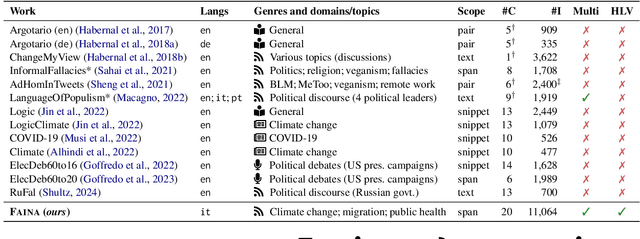
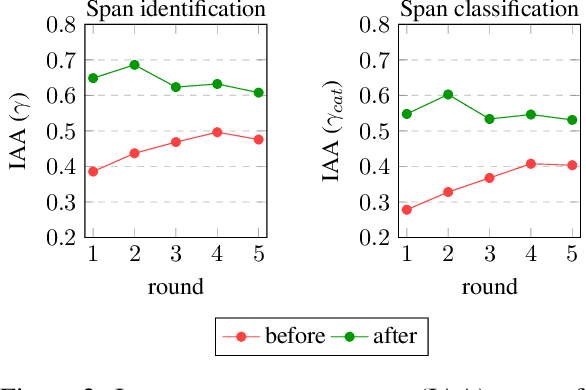
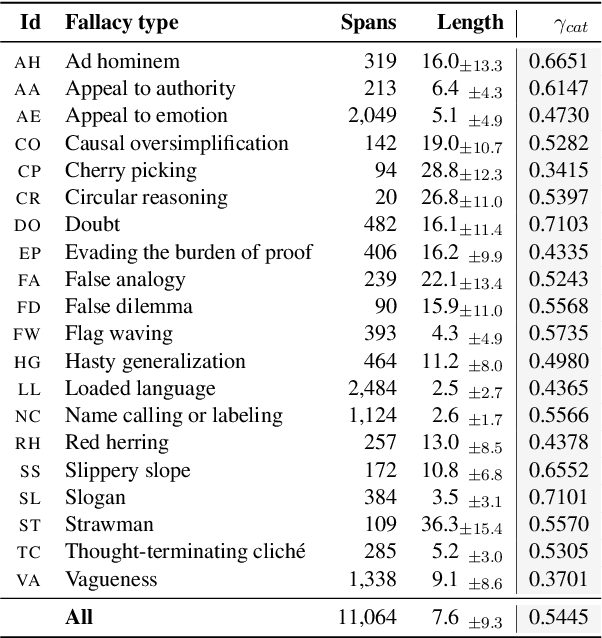
We introduce Faina, the first dataset for fallacy detection that embraces multiple plausible answers and natural disagreement. Faina includes over 11K span-level annotations with overlaps across 20 fallacy types on social media posts in Italian about migration, climate change, and public health given by two expert annotators. Through an extensive annotation study that allowed discussion over multiple rounds, we minimize annotation errors whilst keeping signals of human label variation. Moreover, we devise a framework that goes beyond "single ground truth" evaluation and simultaneously accounts for multiple (equally reliable) test sets and the peculiarities of the task, i.e., partial span matches, overlaps, and the varying severity of labeling errors. Our experiments across four fallacy detection setups show that multi-task and multi-label transformer-based approaches are strong baselines across all settings. We release our data, code, and annotation guidelines to foster research on fallacy detection and human label variation more broadly.