 Add to Chrome
 Add to Firefox
 Add to Edge
Efficient Mixture-of-Experts LLM Inference with Apple Silicon NPUs
Apr 20, 2026
Apple Neural Engine (ANE) is a dedicated neural processing unit (NPU) present in every Apple Silicon chip. Mixture-of-Experts (MoE) LLMs improve inference efficiency via sparse activation but are challenging for NPUs in three ways: expert routing is unpredictable and introduces dynamic tensor shapes that conflict with the shape-specific constraints of NPUs; several irregular operators, e.g., top-k, scatter/gather, etc., are not NPU-friendly; and launching many small expert kernels incurs substantial dispatch and synchronization overhead. NPUs are designed to offload AI compute from CPU and GPU; our goal is to enable such offloading for MoE inference, particularly during prefill, where long-context workloads consume substantial system resources. This paper presents NPUMoE, a runtime inference engine that accelerates MoE execution on Apple Silicon by offloading dense, static computation to NPU, while preserving a CPU/GPU fallback path for dynamic operations. NPUMoE uses offline calibration to estimate expert capacity and popularity that drives three key techniques: (1) Static tiers for expert capacity to address dynamic expert routing (2) Grouped expert execution to mitigate NPU concurrency limits (3) Load-aware expert compute graph residency to reduce CPU-NPU synchronization overhead. Experiments on Apple M-series devices using three representative MoE LLMs and four long-context workloads show that NPUMoE consistently outperforms baselines, reducing latency by 1.32x-5.55x, improving energy efficiency by 1.81x-7.37x, and reducing CPU-cycle usage by 1.78x-5.54x through effective NPU offloading.

Leveraging cache to enable SLU on tiny devices
Nov 30, 2023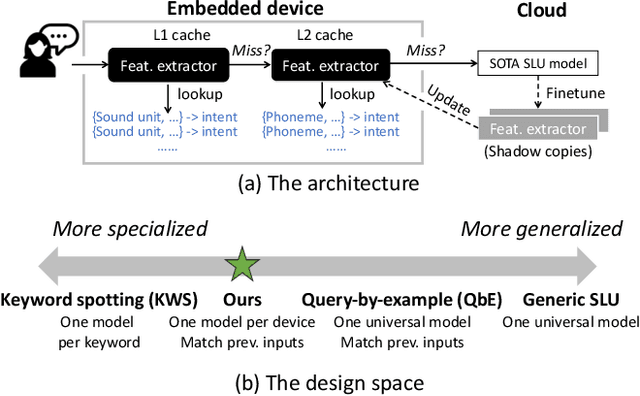
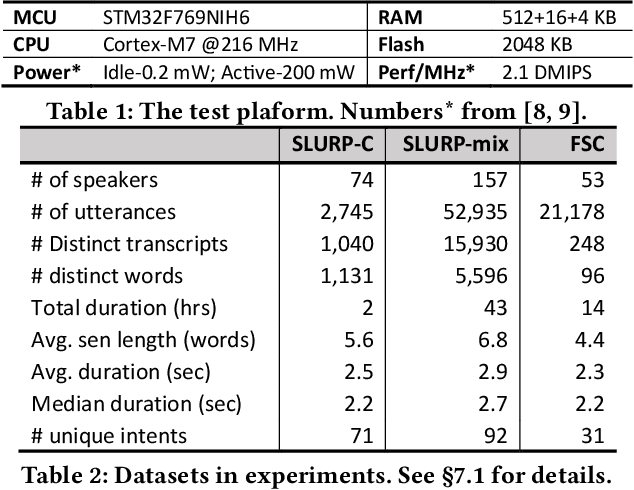
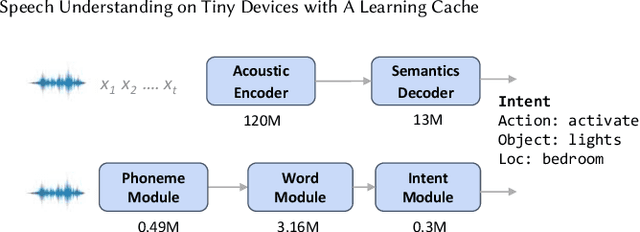
This paper addresses spoken language understanding (SLU) on microcontroller-like embedded devices, integrating on-device execution with cloud offloading in a novel fashion. We exploit temporal locality in a device's speech inputs and accordingly reuse recent SLU inferences. Our idea is simple: let the device match new inputs against cached results, and only offload unmatched inputs to the cloud for full inference. Realization of this idea, however, is non-trivial: the device needs to compare acoustic features in a robust, low-cost way. To this end, we present XYZ, a speech cache for tiny devices. It matches speech inputs at two levels of representations: first by clustered sequences of raw sound units, then as sequences of phonemes. Working in tandem, the two representations offer complementary cost/accuracy tradeoffs. To further boost accuracy, our cache is learning: with the mismatched and then offloaded inputs, it continuously finetunes the device's feature extractors (with the assistance of the cloud). We implement XYZ on an off-the-shelf STM32 microcontroller. The resultant implementation has a small memory footprint of 2MB. Evaluated on challenging speech benchmarks, our system resolves 45%--90% of inputs on device, reducing the average latency by up to 80% compared to offloading to popular cloud speech services. Our benefit is pronounced even in adversarial settings -- noisy environments, cold cache, or one device shared by a number of users.