 Add to Chrome
 Add to Firefox
 Add to Edge
Single Plane Spatial Mode Sorter
Apr 15, 2026
A mode sorter separates a set of M orthogonal spatial modes in a shared input channel into M different output channels. Here we present an analytic derivation and experimental validation of a single plane device for sorting spatial modes from a diverse variety of mode families, including Hermite-Gaussian (HG), Laguerre-Gaussian (LG), Bessel-Gaussian (BG), with almost no cross-talk. This sorting capability is required for a wide range of applications that employ classical or quantum light. We also show that applying this design in order to sort a set of Orbital Angular Momentum (OAM) modes with zero radial index reproduces the well-known Fork grating configuration. Furthermore, by taking the limit of M -> inf, we present an analytical expression for sorting all the modes of a given family. By operating this device in reverse, it can be used to generate arbitrary modes, by illuminating it with a Gaussian beam. The power transmission coefficient for this sorter goes as 1/M and we provide a mathematical proof that this is optimal for any typical arrangement of the detector positions. We further study the sorter sensitivity to wavelength and random phase noise.
* 29 pages, 17 figures. Published in Opt. Express 34, 1837-1849 (2026)

Designing Nonlinear Photonic Crystals for High-Dimensional Quantum State Engineering
Apr 13, 2023


We propose a novel, physically-constrained and differentiable approach for the generation of D-dimensional qudit states via spontaneous parametric down-conversion (SPDC) in quantum optics. We circumvent any limitations imposed by the inherently stochastic nature of the physical process and incorporate a set of stochastic dynamical equations governing its evolution under the SPDC Hamiltonian. We demonstrate the effectiveness of our model through the design of structured nonlinear photonic crystals (NLPCs) and shaped pump beams; and show, theoretically and experimentally, how to generate maximally entangled states in the spatial degree of freedom. The learning of NLPC structures offers a promising new avenue for shaping and controlling arbitrary quantum states and enables all-optical coherent control of the generated states. We believe that this approach can readily be extended from bulky crystals to thin Metasurfaces and potentially applied to other quantum systems sharing a similar Hamiltonian structures, such as superfluids and superconductors.
SPDCinv: Inverse Quantum-Optical Design of High-Dimensional Qudits
Dec 11, 2021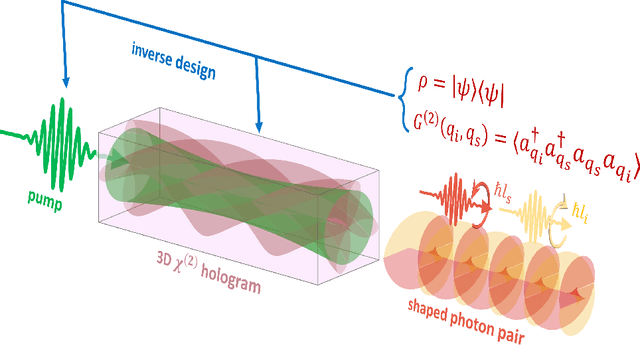
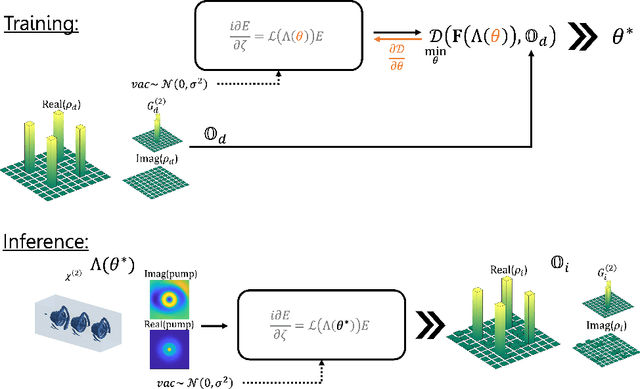
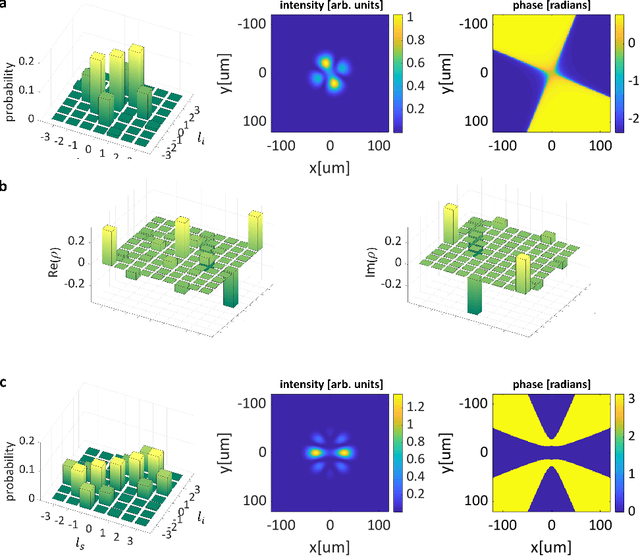
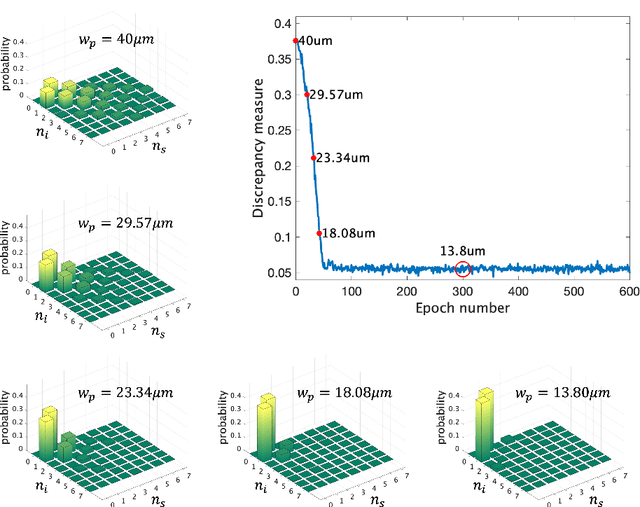
Spontaneous parametric down-conversion in quantum optics is an invaluable resource for the realization of high-dimensional qudits with spatial modes of light. One of the main open challenges is how to directly generate a desirable qudit state in the SPDC process. This problem can be addressed through advanced computational learning methods; however, due to difficulties in modeling the SPDC process by a fully differentiable algorithm that takes into account all interaction effects, progress has been limited. Here, we overcome these limitations and introduce a physically-constrained and differentiable model, validated against experimental results for shaped pump beams and structured crystals, capable of learning every interaction parameter in the process. We avoid any restrictions induced by the stochastic nature of our physical model and integrate the dynamic equations governing the evolution under the SPDC Hamiltonian. We solve the inverse problem of designing a nonlinear quantum optical system that achieves the desired quantum state of down-converted photon pairs. The desired states are defined using either the second-order correlations between different spatial modes or by specifying the required density matrix. By learning nonlinear volume holograms as well as different pump shapes, we successfully show how to generate maximally entangled states. Furthermore, we simulate all-optical coherent control over the generated quantum state by actively changing the profile of the pump beam. Our work can be useful for applications such as novel designs of high-dimensional quantum key distribution and quantum information processing protocols. In addition, our method can be readily applied for controlling other degrees of freedom of light in the SPDC process, such as the spectral and temporal properties, and may even be used in condensed-matter systems having a similar interaction Hamiltonian.
Inverse Design of Quantum Holograms in Three-Dimensional Nonlinear Photonic Crystals
Feb 20, 2021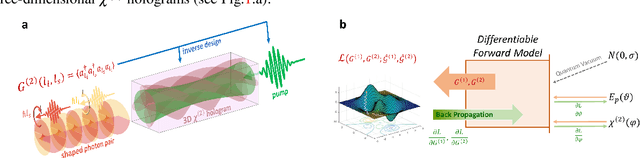
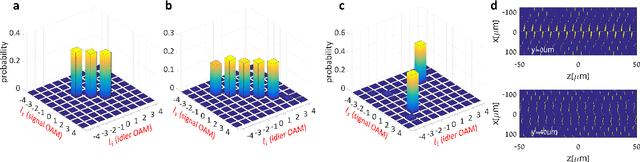
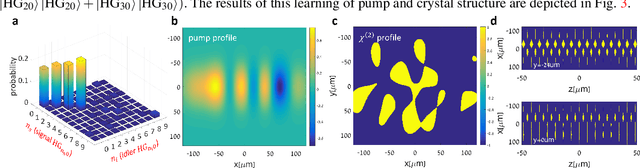
We introduce a systematic approach for designing 3D nonlinear photonic crystals and pump beams for generating desired quantum correlations between structured photon-pairs. Our model is fully differentiable, allowing accurate and efficient learning and discovery of novel designs.