 Add to Chrome
 Add to Firefox
 Add to Edge
Structure-Preserving Neural Surrogates with Tractable Uncertainty Quantification
Jun 10, 2026
Recent advances in scientific machine learning provide a means of near-real-time solution to partial differential equations (PDEs), but lack the theoretical underpinnings of conventional simulators that support contemporary verification and validation. In this work, we construct data-driven reduced-order models that serve as structure-preserving, real-time surrogates. Remarkably, the exterior calculus that imposes physical conservation structure also exposes topological structure that we use to build a Gaussian process (GP) representation of uncertainty in state-flux relationships, ultimately yielding a Dirichlet-to-Neumann map for quantities of interest with closed-form expressions for posterior uncertainty. We specifically propose structure-preserving $H(\mathrm{div})$--$L^2$ subspaces of conventional Raviart--Thomas and $dgP_0$ elements prescribed by a lightweight transformer. Reduced-order dynamics consistent with this subspace are learned by posing a conservation law in which a GP describes the fluxes between volumes. This work hinges on a novel interface between mixed FEM spaces and GP regression; when training is posed as the optimal recovery problem (ORP), the resulting GP regression can be written as an optimization problem with equality constraints that impose a conservation structure, amenable to a fast Schur-complement training strategy. The trained model can then be solved in real time with closed-form estimators for boundary fluxes driven by prescribed Dirichlet data. The paper includes RKHS posterior error bounds for linear functionals to support uncertainty quantification, as well as numerical experiments demonstrating the accuracy of the posterior distribution as a surrogate for error estimation.

Transfer Learning on Multi-Dimensional Data: A Novel Approach to Neural Network-Based Surrogate Modeling
Oct 16, 2024

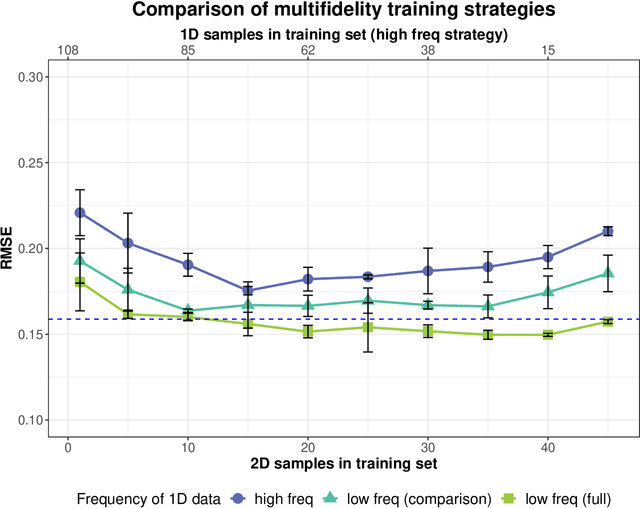
The development of efficient surrogates of partial differential equations (PDEs) is a critical step towards scalable modeling of complex, multiscale systems-of-systems. Convolutional neural networks (CNNs) have gained popularity as the basis for such surrogate models due to their success in capturing high-dimensional input-output mappings and the negligible cost of a forward pass. However, the high cost of generating training data -- typically via classical numerical solvers -- raises the question of whether these models are worth pursuing over more straightforward alternatives with well-established theoretical foundations, such as Monte Carlo methods. To reduce the cost of data generation, we propose training a CNN surrogate model on a mixture of numerical solutions to both the $d$-dimensional problem and its ($d-1$)-dimensional approximation, taking advantage of the efficiency savings guaranteed by the curse of dimensionality. We demonstrate our approach on a multiphase flow test problem, using transfer learning to train a dense fully-convolutional encoder-decoder CNN on the two classes of data. Numerical results from a sample uncertainty quantification task demonstrate that our surrogate model outperforms Monte Carlo with several times the data generation budget.