 Add to Chrome
 Add to Firefox
 Add to Edge
Enhancing Tree Species Classification: Insights from YOLOv8 and Explainable AI Applied to TLS Point Cloud Projections
Dec 17, 2025
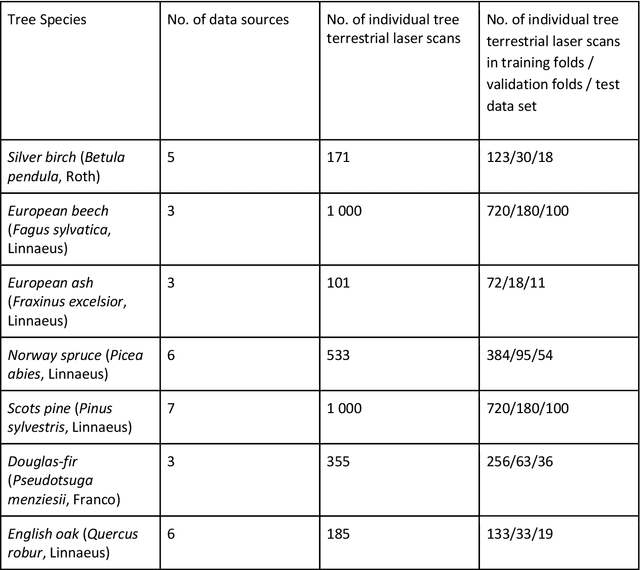
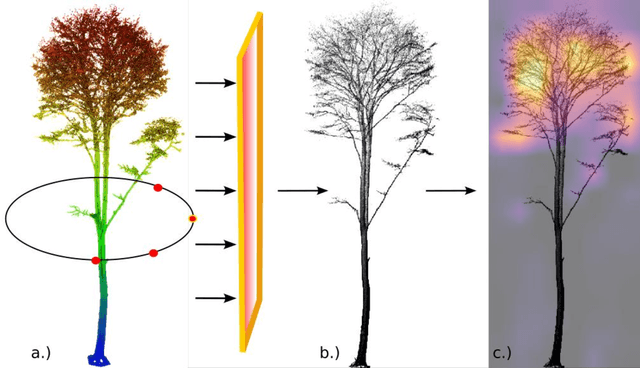
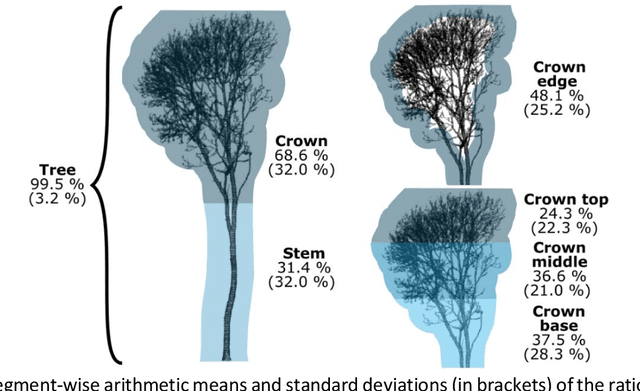
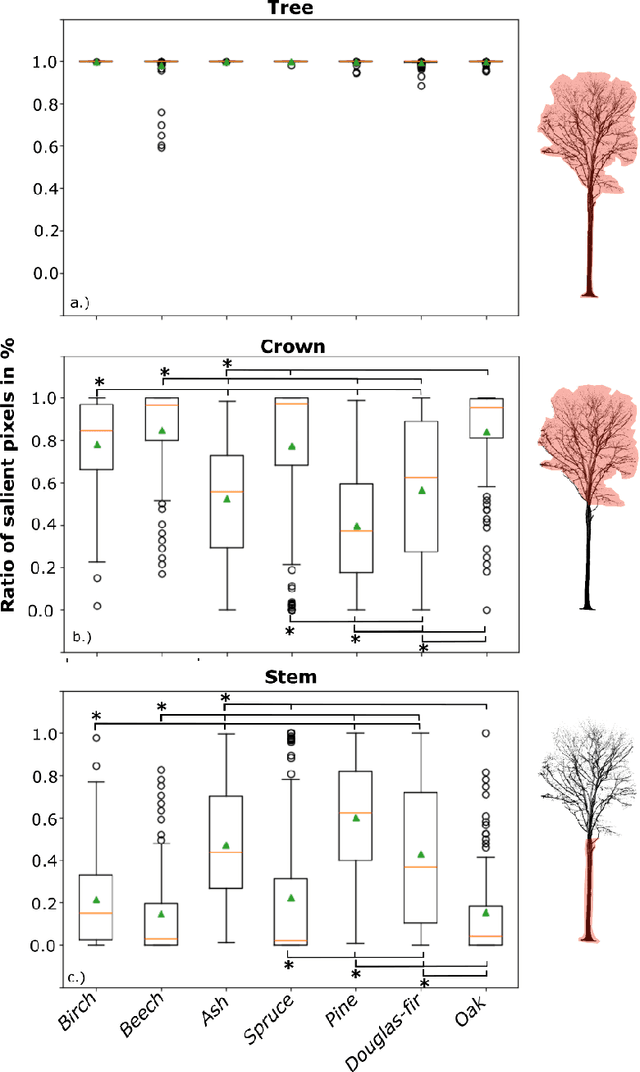
Classifying tree species has been a core research area in forest remote sensing for decades. New sensors and classification approaches like TLS and deep learning achieve state-of-the art accuracy but their decision processes remain unclear. Methods such as Finer-CAM (Class Activation Mapping) can highlight features in TLS projections that contribute to the classification of a target species, yet are uncommon in similar looking contrastive tree species. We propose a novel method linking Finer-CAM explanations to segments of TLS projections representing structural tree features to systemically evaluate which features drive species discrimination. Using TLS data from 2,445 trees across seven European tree species, we trained and validated five YOLOv8 models with cross-validation, reaching a mean accuracy of 96% (SD = 0.24%). Analysis of 630 saliency maps shows the models primarily rely on crown features in TLS projections for species classification. While this result is pronounced in Silver Birch, European Beech, English oak, and Norway spruce, stem features contribute more frequently to the differentiation of European ash, Scots pine, and Douglas fir. Particularly representations of finer branches contribute to the decisions of the models. The models consider those tree species similar to each other which a human expert would also regard as similar. Furthermore, our results highlight the need for an improved understanding of the decision processes of tree species classification models to help reveal data set and model limitations, biases, and to build confidence in model predictions.

Benchmarking tree species classification from proximally-sensed laser scanning data: introducing the FOR-species20K dataset
Aug 12, 2024Proximally-sensed laser scanning offers significant potential for automated forest data capture, but challenges remain in automatically identifying tree species without additional ground data. Deep learning (DL) shows promise for automation, yet progress is slowed by the lack of large, diverse, openly available labeled datasets of single tree point clouds. This has impacted the robustness of DL models and the ability to establish best practices for species classification. To overcome these challenges, the FOR-species20K benchmark dataset was created, comprising over 20,000 tree point clouds from 33 species, captured using terrestrial (TLS), mobile (MLS), and drone laser scanning (ULS) across various European forests, with some data from other regions. This dataset enables the benchmarking of DL models for tree species classification, including both point cloud-based (PointNet++, MinkNet, MLP-Mixer, DGCNNs) and multi-view image-based methods (SimpleView, DetailView, YOLOv5). 2D image-based models generally performed better (average OA = 0.77) than 3D point cloud-based models (average OA = 0.72), with consistent results across different scanning platforms and sensors. The top model, DetailView, was particularly robust, handling data imbalances well and generalizing effectively across tree sizes. The FOR-species20K dataset, available at https://zenodo.org/records/13255198, is a key resource for developing and benchmarking DL models for tree species classification using laser scanning data, providing a foundation for future advancements in the field.