 Add to Chrome
 Add to Firefox
 Add to Edge
Practical Hybrid Quantum Language Models with Observable Readout on Real Hardware
Dec 14, 2025
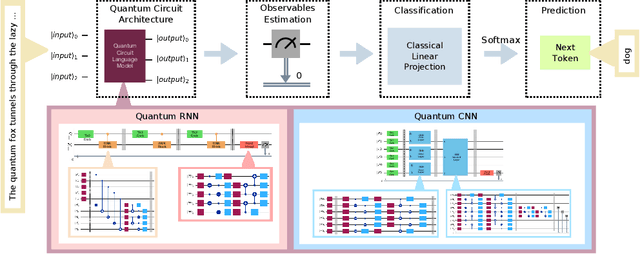
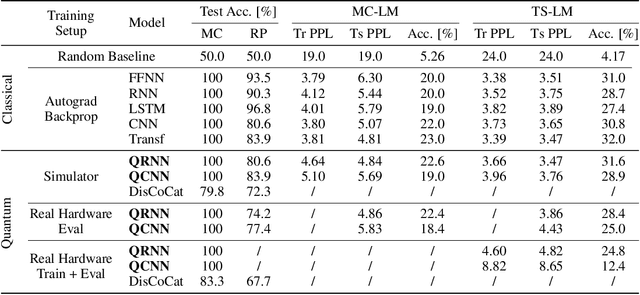
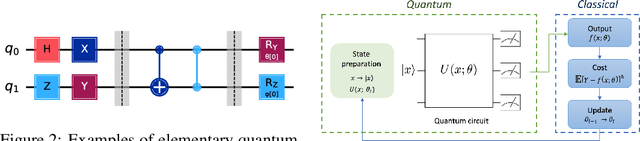
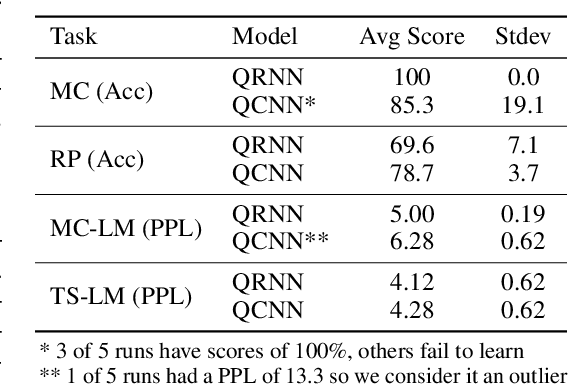
Hybrid quantum-classical models represent a crucial step toward leveraging near-term quantum devices for sequential data processing. We present Quantum Recurrent Neural Networks (QRNNs) and Quantum Convolutional Neural Networks (QCNNs) as hybrid quantum language models, reporting the first empirical demonstration of generative language modeling trained and evaluated end-to-end on real quantum hardware. Our architecture combines hardware-optimized parametric quantum circuits with a lightweight classical projection layer, utilizing a multi-sample SPSA strategy to efficiently train quantum parameters despite hardware noise. To characterize the capabilities of these models, we introduce a synthetic dataset designed to isolate syntactic dependencies in a controlled, low-resource environment. Experiments on IBM Quantum processors reveal the critical trade-offs between circuit depth and trainability, demonstrating that while noise remains a significant factor, observable-based readout enables the successful learning of sequential patterns on NISQ devices. These results establish a rigorous engineering baseline for generative quantum natural language processing, validating the feasibility of training complex sequence models on current quantum hardware.

When will the mist clear? On the Interpretability of Machine Learning for Medical Applications: a survey
Oct 01, 2020
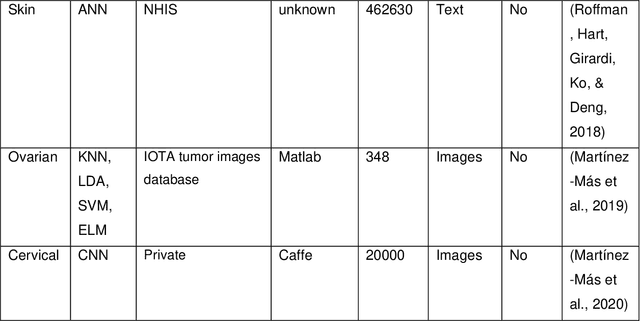


Artificial Intelligence is providing astonishing results, with medicine being one of its favourite playgrounds. In a few decades, computers may be capable of formulating diagnoses and choosing the correct treatment, while robots may perform surgical operations, and conversational agents could interact with patients as virtual coaches. Machine Learning and, in particular, Deep Neural Networks are behind this revolution. In this scenario, important decisions will be controlled by standalone machines that have learned predictive models from provided data. Among the most challenging targets of interest in medicine are cancer diagnosis and therapies but, to start this revolution, software tools need to be adapted to cover the new requirements. In this sense, learning tools are becoming a commodity in Python and Matlab libraries, just to name two, but to exploit all their possibilities, it is essential to fully understand how models are interpreted and which models are more interpretable than others. In this survey, we analyse current machine learning models, frameworks, databases and other related tools as applied to medicine - specifically, to cancer research - and we discuss their interpretability, performance and the necessary input data. From the evidence available, ANN, LR and SVM have been observed to be the preferred models. Besides, CNNs, supported by the rapid development of GPUs and tensor-oriented programming libraries, are gaining in importance. However, the interpretability of results by doctors is rarely considered which is a factor that needs to be improved. We therefore consider this study to be a timely contribution to the issue.