 Add to Chrome
 Add to Firefox
 Add to Edge
The Blessing of Dimensionality: How Near-Orthogonality in High-Dimensional Spaces Explains Temporal Portability
Jul 22, 2026
Fine-tuning has been widely used to adapt large language models (LLMs) for domain-specific tasks. Parameter efficient fine-tuning (PEFT) methods such as low-rank adaptation (LoRA) are frequently used to reduce computational costs. PortLLM is a training-free and data-free scheme used to adapt LLMs after continual pretraining. Although the initial PortLLM results show that LoRA patches exhibit short-term temporal portability, the long-term performance of PortLLM across several updates of continual pretraining remains underexplored. Furthermore, the intriguing effectiveness of PortLLM is not well understood from a theoretical standpoint. We address these two open questions by (1) performing an extensive empirical study of the long-term temporal portability of PortLLM patches across 10 continual pretraining steps using base models Mistral, Gemma, and Qwen; and (2) offering two theoretical analyses to explain our observation that the simple PortLLM method achieves competitive performance. We find empirically that the portability persists across longer time duration, indicating that repeated fine-tuning is not required when the base model is periodically updated. We find theoretically that near-orthogonality of high-dimensional vectors is a key justification for temporal portability. Our analyses also demonstrate a geometric perspective of the loss landscape in facilitating the theoretical comparison of different adaptation options.

HATFormer: Historic Handwritten Arabic Text Recognition with Transformers
Oct 03, 2024
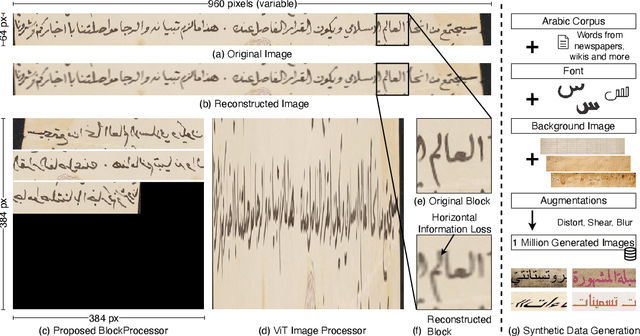
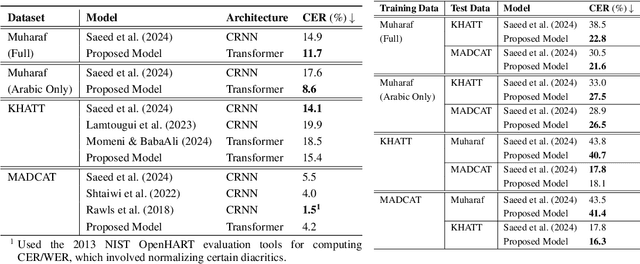
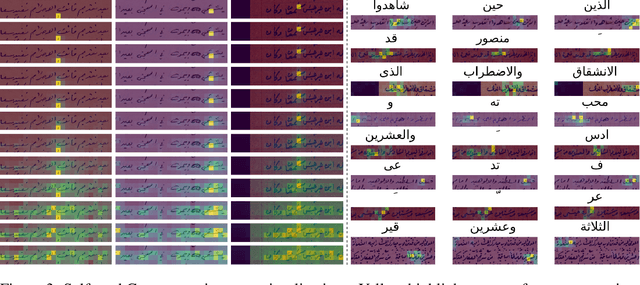
Arabic handwritten text recognition (HTR) is challenging, especially for historical texts, due to diverse writing styles and the intrinsic features of Arabic script. Additionally, Arabic handwriting datasets are smaller compared to English ones, making it difficult to train generalizable Arabic HTR models. To address these challenges, we propose HATFormer, a transformer-based encoder-decoder architecture that builds on a state-of-the-art English HTR model. By leveraging the transformer's attention mechanism, HATFormer captures spatial contextual information to address the intrinsic challenges of Arabic script through differentiating cursive characters, decomposing visual representations, and identifying diacritics. Our customization to historical handwritten Arabic includes an image processor for effective ViT information preprocessing, a text tokenizer for compact Arabic text representation, and a training pipeline that accounts for a limited amount of historic Arabic handwriting data. HATFormer achieves a character error rate (CER) of 8.6% on the largest public historical handwritten Arabic dataset, with a 51% improvement over the best baseline in the literature. HATFormer also attains a comparable CER of 4.2% on the largest private non-historical dataset. Our work demonstrates the feasibility of adapting an English HTR method to a low-resource language with complex, language-specific challenges, contributing to advancements in document digitization, information retrieval, and cultural preservation.
Muharaf: Manuscripts of Handwritten Arabic Dataset for Cursive Text Recognition
Jun 13, 2024
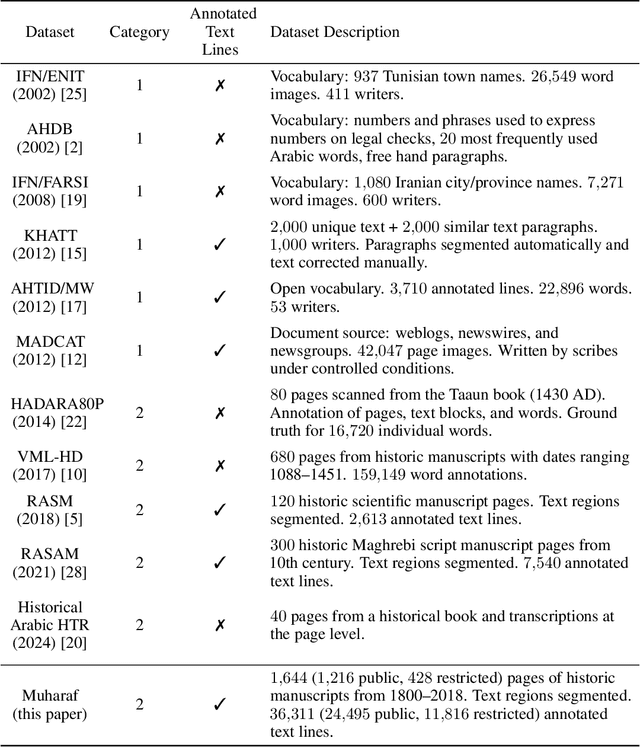
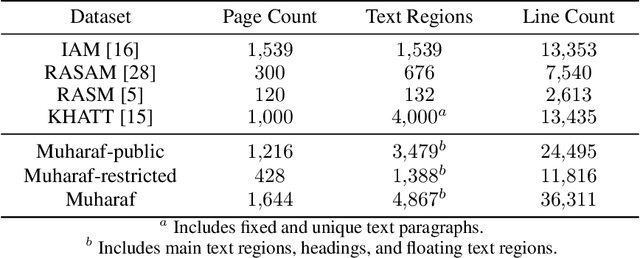
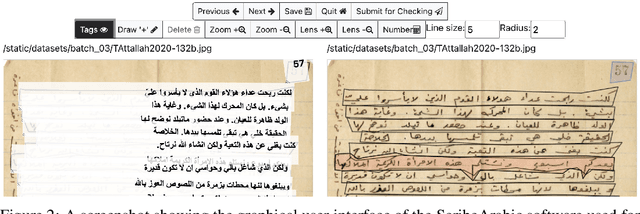
We present the Manuscripts of Handwritten Arabic~(Muharaf) dataset, which is a machine learning dataset consisting of more than 1,600 historic handwritten page images transcribed by experts in archival Arabic. Each document image is accompanied by spatial polygonal coordinates of its text lines as well as basic page elements. This dataset was compiled to advance the state of the art in handwritten text recognition (HTR), not only for Arabic manuscripts but also for cursive text in general. The Muharaf dataset includes diverse handwriting styles and a wide range of document types, including personal letters, diaries, notes, poems, church records, and legal correspondences. In this paper, we describe the data acquisition pipeline, notable dataset features, and statistics. We also provide a preliminary baseline result achieved by training convolutional neural networks using this data.