 Add to Chrome
 Add to Firefox
 Add to Edge
Characterizing the Quality Profile of AI-Generated C++ in Production
Aug 06, 2026
The widespread integration of AI coding assistants offers undeniable boosts to engineering velocity. Yet, recent studies point to a growing trade-off, revealing persistent challenges with code quality and maintainability. Industry leaders, including frontier AI labs, echo these concerns. As large language models are increasingly relied upon to author production code, understanding their impact on shipped software quality has become a critical priority. However, assessing these effects in industrial workflows remains difficult due to observability barriers. We study the impact of AI-generated code on production quality within a large enterprise operating global products relied upon by billions of users daily. Driven by this scale and user trust, the organization values code quality and has built thorough observability for every line of code deployed into production, enabling us to overcome measurement barriers to assess these effects. This study presents a large-scale empirical analysis of AI-generated C++ code from April 2025 to April 2026, tracking 3.52 million code changes across this enterprise's brownfield codebase. The core purpose is to understand the quality, performance, and maintenance characteristics of AI-generated code compared to human-written code in a production environment at scale. We find that AI-generated C++ code has a distinct quality profile, showing higher rates of interface and coupling burdens, copy and allocation overheads, and a reliance on explicit loops over optimized standard APIs. These issues translate into tangible downstream costs, including increased review effort and a 5-8% increase in compute resource consumption. However, we demonstrate that providing models with targeted, taxonomy-informed feedback can mitigate these effects, leading to an 11.1% reduction in targeted static analysis warnings and improved computational efficiency.

Streaming Bilingual End-to-End ASR model using Attention over Multiple Softmax
Jan 22, 2024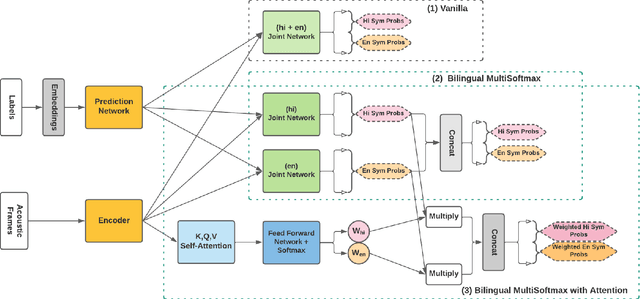
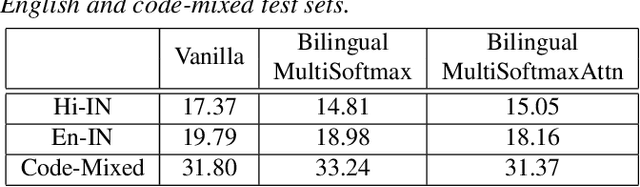
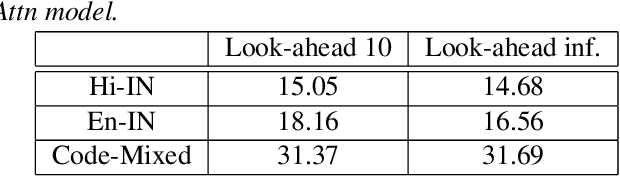
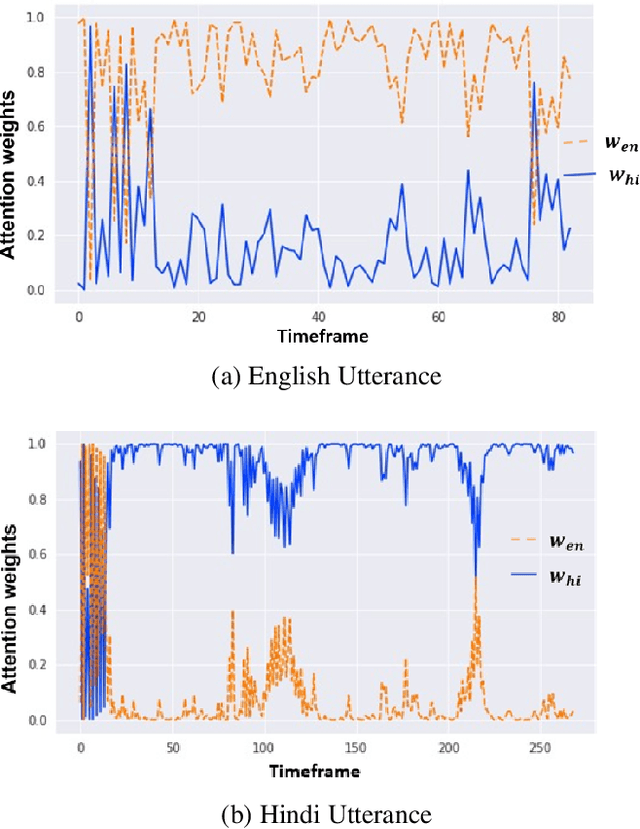
Even with several advancements in multilingual modeling, it is challenging to recognize multiple languages using a single neural model, without knowing the input language and most multilingual models assume the availability of the input language. In this work, we propose a novel bilingual end-to-end (E2E) modeling approach, where a single neural model can recognize both languages and also support switching between the languages, without any language input from the user. The proposed model has shared encoder and prediction networks, with language-specific joint networks that are combined via a self-attention mechanism. As the language-specific posteriors are combined, it produces a single posterior probability over all the output symbols, enabling a single beam search decoding and also allowing dynamic switching between the languages. The proposed approach outperforms the conventional bilingual baseline with 13.3%, 8.23% and 1.3% word error rate relative reduction on Hindi, English and code-mixed test sets, respectively.
* Published in IEEE's Spoken Language Technology (SLT) 2022, 8 pages (6 + 2 for references), 5 figures
Expanding the Design Space for Electrically-Driven Soft Robots through Handed Shearing Auxetics
Oct 01, 2021Handed Shearing Auxetics (HSA) are a promising structure for making electrically driven robots with distributed compliance that convert a motors rotation and torque into extension and force. We overcame past limitations on the range of actuation, blocked force, and stiffness by focusing on two key design parameters: the point of an HSA's auxetic trajectory that is energetically preferred, and the number of cells along the HSAs length. Modeling the HSA as a programmable spring, we characterize the effect of both on blocked force, minimum energy length, spring constant, angle range and holding torque. We also examined the effect viscoelasticity has on actuation forces over time. By varying the auxetic trajectory point, we were able to make actuators that can push, pull, or do both. We expanded the range of forces possible from 5N to 150N, and the range of stiffness from 2 N/mm to 89 N/mm. For a fixed point on the auxetic trajectory, we found decreasing length can improve force output, at the expense of needing higher torques, and having a shorter throw. We also found that the viscoelastic effects can limit the amount of force a 3D printed HSA can apply over time.