 Add to Chrome
 Add to Firefox
 Add to Edge
Region-Grounded Report Generation for 3D Medical Imaging: A Fine-Grained Dataset and Graph-Enhanced Framework
Apr 20, 2026
Automated medical report generation for 3D PET/CT imaging is fundamentally challenged by the high-dimensional nature of volumetric data and a critical scarcity of annotated datasets, particularly for low-resource languages. Current black-box methods map whole volumes to reports, ignoring the clinical workflow of analyzing localized Regions of Interest (RoIs) to derive diagnostic conclusions. In this paper, we bridge this gap by introducing VietPET-RoI, the first large-scale 3D PET/CT dataset with fine-grained RoI annotation for a low-resource language, comprising 600 PET/CT samples and 1,960 manually annotated RoIs, paired with corresponding clinical reports. Furthermore, to demonstrate the utility of this dataset, we propose HiRRA, a novel framework that mimics the professional radiologist diagnostic workflow by employing graph-based relational modules to capture dependencies between RoI attributes. This approach shifts from global pattern matching toward localized clinical findings. Additionally, we introduce new clinical evaluation metrics, namely RoI Coverage and RoI Quality Index, that measure both RoI localization accuracy and attribute description fidelity using LLM-based extraction. Extensive evaluation demonstrates that our framework achieves SOTA performance, surpassing existing models by 19.7% in BLEU and 4.7% in ROUGE-L, while achieving a remarkable 45.8% improvement in clinical metrics, indicating enhanced clinical reliability and reduced hallucination. Our code and dataset are available on GitHub.

Few-Shot Contrastive Adaptation for Audio Abuse Detection in Low-Resource Indic Languages
Apr 10, 2026Abusive speech detection is becoming increasingly important as social media shifts towards voice-based interaction, particularly in multilingual and low-resource settings. Most current systems rely on automatic speech recognition (ASR) followed by text-based hate speech classification, but this pipeline is vulnerable to transcription errors and discards prosodic information carried in speech. We investigate whether Contrastive Language-Audio Pre-training (CLAP) can support abusive speech detection directly from audio. Using the ADIMA dataset, we evaluate CLAP-based representations under few-shot supervised contrastive adaptation in cross-lingual and leave-one-language-out settings, with zero-shot prompting included as an auxiliary analysis. Our results show that CLAP yields strong cross-lingual audio representations across ten Indic languages, and that lightweight projection-only adaptation achieves competitive performance with respect to fully supervised systems trained on complete training data. However, the benefits of few-shot adaptation are language-dependent and not monotonic with shot size. These findings suggest that contrastive audio-text models provide a promising basis for cross-lingual audio abuse detection in low-resource settings, while also indicating that transfer remains incomplete and language-specific in important ways.
Towards Cross-Lingual Audio Abuse Detection in Low-Resource Settings with Few-Shot Learning
Dec 03, 2024Online abusive content detection, particularly in low-resource settings and within the audio modality, remains underexplored. We investigate the potential of pre-trained audio representations for detecting abusive language in low-resource languages, in this case, in Indian languages using Few Shot Learning (FSL). Leveraging powerful representations from models such as Wav2Vec and Whisper, we explore cross-lingual abuse detection using the ADIMA dataset with FSL. Our approach integrates these representations within the Model-Agnostic Meta-Learning (MAML) framework to classify abusive language in 10 languages. We experiment with various shot sizes (50-200) evaluating the impact of limited data on performance. Additionally, a feature visualization study was conducted to better understand model behaviour. This study highlights the generalization ability of pre-trained models in low-resource scenarios and offers valuable insights into detecting abusive language in multilingual contexts.
Revisiting The Classics: A Study on Identifying and Rectifying Gender Stereotypes in Rhymes and Poems
Mar 25, 2024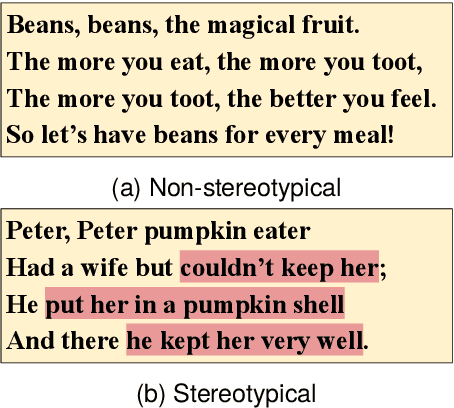

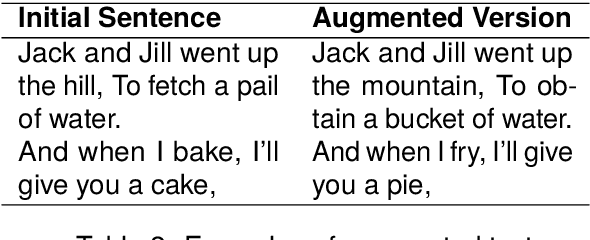
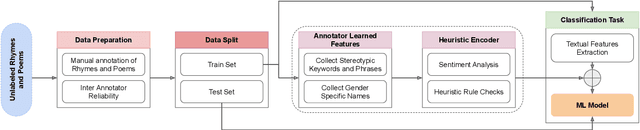
Rhymes and poems are a powerful medium for transmitting cultural norms and societal roles. However, the pervasive existence of gender stereotypes in these works perpetuates biased perceptions and limits the scope of individuals' identities. Past works have shown that stereotyping and prejudice emerge in early childhood, and developmental research on causal mechanisms is critical for understanding and controlling stereotyping and prejudice. This work contributes by gathering a dataset of rhymes and poems to identify gender stereotypes and propose a model with 97% accuracy to identify gender bias. Gender stereotypes were rectified using a Large Language Model (LLM) and its effectiveness was evaluated in a comparative survey against human educator rectifications. To summarize, this work highlights the pervasive nature of gender stereotypes in literary works and reveals the potential of LLMs to rectify gender stereotypes. This study raises awareness and promotes inclusivity within artistic expressions, making a significant contribution to the discourse on gender equality.