 Add to Chrome
 Add to Firefox
 Add to Edge
SectEval: Evaluating the Latent Sectarian Preferences of Large Language Models
Mar 13, 2026
As Large Language Models (LLMs) becomes a popular source for religious knowledge, it is important to know if it treats different groups fairly. This study is the first to measure how LLMs handle the differences between the two main sects of Islam: Sunni and Shia. We present a test called SectEval, available in both English and Hindi, consisting of 88 questions, to check the bias-ness of 15 top LLM models, both proprietary and open-weights. Our results show a major inconsistency based on language. In English, many powerful models DeepSeek-v3 and GPT-4o often favored Shia answers. However, when asked the exact same questions in Hindi, these models switched to favoring Sunni answers. This means a user could get completely different religious advice just by changing languages. We also looked at how models react to location. Advanced models Claude-3.5 changed their answers to match the user's country-giving Shia answers to a user from Iran and Sunni answers to a user from Saudi Arabia. In contrast, smaller models (especially in Hindi) ignored the user's location and stuck to a Sunni viewpoint. These findings show that AI is not neutral; its religious ``truth'' changes depending on the language you speak and the country you claim to be from. The data set is available at https://github.com/secteval/SectEval/

NEXUS: A compact neural architecture for high-resolution spatiotemporal air quality forecasting in Delhi National Capital Region
Feb 24, 2026Urban air pollution in megacities poses critical public health challenges, particularly in Delhi National Capital Region (NCR) where severe degradation affects millions. We present NEXUS (Neural Extraction and Unified Spatiotemporal) architecture for forecasting carbon monoxide, nitrogen oxide, and sulfur dioxide. Working with four years (2018--2021) of atmospheric data across sixteen spatial grids, NEXUS achieves R$^2$ exceeding 0.94 for CO, 0.91 for NO, and 0.95 for SO$_2$ using merely 18,748 parameters -- substantially fewer than SCINet (35,552), Autoformer (68,704), and FEDformer (298,080). The architecture integrates patch embedding, low-rank projections, and adaptive fusion mechanisms to decode complex atmospheric chemistry patterns. Our investigation uncovers distinct diurnal rhythms and pronounced seasonal variations, with winter months experiencing severe pollution episodes driven by temperature inversions and agricultural biomass burning. Analysis identifies critical meteorological thresholds, quantifies wind field impacts on pollutant dispersion, and maps spatial heterogeneity across the region. Extensive ablation experiments demonstrate each architectural component's role. NEXUS delivers superior predictive performance with remarkable computational efficiency, enabling real-time deployment for air quality monitoring systems.
TwinFormer: A Dual-Level Transformer for Long-Sequence Time-Series Forecasting
Dec 13, 2025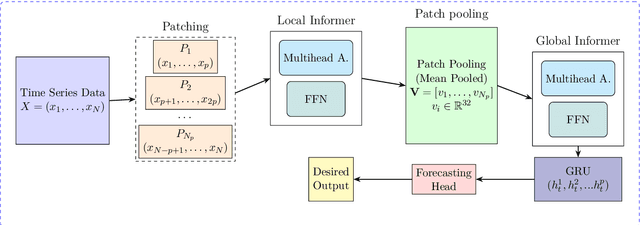
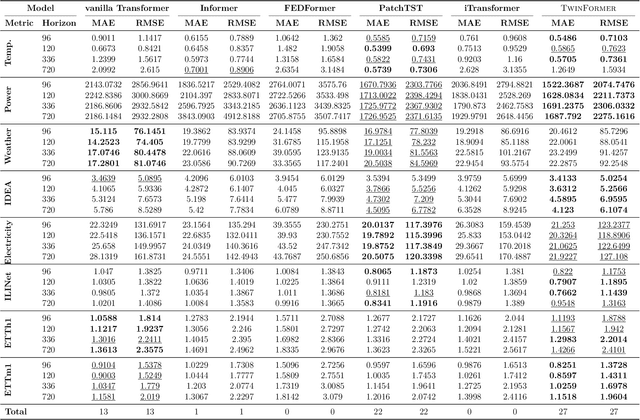
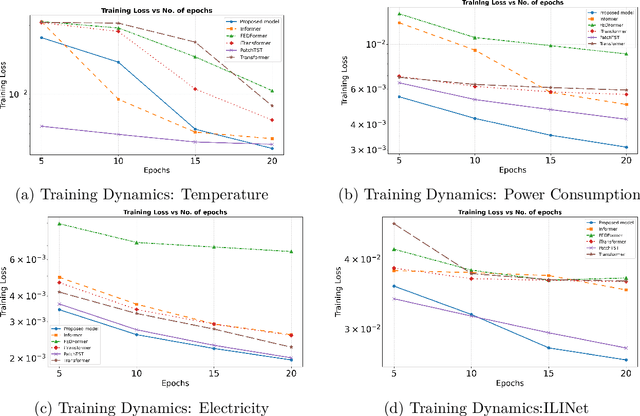

TwinFormer is a hierarchical Transformer for long-sequence time-series forecasting. It divides the input into non-overlapping temporal patches and processes them in two stages: (1) a Local Informer with top-$k$ Sparse Attention models intra-patch dynamics, followed by mean pooling; (2) a Global Informer captures long-range inter-patch dependencies using the same top-$k$ attention. A lightweight GRU aggregates the globally contextualized patch tokens for direct multi-horizon prediction. The resulting architecture achieves linear $O(kLd)$ time and memory complexity. On eight real-world benchmarking datasets from six different domains, including weather, stock price, temperature, power consumption, electricity, and disease, and forecasting horizons $96-720$, TwinFormer secures $27$ positions in the top two out of $34$. Out of the $27$, it achieves the best performance on MAE and RMSE at $17$ places and $10$ at the second-best place on MAE and RMSE. This consistently outperforms PatchTST, iTransformer, FEDformer, Informer, and vanilla Transformers. Ablations confirm the superiority of top-$k$ Sparse Attention over ProbSparse and the effectiveness of GRU-based aggregation. Code is available at this repository: https://github.com/Mahimakumavat1205/TwinFormer.