 Add to Chrome
 Add to Firefox
 Add to Edge
A Comparative Analysis of Institutional and Course Generative AI Policies within Higher Education: Implications for Instruction in Computing Education
Jul 14, 2026
With the increased use of generative AI (GenAI) applications such as ChatGPT, higher education institutions (HEIs) have released a range of guidelines and policies to direct adoption within their institutions. In computer science (CS) courses GenAI adoption is especially high and the implications for student learning are significant. At the same time, instructors have also been forced to address the use of GenAI as students have started to use it for a range of functions. Currently, comparative analysis of guidance provided by institutions and its uptake in instruction is lacking. In this paper we bridge this gap by comparing institutional and computing course level guidance to better understand this terrain. We utilize secondary analysis of institutional and course syllabi guidelines from higher education institutions in the U.S. classified as research-intensive. Our findings reveal that although institutional guidance is more pro-use, at the course-level the uptake is still guarded. We discuss the implications and propose an instructor-centered framework to guide future adoption of GenAI.

A Longitudinal Analysis of Public Discourse on AI Ethics in Education Using Twitter Data
Jul 14, 2026The rapid integration of artificial intelligence (AI) and generative AI (GenAI) into education presents significant opportunities to enhance teaching and learning, while raising ethical concerns about the responsible use of these technologies in educational settings. Understanding how the public perceives and debates these issues is increasingly important for educators, institutions, and policymakers seeking to integrate AI responsibly and equitably. Social media platforms, where such debates unfold frequently and at scale, offer a valuable lens for capturing large-scale, real-time public reactions to key developments as they emerge. In this study, we analyse five years (2019-2024) of discourse on Twitter (now X) to trace the evolving public conversation around AI ethics in education, paying particular attention to the release of ChatGPT as a pivotal moment that reshaped the nature and tone of that discourse. Using BERT-based topic modelling and SetFit sentiment analysis to identify dominant themes and track sentiment over time, we find that the discourse has been predominantly positive across the observation period, with negative sentiment concentrated around specific ethical controversies. More recently, anxieties about academic integrity and the broader implications of generative AI have come to dominate the conversation. Rather than reflecting a polarized debate, public discourse appears pragmatic and largely receptive to AI integration, though accompanied by growing calls for ethical oversight and institutional accountability. By providing a longitudinal account of public sentiment surrounding AI ethics in education, this study informs educators, institutions, and policymakers an empirically grounded understanding of public expectations, informing the development of responsible, transparent, and equitable approaches to AI integration across educational contexts.
Expanding AI Awareness Through Everyday Interactions with AI: A Reflective Journal Study
Oct 24, 2024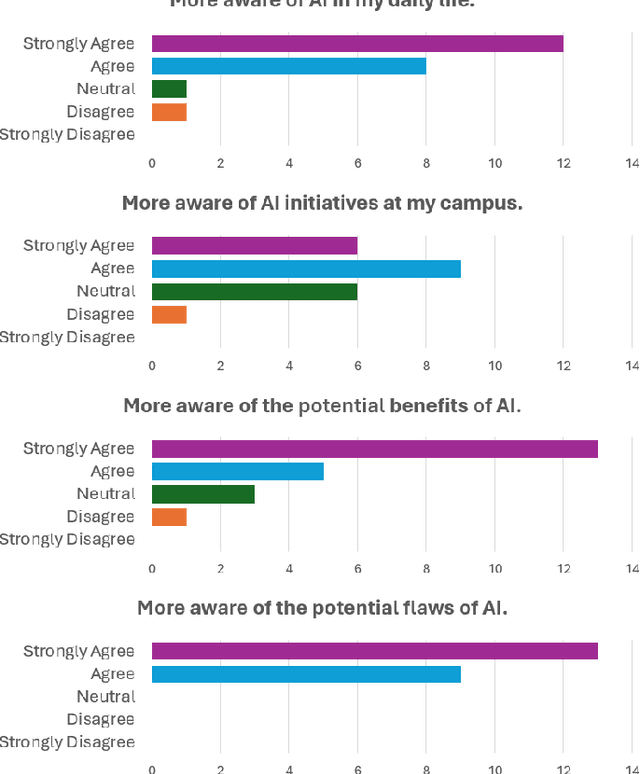

As the application of AI continues to expand, students in technology programs are poised to be both producers and users of the technologies. They are also positioned to engage with AI applications within and outside the classroom. While focusing on the curriculum when examining students' AI knowledge is common, extending this connection to students' everyday interactions with AI provides a more complete picture of their learning. In this paper, we explore student's awareness and engagement with AI in the context of school and their daily lives. Over six weeks, 22 undergraduate students participated in a reflective journal study and submitted a weekly journal entry about their interactions with AI. The participants were recruited from a technology and society course that focuses on the implications of technology on people, communities, and processes. In their weekly journal entries, participants reflected on interactions with AI on campus (coursework, advertises campus events, or seminars) and beyond (social media, news, or conversations with friends and family). The journal prompts were designed to help them think through what they had read, watched, or been told and reflect on the development of their own perspectives, knowledge, and literacy on the topic. Overall, students described nine categories of interactions: coursework, news and current events, using software and applications, university events, social media related to their work, personal discussions with friends and family, interacting with content, and gaming. Students reported that completing the diaries allowed them time for reflection and made them more aware of the presence of AI in their daily lives and of its potential benefits and drawbacks. This research contributes to the ongoing work on AI awareness and literacy by bringing in perspectives from beyond a formal educational context.
A Framework for Responsible Development of Automated Student Feedback with Generative AI
Aug 29, 2023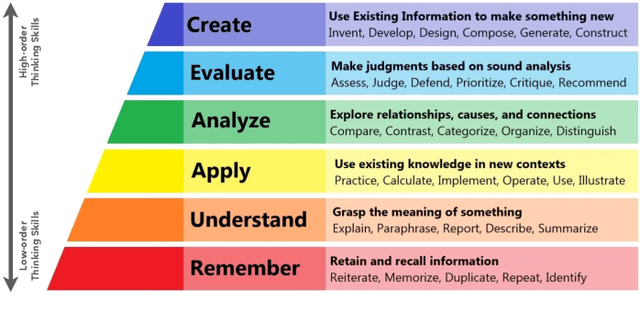
Providing rich feedback to students is essential for supporting student learning. Recent advances in generative AI, particularly within large language modelling (LLM), provide the opportunity to deliver repeatable, scalable and instant automatically generated feedback to students, making abundant a previously scarce and expensive learning resource. Such an approach is feasible from a technical perspective due to these recent advances in Artificial Intelligence (AI) and Natural Language Processing (NLP); while the potential upside is a strong motivator, doing so introduces a range of potential ethical issues that must be considered as we apply these technologies. The attractiveness of AI systems is that they can effectively automate the most mundane tasks; but this risks introducing a "tyranny of the majority", where the needs of minorities in the long tail are overlooked because they are difficult to automate. Developing machine learning models that can generate valuable and authentic feedback requires the input of human domain experts. The choices we make in capturing this expertise -- whose, which, when, and how -- will have significant consequences for the nature of the resulting feedback. How we maintain our models will affect how that feedback remains relevant given temporal changes in context, theory, and prior learning profiles of student cohorts. These questions are important from an ethical perspective; but they are also important from an operational perspective. Unless they can be answered, our AI generated systems will lack the trust necessary for them to be useful features in the contemporary learning environment. This article will outline the frontiers of automated feedback, identify the ethical issues involved in the provision of automated feedback and present a framework to assist academics to develop such systems responsibly.
Real-Time Inference of User Types to Assist with More Inclusive Social Media Activism Campaigns
Apr 25, 2018
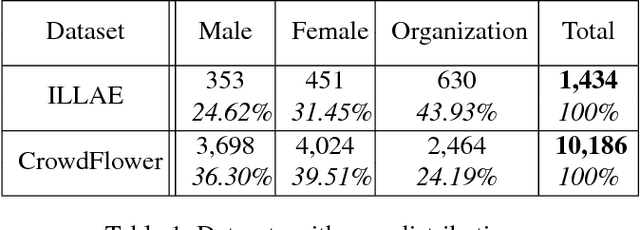
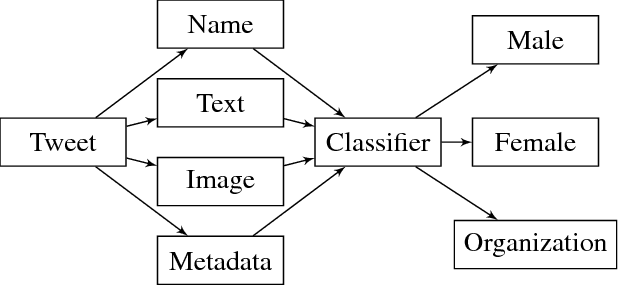
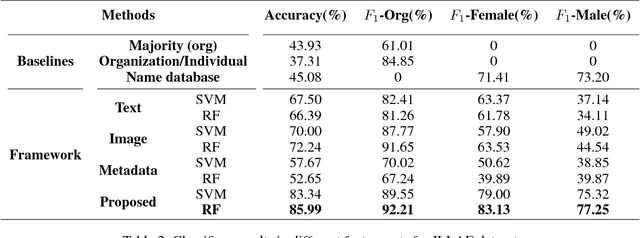
Social media provides a mechanism for people to engage with social causes across a range of issues. It also provides a strategic tool to those looking to advance a cause to exchange, promote or publicize their ideas. In such instances, AI can be either an asset if used appropriately or a barrier. One of the key issues for a workforce diversity campaign is to understand in real-time who is participating - specifically, whether the participants are individuals or organizations, and in case of individuals, whether they are male or female. In this paper, we present a study to demonstrate a case for AI for social good that develops a model to infer in real-time the different user types participating in a cause-driven hashtag campaign on Twitter, ILookLikeAnEngineer (ILLAE). A generic framework is devised to classify a Twitter user into three classes: organization, male and female in a real-time manner. The framework is tested against two datasets (ILLAE and a general dataset) and outperforms the baseline binary classifiers for categorizing organization/individual and male/female. The proposed model can be applied to future social cause-driven campaigns to get real-time insights on the macro-level social behavior of participants.
Predicting Performance on MOOC Assessments using Multi-Regression Models
May 08, 2016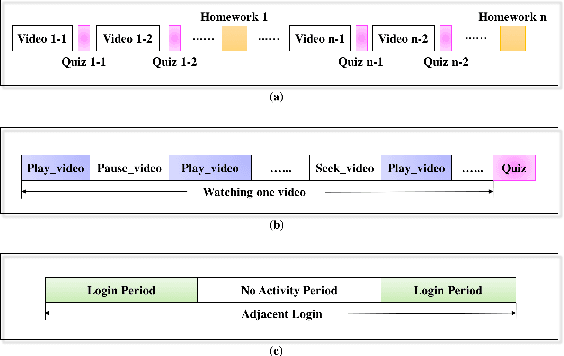
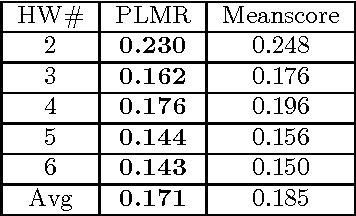
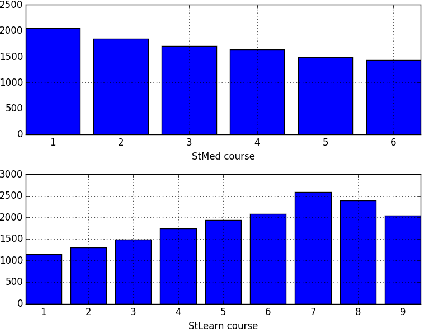
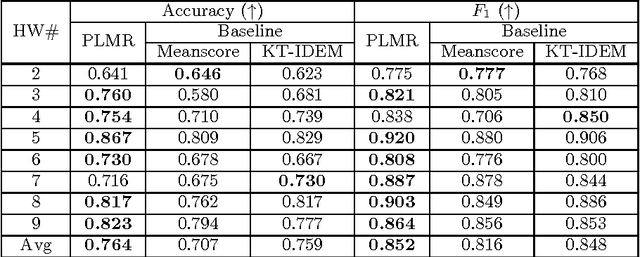
The past few years has seen the rapid growth of data min- ing approaches for the analysis of data obtained from Mas- sive Open Online Courses (MOOCs). The objectives of this study are to develop approaches to predict the scores a stu- dent may achieve on a given grade-related assessment based on information, considered as prior performance or prior ac- tivity in the course. We develop a personalized linear mul- tiple regression (PLMR) model to predict the grade for a student, prior to attempting the assessment activity. The developed model is real-time and tracks the participation of a student within a MOOC (via click-stream server logs) and predicts the performance of a student on the next as- sessment within the course offering. We perform a com- prehensive set of experiments on data obtained from three openEdX MOOCs via a Stanford University initiative. Our experimental results show the promise of the proposed ap- proach in comparison to baseline approaches and also helps in identification of key features that are associated with the study habits and learning behaviors of students.