 Add to Chrome
 Add to Firefox
 Add to Edge
Faithful Autoformalization of Natural Language Assertions
Jul 14, 2026
Formal contracts are essential for software testing and verification, yet writing them remains labor-intensive and error-prone. LLMs offer a promising path toward autoformalization: synthesizing executable assertions from natural-language specifications and thereby bridging the gap between informal developer intent and formal executable specifications. We present Monty: an autoformalization framework for assertions that tackles the challenges of expectations of validity of assertions and ambiguity in natural-language. Our techniques are based on filtering formalizations using a novel conformance score metric and validity scores obtained from testing the code against formalized assertions. We evaluate our approach on 541 assertion-generation tasks derived from 22 collection-like Java classes, and show that our technique produces the ground truth more reliably (improving upto 20 points in precision on average) than when using LLMs naively to translate assertions.

Counterexample Guided Learning in the Large using Reasoning Agents
Jun 09, 2026LLMs and LLM agents should improve when given feedback, but identifying when they are able to do so is difficult: feedback is heterogeneous, domain-specific, and difficult to control. We approach this challenge by asking LLMs to perform regular-expression induction, a classical symbolic learning problem where precise mechanisms for feedback exist in the form of counterexamples. In counterexample-guided learning, a learner (LLM) proposes candidate regular expressions from positive/negative-labeled strings, and the teacher (verifier) returns counterexamples showcasing the difference between the candidate and target languages. We identify novel counterexample-guided refinement strategies that enable effective regex learning, such as regularization and symbolic counterexample clusters. We also explore agentic strategies such as reflection and repair loops. Empirically, we find that verifier feedback substantially improves sample efficiency on challenging regex-induction tasks, reducing the number of labeled examples required and enabling learning of complex target expressions where standard prompting fails. For example, on the hardest task groups, our counterexample-guided framework improves success from 3.2% to 38.1% and from 38.9% to 74.1% on two different regex domains. These results suggest that LLMs can benefit from rich feedback beyond treating it as additional data, opening the door for robust verifier-guided methods for LLM-based program synthesis and formal reasoning.
Applying Deep Reinforcement Learning to the HP Model for Protein Structure Prediction
Dec 09, 2022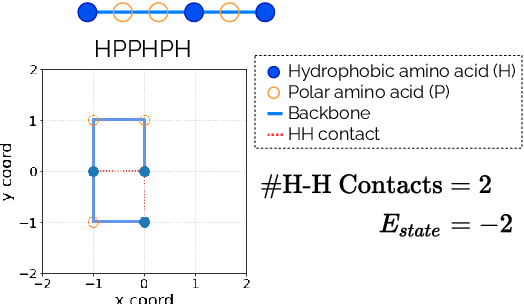
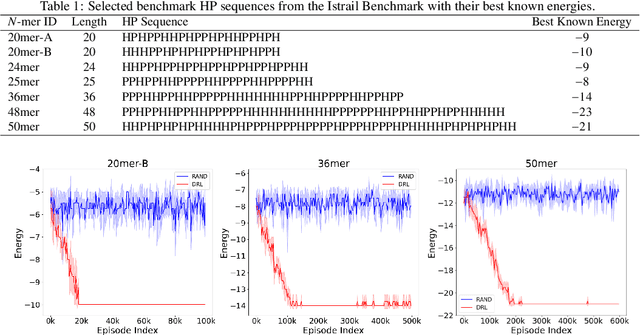

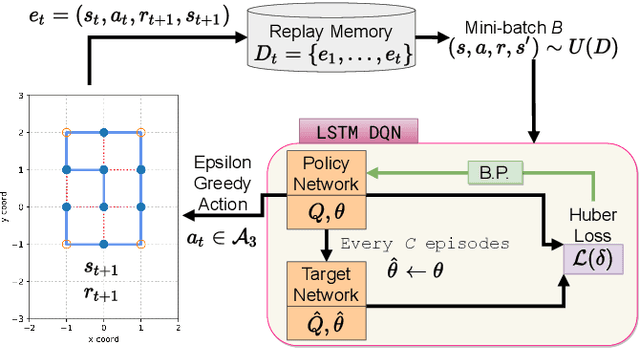
A central problem in computational biophysics is protein structure prediction, i.e., finding the optimal folding of a given amino acid sequence. This problem has been studied in a classical abstract model, the HP model, where the protein is modeled as a sequence of H (hydrophobic) and P (polar) amino acids on a lattice. The objective is to find conformations maximizing H-H contacts. It is known that even in this reduced setting, the problem is intractable (NP-hard). In this work, we apply deep reinforcement learning (DRL) to the two-dimensional HP model. We can obtain the conformations of best known energies for benchmark HP sequences with lengths from 20 to 50. Our DRL is based on a deep Q-network (DQN). We find that a DQN based on long short-term memory (LSTM) architecture greatly enhances the RL learning ability and significantly improves the search process. DRL can sample the state space efficiently, without the need of manual heuristics. Experimentally we show that it can find multiple distinct best-known solutions per trial. This study demonstrates the effectiveness of deep reinforcement learning in the HP model for protein folding.
Augmenting Neural Nets with Symbolic Synthesis: Applications to Few-Shot Learning
Jul 12, 2019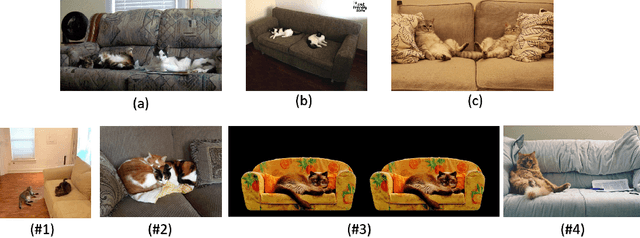
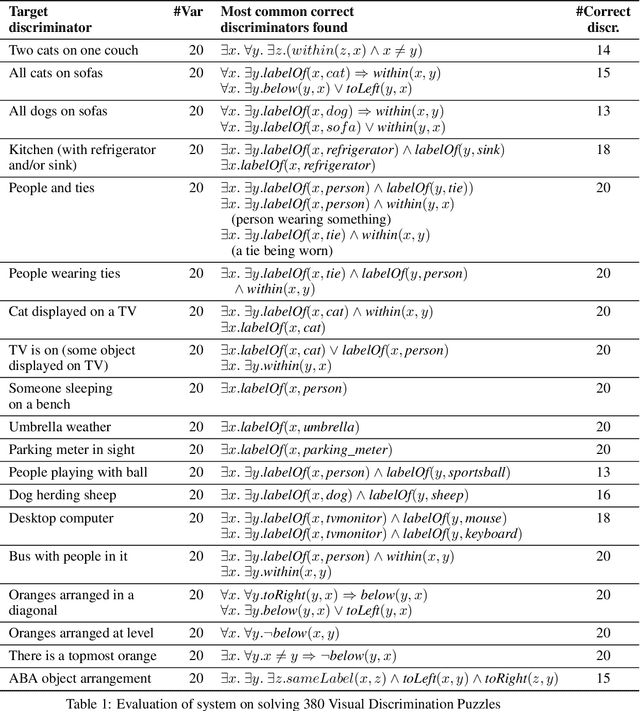
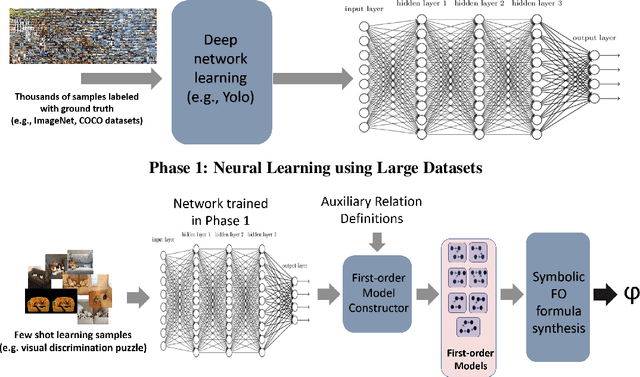
We propose symbolic learning as extensions to standard inductive learning models such as neural nets as a means to solve few shot learning problems. We device a class of visual discrimination puzzles that calls for recognizing objects and object relationships as well learning higher-level concepts from very few images. We propose a two-phase learning framework that combines models learned from large data sets using neural nets and symbolic first-order logic formulas learned from a few shot learning instance. We develop first-order logic synthesis techniques for discriminating images by using symbolic search and logic constraint solvers. By augmenting neural nets with them, we develop and evaluate a tool that can solve few shot visual discrimination puzzles with interpretable concepts.