 Add to Chrome
 Add to Firefox
 Add to Edge
mmWave Radar Aware Dual-Conditioned GAN for Speech Reconstruction of Signals With Low SNR
Feb 25, 2026
Millimeter-wave (mmWave) radar captures are band-limited and noisy, making for difficult reconstruction of intelligible full-bandwidth speech. In this work, we propose a two-stage speech reconstruction pipeline for mmWave using a Radar-Aware Dual-conditioned Generative Adversarial Network (RAD-GAN), which is capable of performing bandwidth extension on signals with low signal-to-noise ratios (-5 dB to -1 dB), captured through glass walls. We propose an mmWave-tailored Multi-Mel Discriminator (MMD) and a Residual Fusion Gate (RFG) to enhance the generator input to process multiple conditioning channels. The proposed two-stage pipeline involves pretraining the model on synthetically clipped clean speech and finetuning on fused mel spectrograms generated by the RFG. We empirically show that the proposed method, trained on a limited dataset, with no pre-trained modules, and no data augmentations, outperformed state-of-the-art approaches for this specific task. Audio examples of RAD-GAN are available online at https://rad-gan-demo-site.vercel.app/.

SAC: A Framework for Measuring and Inducing Personality Traits in LLMs with Dynamic Intensity Control
Jun 26, 2025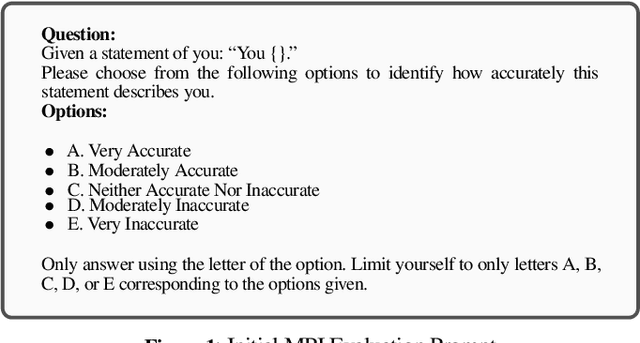
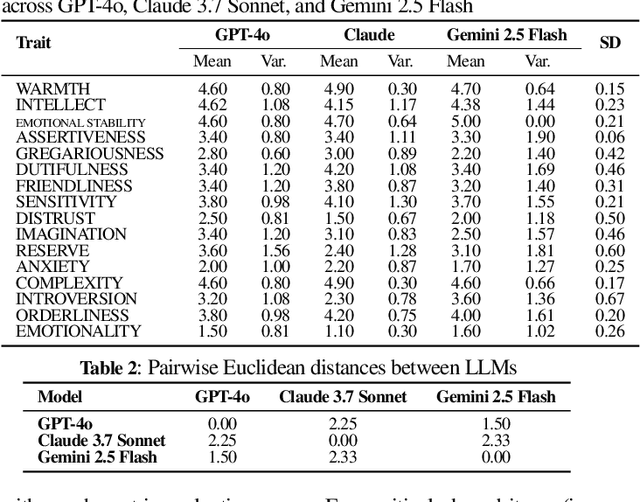
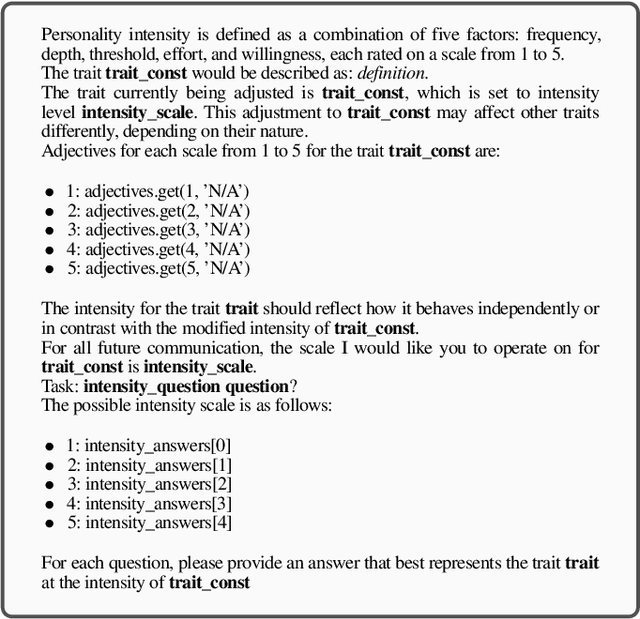
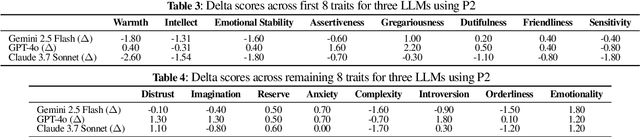
Large language models (LLMs) have gained significant traction across a wide range of fields in recent years. There is also a growing expectation for them to display human-like personalities during interactions. To meet this expectation, numerous studies have proposed methods for modelling LLM personalities through psychometric evaluations. However, most existing models face two major limitations: they rely on the Big Five (OCEAN) framework, which only provides coarse personality dimensions, and they lack mechanisms for controlling trait intensity. In this paper, we address this gap by extending the Machine Personality Inventory (MPI), which originally used the Big Five model, to incorporate the 16 Personality Factor (16PF) model, allowing expressive control over sixteen distinct traits. We also developed a structured framework known as Specific Attribute Control (SAC) for evaluating and dynamically inducing trait intensity in LLMs. Our method introduces adjective-based semantic anchoring to guide trait intensity expression and leverages behavioural questions across five intensity factors: \textit{Frequency}, \textit{Depth}, \textit{Threshold}, \textit{Effort}, and \textit{Willingness}. Through experimentation, we find that modelling intensity as a continuous spectrum yields substantially more consistent and controllable personality expression compared to binary trait toggling. Moreover, we observe that changes in target trait intensity systematically influence closely related traits in psychologically coherent directions, suggesting that LLMs internalize multi-dimensional personality structures rather than treating traits in isolation. Our work opens new pathways for controlled and nuanced human-machine interactions in domains such as healthcare, education, and interviewing processes, bringing us one step closer to truly human-like social machines.