 Add to Chrome
 Add to Firefox
 Add to Edge
PORTER: Language-Grounded Event Representations for Portable Structured EHR Foundation Models
Jun 23, 2026
Most electronic health record (EHR) foundation models encode clinical events as discrete event tokens from a fixed vocabulary and therefore cannot directly represent events containing unseen concepts or new combinations of concepts and attributes such as numeric values. This limits transfer across institutions and even across deployment pipelines within the same institution. We introduce PORTER, a language-grounded structured EHR foundation model that decouples event representation from this fixed vocabulary. PORTER represents events through their descriptions using a frozen text encoder, integrates numeric values through a dedicated pathway, and learns clinical dynamics over patient timelines with an autoregressively pretrained temporal backbone. Across 74 clinical prediction tasks at a pediatric hospital, PORTER matched the mean AUROC of a fixed-vocabulary model with the same temporal backbone and pretraining objective. When the same patient timelines were rendered using event descriptions not seen during pretraining, PORTER transferred without retraining or vocabulary mapping, recovering 97.1% of the mean AUROC of a model trained directly on the target vocabulary. When transferred to MIMIC, PORTER outperformed the fixed-vocabulary model, which dropped 69% of events because their tokens were unseen. Mechanistic analyses showed cross-vocabulary transfer tracked preservation of patient-level representation geometry rather than the scale of the text encoder, and the numeric pathway improved sensitivity to magnitude without disrupting clinical concept identity. PORTER also achieved higher AUROC than a task-specific text serialization comparator, at 329-fold lower amortized compute. PORTER is a step toward vocabulary-independent EHR foundation models that reduce the need for vocabulary harmonization while preserving in-domain performance and enabling efficient cross-task reuse.

Answering real-world clinical questions using large language model based systems
Jun 29, 2024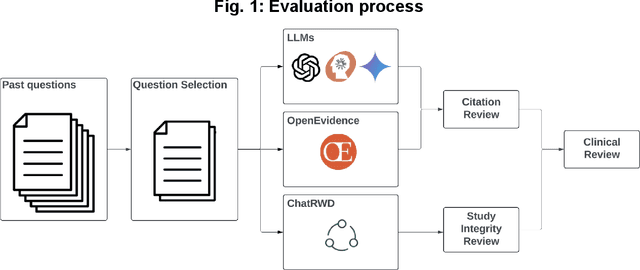
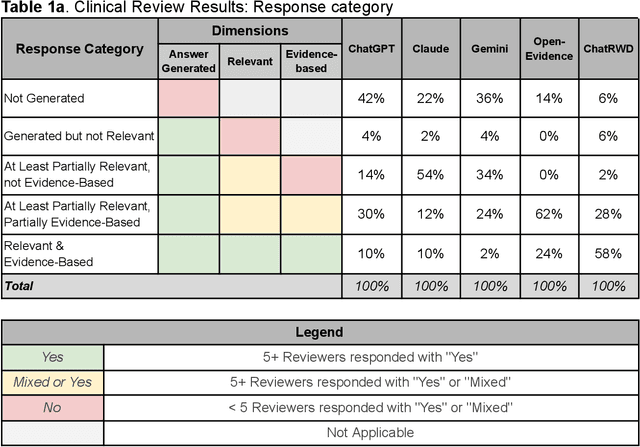

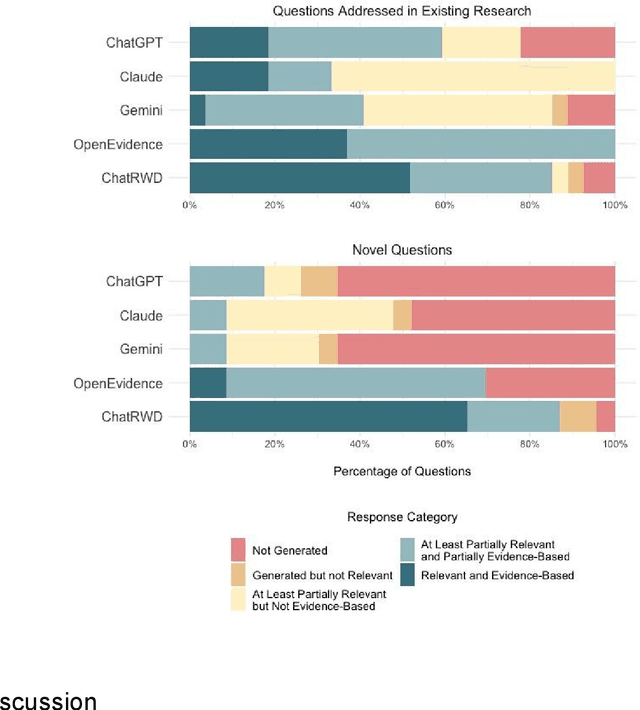
Evidence to guide healthcare decisions is often limited by a lack of relevant and trustworthy literature as well as difficulty in contextualizing existing research for a specific patient. Large language models (LLMs) could potentially address both challenges by either summarizing published literature or generating new studies based on real-world data (RWD). We evaluated the ability of five LLM-based systems in answering 50 clinical questions and had nine independent physicians review the responses for relevance, reliability, and actionability. As it stands, general-purpose LLMs (ChatGPT-4, Claude 3 Opus, Gemini Pro 1.5) rarely produced answers that were deemed relevant and evidence-based (2% - 10%). In contrast, retrieval augmented generation (RAG)-based and agentic LLM systems produced relevant and evidence-based answers for 24% (OpenEvidence) to 58% (ChatRWD) of questions. Only the agentic ChatRWD was able to answer novel questions compared to other LLMs (65% vs. 0-9%). These results suggest that while general-purpose LLMs should not be used as-is, a purpose-built system for evidence summarization based on RAG and one for generating novel evidence working synergistically would improve availability of pertinent evidence for patient care.