 Add to Chrome
 Add to Firefox
 Add to Edge
Identifying and Characterising Response in Clinical Trials: Development and Validation of a Machine Learning Approach in Colorectal Cancer
Feb 28, 2026
Precision medicine promises to transform health care by offering individualised treatments that dramatically improve clinical outcomes. A necessary prerequisite is to identify subgroups of patients who respond differently to different therapies. Current approaches are limited to static measures of treatment success, neglecting the repeated measures found in most clinical trials. Our approach combines the concept of partly conditional modelling with treatment effect estimation based on the Virtual Twins method. The resulting time-specific responses to treatment are characterised using survLIME, an extension of Local Interpretable Model-agnostic Explanations (LIME) to survival data. Performance was evaluated using synthetic data and applied to clinical trials examining the effectiveness of panitumumab to treat metastatic colorectal cancer. An area under the receiver operating characteristic curve (AUC) of 0.77 for identifying fixed responders was achieved in a 1000 patient simulation. When considering dynamic responders, partly conditional modelling increased the AUC from 0.597 to 0.685. Applying the approach to colorectal cancer trials found genetic mutations, sites of metastasis, and ethnicity as important factors for response to treatment. Our approach can accommodate a dynamic response to treatment while potentially providing better performance than existing methods in instances of a fixed response to treatment. When applied to clinical data we attain results consistent with the literature.

Stroke outcome and evolution prediction from CT brain using a spatiotemporal diffusion autoencoder
Feb 28, 2026Stroke is a major cause of death and disability worldwide. Accurate outcome and evolution prediction has the potential to revolutionize stroke care by individualizing clinical decision-making leading to better outcomes. However, despite a plethora of attempts and the rich data provided by neuroimaging, modelling the ultimate fate of brain tissue remains a challenging task. In this work, we apply recent ideas in the field of diffusion probabilistic models to generate a self-supervised semantically meaningful stroke representation from Computed Tomography (CT) images. We then improve this representation by extending the method to accommodate longitudinal images and the time from stroke onset. The effectiveness of our approach is evaluated on a dataset consisting of 5,824 CT images from 3,573 patients across two medical centers with minimal labels. Comparative experiments show that our method achieves the best performance for predicting next-day severity and functional outcome at discharge.
Concurrent ischemic lesion age estimation and segmentation of CT brain using a Transformer-based network
Jun 21, 2023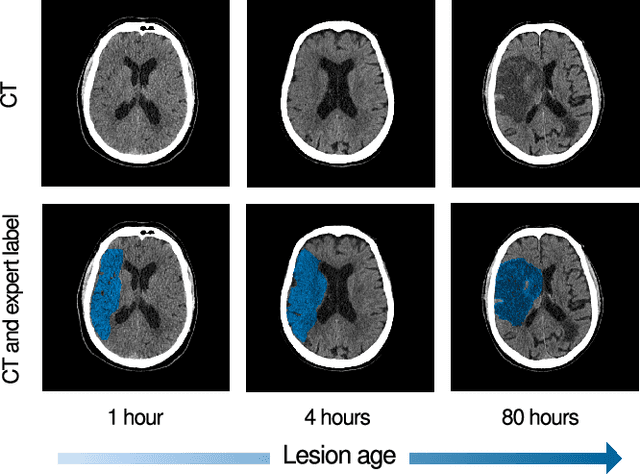
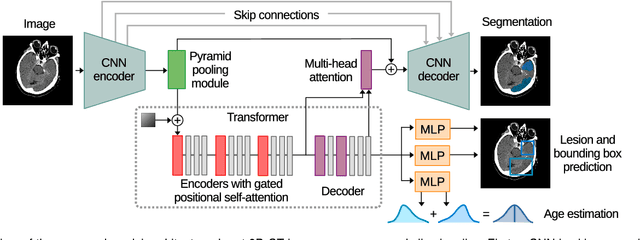
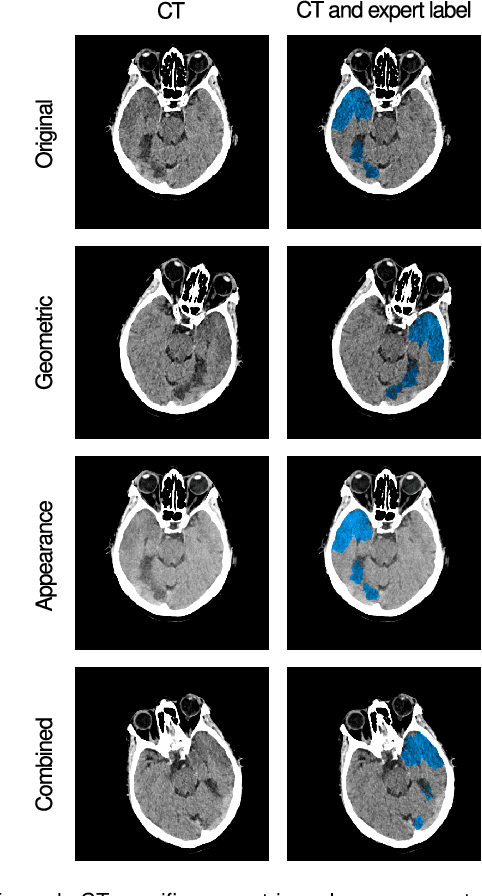
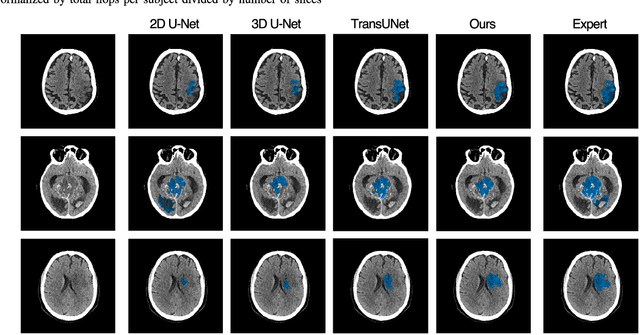
The cornerstone of stroke care is expedient management that varies depending on the time since stroke onset. Consequently, clinical decision making is centered on accurate knowledge of timing and often requires a radiologist to interpret Computed Tomography (CT) of the brain to confirm the occurrence and age of an event. These tasks are particularly challenging due to the subtle expression of acute ischemic lesions and the dynamic nature of their appearance. Automation efforts have not yet applied deep learning to estimate lesion age and treated these two tasks independently, so, have overlooked their inherent complementary relationship. To leverage this, we propose a novel end-to-end multi-task transformer-based network optimized for concurrent segmentation and age estimation of cerebral ischemic lesions. By utilizing gated positional self-attention and CT-specific data augmentation, the proposed method can capture long-range spatial dependencies while maintaining its ability to be trained from scratch under low-data regimes commonly found in medical imaging. Furthermore, to better combine multiple predictions, we incorporate uncertainty by utilizing quantile loss to facilitate estimating a probability density function of lesion age. The effectiveness of our model is then extensively evaluated on a clinical dataset consisting of 776 CT images from two medical centers. Experimental results demonstrate that our method obtains promising performance, with an area under the curve (AUC) of 0.933 for classifying lesion ages <=4.5 hours compared to 0.858 using a conventional approach, and outperforms task-specific state-of-the-art algorithms.