 Add to Chrome
 Add to Firefox
 Add to Edge
Repairing Shape-Prior Shortcuts in Long-Range Single-Shot Fringe Projection Profilometry
Jul 10, 2026
Single-shot fringe projection profilometry (FPP) networks that regress depth directly can exploit a shape-prior shortcut, recovering depth from object boundaries rather than from fringe phase. On a photorealistic synthetic benchmark (15,600 fringe images, 50 objects at 1.5-2.1 m standoff), the best such UNet baseline plateaus at 14.54 mm object mean absolute error (MAE), and neither more data nor more capacity removes the shortcut, because neither changes the hypothesis space the optimizer searches. We introduce PhiCalNet, which outputs a wrapped-phase representation $(\sinφ, \cosφ)$ and maps it to depth through a fixed differentiable calibration layer, removing the shape-prior solution architecturally rather than by a loss penalty. Because the single-shot mapping is non-injective without fringe order, PhiCalNet takes the fringe order as auxiliary input, an assumption a sensitivity analysis shows tolerates realistic decoding error; a physics-informed (PINN) baseline with the same physics as a soft penalty yields no gain, isolating the architectural choice as the operative factor. PhiCalNet reduces object MAE 3.3x to 4.46 mm, its residual confined to 0.103% of pixels at the $\pmπ$ wrap discontinuity, and a three-frame extension reaches 1.16 mm. Two checks agree: interpretability makes phase the most decodable internal feature, and pixel-wise conformal uncertainty quantification, to our knowledge the first for FPP, localizes error at the same discontinuity, where rejecting the top 5% of pixels by snapshot disagreement cuts root-mean-square error by 64% versus 3.5% for the baseline.

Diagnosing and Repairing Shape-Prior Shortcuts in Long-Range Single-Shot Fringe Projection Profilometry
Jun 13, 2026Learning-based single-shot fringe projection profilometry (FPP) has been studied mostly at close range. The long-range regime (standoff beyond 1 m) remains largely unaddressed: inverse-square intensity falloff lowers fringe signal-to-noise ratio and degrades physical ground truth, the single-shot problem is ill-posed because fringe-order information is absent from one image, and these architectures have not been studied mechanistically. We present a diagnose-repair-verify study using mechanistic interpretability (MI) and conformal uncertainty quantification (UQ) as convergent diagnostics: they agree on one physical failure locus, driving and verifying an architectural repair. On a photorealistic synthetic benchmark (15,600 fringe images, 50 objects at 1.5-2.1 m), a best UNet baseline reaches 14.54 mm object mean absolute error (MAE). Three probes (linear probing, Grad-CAM, flat-plane out-of-distribution test) converge: the baseline solves the task via object-boundary shape priors rather than fringe-phase decoding. We repair this with PhiCalNet, which outputs wrapped phase rather than depth and applies a fixed differentiable calibration layer mapping phase to depth, removing the shape-prior solution from the hypothesis space architecturally rather than by a loss penalty. A physics-informed loss that enforces the same physics as a soft penalty on a depth-regressing network yields no measurable gain, isolating the architecture as the operative factor. PhiCalNet reduces object MAE 3.3x to 4.46 mm; the residual is carried by 0.103% of pixels at the +/-pi wrap discontinuity. Pixel-wise conformal UQ confirms the diagnosis: rejecting the top 5% of object pixels by snapshot disagreement cuts PhiCalNet RMSE by 64% (20.6->7.4 mm) versus 3.5% for the baseline. MI and UQ converge on the same failure locus.
LCLA: Language-Conditioned Latent Alignment for Vision-Language Navigation
Feb 07, 2026We propose LCLA (Language-Conditioned Latent Alignment), a framework for vision-language navigation that learns modular perception-action interfaces by aligning sensory observations to a latent representation of an expert policy. The expert is first trained with privileged state information, inducing a latent space sufficient for control, after which its latent interface and action head are frozen. A lightweight adapter is then trained to map raw visual-language observations, via a frozen vision-language model, into the expert's latent space, reducing the problem of visuomotor learning to supervised latent alignment rather than end-to-end policy optimization. This decoupling enforces a stable contract between perception and control, enabling expert behavior to be reused across sensing modalities and environmental variations. We instantiate LCLA and evaluate it on a vision-language indoor navigation task, where aligned latent spaces yield strong in-distribution performance and robust zero-shot generalization to unseen environments, lighting conditions, and viewpoints while remaining lightweight at inference time.
Comprehensive Machine Learning Benchmarking for Fringe Projection Profilometry with Photorealistic Synthetic Data
Jan 13, 2026Machine learning approaches for fringe projection profilometry (FPP) are hindered by the lack of large, diverse datasets and comprehensive benchmarking protocols. This paper introduces the first open-source, photorealistic synthetic dataset for FPP, generated using NVIDIA Isaac Sim with 15,600 fringe images and 300 depth reconstructions across 50 diverse objects. We benchmark four neural network architectures (UNet, Hformer, ResUNet, Pix2Pix) on single-shot depth reconstruction, revealing that all models achieve similar performance (58-77 mm RMSE) despite substantial architectural differences. Our results demonstrate fundamental limitations of direct fringe-to-depth mapping without explicit phase information, with reconstruction errors approaching 75-95\% of the typical object depth range. This resource provides standardized evaluation protocols enabling systematic comparison and development of learning-based FPP approaches.
Can Pretrained Vision-Language Embeddings Alone Guide Robot Navigation?
Jun 17, 2025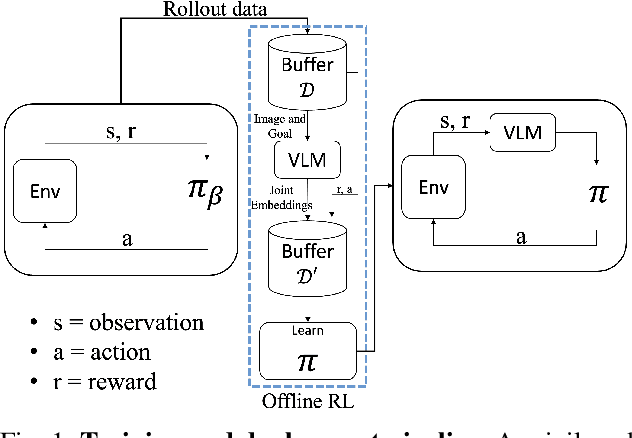
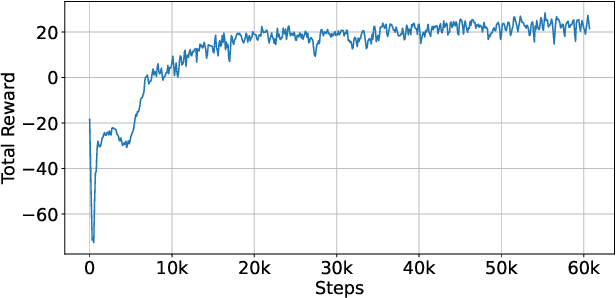
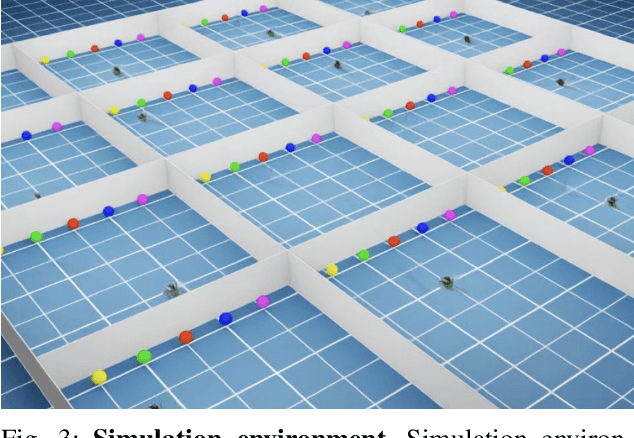
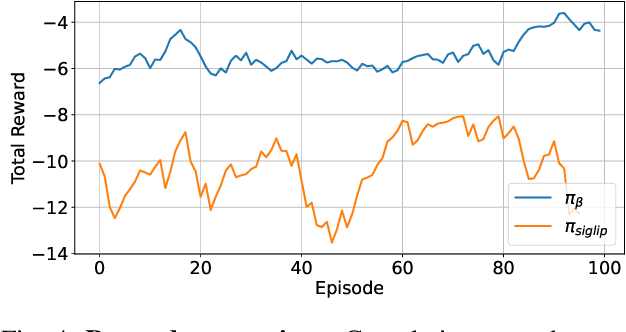
Foundation models have revolutionized robotics by providing rich semantic representations without task-specific training. While many approaches integrate pretrained vision-language models (VLMs) with specialized navigation architectures, the fundamental question remains: can these pretrained embeddings alone successfully guide navigation without additional fine-tuning or specialized modules? We present a minimalist framework that decouples this question by training a behavior cloning policy directly on frozen vision-language embeddings from demonstrations collected by a privileged expert. Our approach achieves a 74% success rate in navigation to language-specified targets, compared to 100% for the state-aware expert, though requiring 3.2 times more steps on average. This performance gap reveals that pretrained embeddings effectively support basic language grounding but struggle with long-horizon planning and spatial reasoning. By providing this empirical baseline, we highlight both the capabilities and limitations of using foundation models as drop-in representations for embodied tasks, offering critical insights for robotics researchers facing practical design tradeoffs between system complexity and performance in resource-constrained scenarios. Our code is available at https://github.com/oadamharoon/text2nav