 Add to Chrome
 Add to Firefox
 Add to Edge
Score-Based Martingale Posteriors for Deep Neural Networks
Jun 14, 2026
In this paper we investigate the efficacy of the score-based martingale posteriors (SMP) (Cui & Walker, 2025; Fong et al., 2023) in the context of modern and large-scale machine learning problems and its potential for meaningful uncertainty quantification. SMPs work with a stochastic gradient ascent-type recursion on the parameter space of stochastic models and construct a martingale on the parameter space. Under simple mathematical assumptions, the recursion can be built so that the parameters form a martingale sequence which possesses a limiting, in time, random variable, the latter of which can be simulated very quickly, in contrast to Monte Carlo-based methods such as Markov chain Monte Carlo. In this expository paper we explore the SMP for inferring the parameters of deep neural networks (DNNs) and, where feasible, compare our results to the state-of-the-art Monte Carlo methods aimed at inferring conventional Bayesian posteriors.

Fourier Neural Networks: A Comparative Study
Feb 08, 2019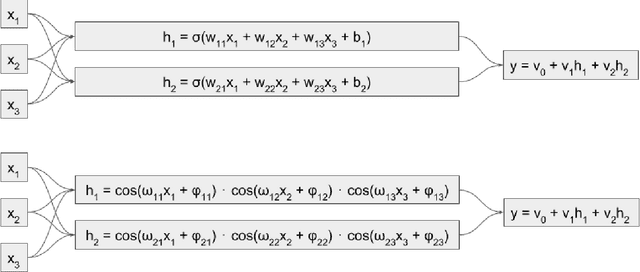
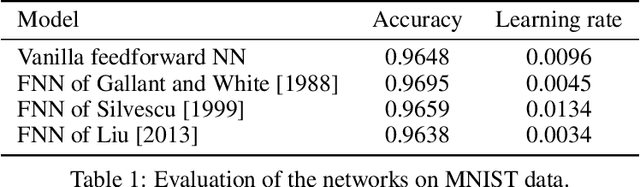
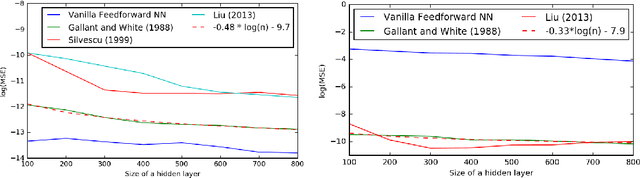
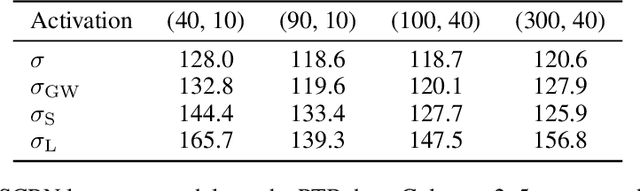
We review neural network architectures which were motivated by Fourier series and integrals and which are referred to as Fourier neural networks. These networks are empirically evaluated in synthetic and real-world tasks. Neither of them outperforms the standard neural network with sigmoid activation function in the real-world tasks. All neural networks, both Fourier and the standard one, empirically demonstrate lower approximation error than the truncated Fourier series when it comes to an approximation of a known function of multiple variables.