 Add to Chrome
 Add to Firefox
 Add to Edge
Time Series Augmented Generation for Financial Applications
Apr 21, 2026
Evaluating the reasoning capabilities of Large Language Models (LLMs) for complex, quantitative financial tasks is a critical and unsolved challenge. Standard benchmarks often fail to isolate an agent's core ability to parse queries and orchestrate computations. To address this, we introduce a novel evaluation methodology and benchmark designed to rigorously measure an LLM agent's reasoning for financial time-series analysis. We apply this methodology in a large-scale empirical study using our framework, Time Series Augmented Generation (TSAG), where an LLM agent delegates quantitative tasks to verifiable, external tools. Our benchmark, consisting of 100 financial questions, is used to compare multiple SOTA agents (e.g., GPT-4o, Llama 3, Qwen2) on metrics assessing tool selection accuracy, faithfulness, and hallucination. The results demonstrate that capable agents can achieve near-perfect tool-use accuracy with minimal hallucination, validating the tool-augmented paradigm. Our primary contribution is this evaluation framework and the corresponding empirical insights into agent performance, which we release publicly to foster standardized research on reliable financial AI.

Application of Liquid Rank Reputation System for Content Recommendation
Sep 15, 2022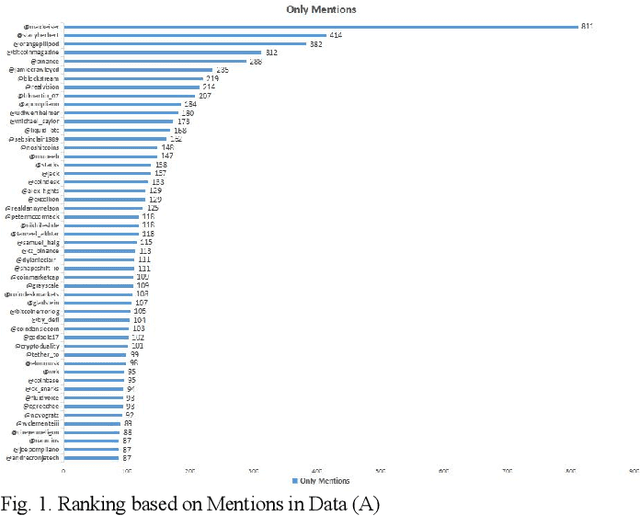
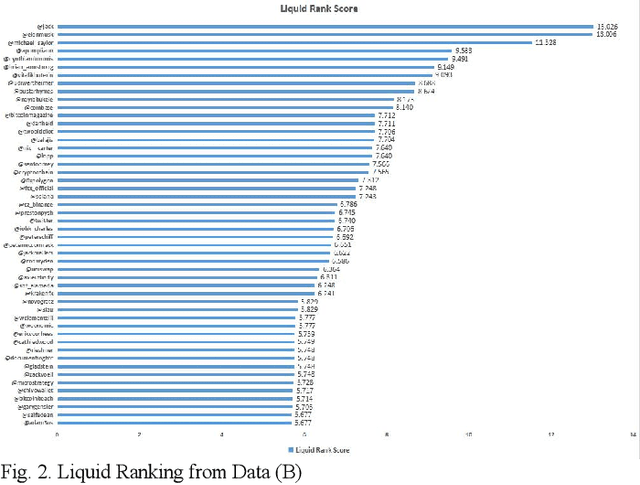
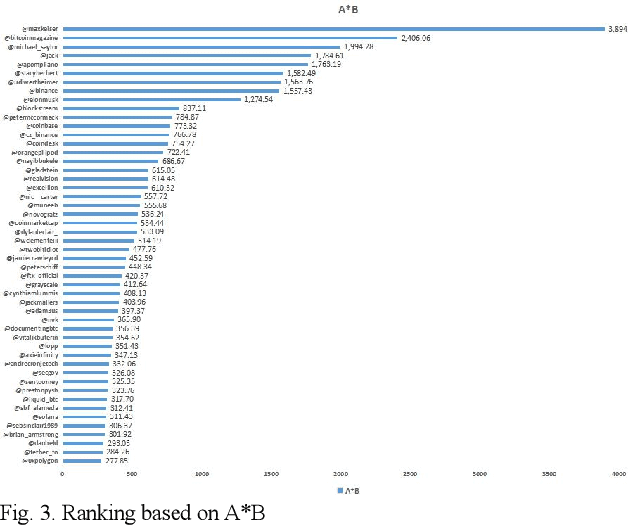
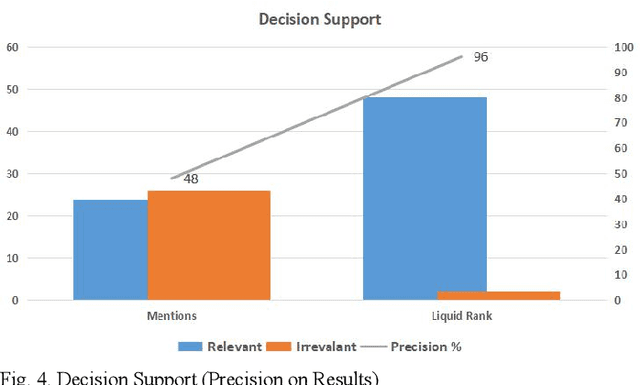
An effective content recommendation on social media platforms should be able to benefit both creators to earn fair compensation and consumers to enjoy really relevant, interesting, and personalized content. In this paper, we propose a model to implement the liquid democracy principle for the content recommendation system. It uses a personalized recommendation model based on reputation ranking system to encourage personal interests driven recommendation. Moreover, the personalization factors to an end users' higher-order friends on the social network (initial input Twitter channels in our case study) to improve the accuracy and diversity of recommendation results. This paper analyzes the dataset based on cryptocurrency news on Twitter to find the opinion leader using the liquid rank reputation system. This paper deals with the tier-2 implementation of a liquid rank in a content recommendation model. This model can be also used as an additional layer in the other recommendation systems. The paper proposes the implementation, challenges, and future scope of the liquid rank reputation model.
Multi-Touch Attribution Based Budget Allocation in Online Advertising
Feb 24, 2015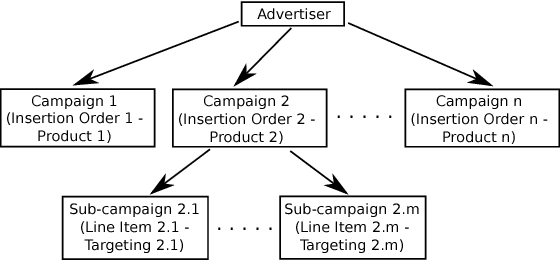
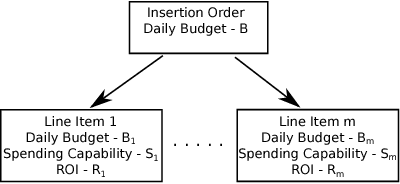
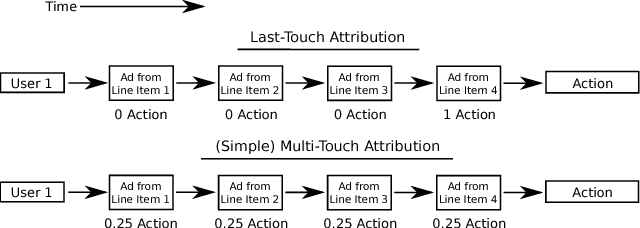
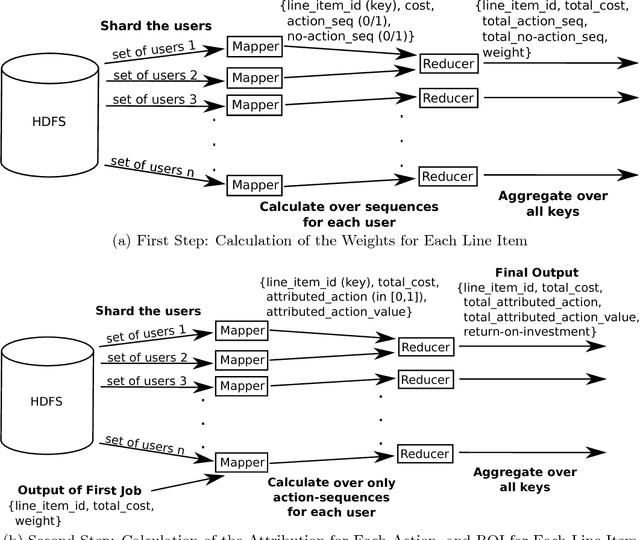
Budget allocation in online advertising deals with distributing the campaign (insertion order) level budgets to different sub-campaigns which employ different targeting criteria and may perform differently in terms of return-on-investment (ROI). In this paper, we present the efforts at Turn on how to best allocate campaign budget so that the advertiser or campaign-level ROI is maximized. To do this, it is crucial to be able to correctly determine the performance of sub-campaigns. This determination is highly related to the action-attribution problem, i.e. to be able to find out the set of ads, and hence the sub-campaigns that provided them to a user, that an action should be attributed to. For this purpose, we employ both last-touch (last ad gets all credit) and multi-touch (many ads share the credit) attribution methodologies. We present the algorithms deployed at Turn for the attribution problem, as well as their parallel implementation on the large advertiser performance datasets. We conclude the paper with our empirical comparison of last-touch and multi-touch attribution-based budget allocation in a real online advertising setting.