 Add to Chrome
 Add to Firefox
 Add to Edge
Motor Imagery Classification Using Feature Fusion of Spatially Weighted Electroencephalography
Nov 14, 2025
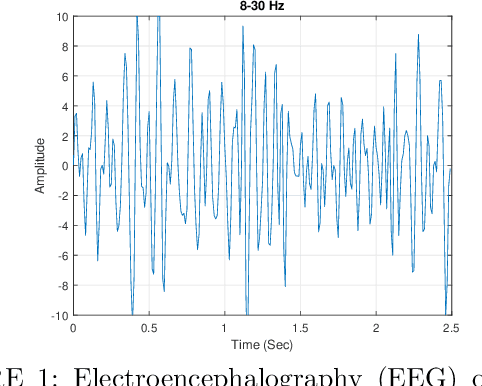
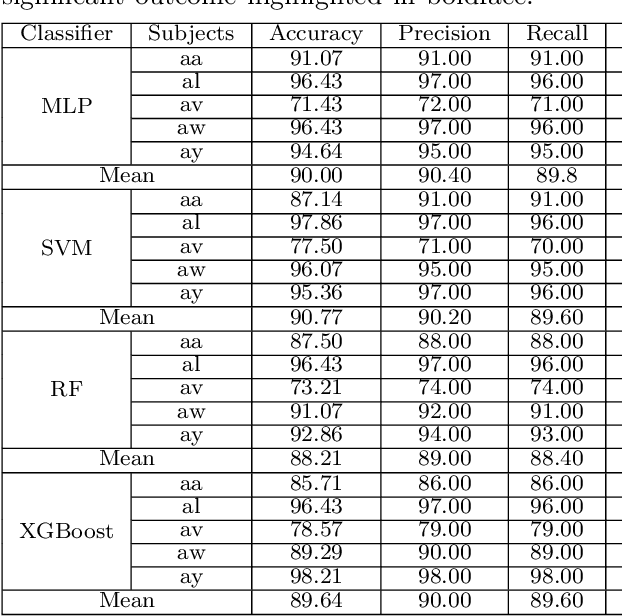
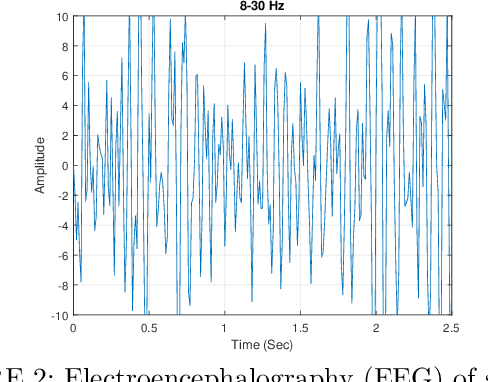
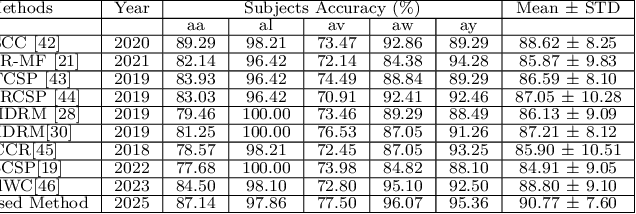
A Brain Computer Interface (BCI) connects the human brain to the outside world, providing a direct communication channel. Electroencephalography (EEG) signals are commonly used in BCIs to reflect cognitive patterns related to motor function activities. However, due to the multichannel nature of EEG signals, explicit information processing is crucial to lessen computational complexity in BCI systems. This study proposes an innovative method based on brain region-specific channel selection and multi-domain feature fusion to improve classification accuracy. The novelty of the proposed approach lies in region-based channel selection, where EEG channels are grouped according to their functional relevance to distinct brain regions. By selecting channels based on specific regions involved in motor imagery (MI) tasks, this technique eliminates irrelevant channels, reducing data dimensionality and improving computational efficiency. This also ensures that the extracted features are more reflective of the brain actual activity related to motor tasks. Three distinct feature extraction methods Common Spatial Pattern (CSP), Fuzzy C-means clustering, and Tangent Space Mapping (TSM), are applied to each group of channels based on their brain region. Each method targets different characteristics of the EEG signal: CSP focuses on spatial patterns, Fuzzy C means identifies clusters within the data, and TSM captures non-linear patterns in the signal. The combined feature vector is used to classify motor imagery tasks (left hand, right hand, and right foot) using Support Vector Machine (SVM). The proposed method was validated on publicly available benchmark EEG datasets (IVA and I) from the BCI competition III and IV. The results show that the approach outperforms existing methods, achieving classification accuracies of 90.77% and 84.50% for datasets IVA and I, respectively.

A Methodological and Structural Review of Hand Gesture Recognition Across Diverse Data Modalities
Aug 10, 2024Researchers have been developing Hand Gesture Recognition (HGR) systems to enhance natural, efficient, and authentic human-computer interaction, especially benefiting those who rely solely on hand gestures for communication. Despite significant progress, the automatic and precise identification of hand gestures remains a considerable challenge in computer vision. Recent studies have focused on specific modalities like RGB images, skeleton data, and spatiotemporal interest points. This paper provides a comprehensive review of HGR techniques and data modalities from 2014 to 2024, exploring advancements in sensor technology and computer vision. We highlight accomplishments using various modalities, including RGB, Skeleton, Depth, Audio, EMG, EEG, and Multimodal approaches and identify areas needing further research. We reviewed over 200 articles from prominent databases, focusing on data collection, data settings, and gesture representation. Our review assesses the efficacy of HGR systems through their recognition accuracy and identifies a gap in research on continuous gesture recognition, indicating the need for improved vision-based gesture systems. The field has experienced steady research progress, including advancements in hand-crafted features and deep learning (DL) techniques. Additionally, we report on the promising developments in HGR methods and the area of multimodal approaches. We hope this survey will serve as a potential guideline for diverse data modality-based HGR research.