 Add to Chrome
 Add to Firefox
 Add to Edge
Vision-Language Models for Analog Gauge Reading: An Empirical Study of Specialization, Transfer and Reliability
Aug 18, 2026
Analog gauges remain common in industrial environments where manual inspection is costly or hazardous. The engineering application addressed here is direct numerical reading of single-target analog-gauge images, while the artificial-intelligence contribution is a systematic evaluation of specialization, transfer, robustness and reliability for a general-purpose vision-language model (VLM) without an explicit pointer-segmentation and geometric-reading pipeline. The Qwen2.5-VL-7B-Instruct model is evaluated using zero-shot prompting, in-context learning (ICL) and parameter-efficient fine-tuning with Quantized Low-Rank Adaptation (QLoRA) on a public synthetic dataset, a video-derived Pressure Gauge dataset and a proprietary industrial dataset. All fine-tuning experiments use a fixed 20-epoch protocol with the final epoch used for analysis; separate models with and without supplied gauge ranges remove prompt-setting confounds. The primary metric is range-normalized mean percentage error (MPE). The best fine-tuned MPE values are 2.39% on the synthetic dataset, with a 95% bootstrap confidence interval (CI) of 1.43-3.90%; 2.61% on the Pressure Gauge dataset, with a CI of 1.66-3.80%; and 4.43% on the proprietary industrial dataset, with a CI of 2.31-7.14%. Leave-one-dataset-out experiments reveal substantial transfer degradation on held-out synthetic and proprietary data, while robustness tests identify Gaussian blur as the strongest tested corruption. Reliability analysis shows that high-confidence errors remain possible, motivating abstention and independent validation in safety-critical use. These results support QLoRA-specialized VLMs for direct single-gauge reading but not yet a deployment-ready plant-monitoring pipeline.

A Generative Approach for Improving Multi-Label Defect Classification in Photovoltaic Modules
Aug 13, 2026This paper addresses the challenge of multi-label defect classification in electroluminescence (EL) images of photovoltaic (PV) cells. Training models on images where multiple defects co-occur creates learning ambiguity, making it difficult to disentangle visual features for specific defect types, a problem compounded by the scarcity of examples for individual classes. To tackle this, we introduce Generative Defect Isolation (GDI), utilizing the LaMa inpainting model with Fast Fourier Convolutions to remove selected defects and generate realistic, single-defect training samples. Extensive experiments on Vision Transformer (ViT-S, ViT-L) and EfficientNetV2-L architectures demonstrate that GDI significantly outperforms baselines. The performance gains are most pronounced in low-data scenarios; class-wise analysis shows substantial improvements, boosting the F1-Score for rare defect classes by up to 63.6%. Furthermore, GDI effectively resolves learning ambiguity from co-occurring defects, yielding a 26% reduction in such co-occurring classification errors. Our work establishes GDI as an effective method for maximizing the value of existing segmentation datasets and sets a new performance benchmark for multi-label classification in this domain.
Bridging Foundation Models and ASTM Metallurgical Standards for Automated Grain Size Estimation from Microscopy Images
Apr 21, 2026Extracting standardized metallurgical metrics from microscopy images remains challenging due to complex grain morphology and the data demands of supervised segmentation. To bridge foundational computer vision with practical metallurgical evaluation, we propose an automated pipeline for dense instance segmentation and grain size estimation that adapts Cellpose-SAM to microstructures and integrates its topology-aware gradient tracking with an ASTM E112 Jeffries planimetric module. We systematically benchmark this pipeline against a classical convolutional network (U-Net), an adaptive-prompting vision foundation model (MatSAM) and a contemporary vision-language model (Qwen2.5-VL-7B). Our evaluations reveal that while the out-of-the-box vision-language model struggles with the localized spatial reasoning required for dense microscopic counting and MatSAM suffers from over-segmentation despite its domain-specific prompt generation, our adapted pipeline successfully maintains topological separation. Furthermore, experiments across progressively reduced training splits demonstrate exceptional few-shot scalability; utilizing only two training samples, the proposed system predicts the ASTM grain size number (G) with a mean absolute percentage error (MAPE) as low as 1.50%, while robustness testing across varying target grain counts empirically validates the ASTM 50-grain sampling minimum. These results highlight the efficacy of application-level foundation model integration for highly accurate, automated materials characterization. Our project repository is available at https://github.com/mueez-overflow/ASTM-Grain-Size-Estimator.
SynSpill: Improved Industrial Spill Detection With Synthetic Data
Aug 13, 2025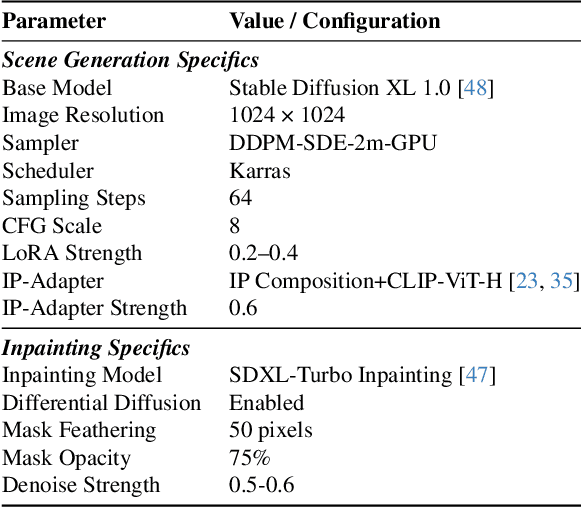
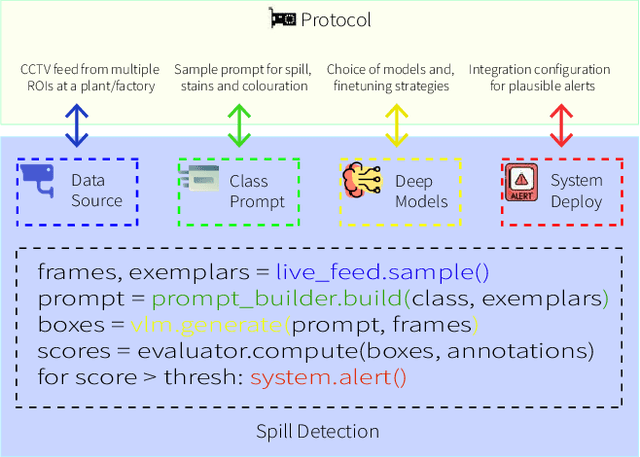
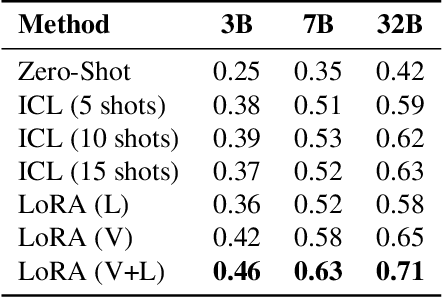
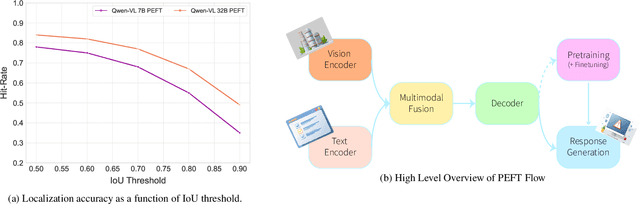
Large-scale Vision-Language Models (VLMs) have transformed general-purpose visual recognition through strong zero-shot capabilities. However, their performance degrades significantly in niche, safety-critical domains such as industrial spill detection, where hazardous events are rare, sensitive, and difficult to annotate. This scarcity -- driven by privacy concerns, data sensitivity, and the infrequency of real incidents -- renders conventional fine-tuning of detectors infeasible for most industrial settings. We address this challenge by introducing a scalable framework centered on a high-quality synthetic data generation pipeline. We demonstrate that this synthetic corpus enables effective Parameter-Efficient Fine-Tuning (PEFT) of VLMs and substantially boosts the performance of state-of-the-art object detectors such as YOLO and DETR. Notably, in the absence of synthetic data (SynSpill dataset), VLMs still generalize better to unseen spill scenarios than these detectors. When SynSpill is used, both VLMs and detectors achieve marked improvements, with their performance becoming comparable. Our results underscore that high-fidelity synthetic data is a powerful means to bridge the domain gap in safety-critical applications. The combination of synthetic generation and lightweight adaptation offers a cost-effective, scalable pathway for deploying vision systems in industrial environments where real data is scarce/impractical to obtain. Project Page: https://synspill.vercel.app