 Add to Chrome
 Add to Firefox
 Add to Edge
AtlasPatch: An Efficient and Scalable Tool for Whole Slide Image Preprocessing in Computational Pathology
Feb 03, 2026
Whole-slide image (WSI) preprocessing, typically comprising tissue detection followed by patch extraction, is foundational to AI-driven computational pathology workflows. This remains a major computational bottleneck as existing tools either rely on inaccurate heuristic thresholding for tissue detection, or adopt AI-based approaches trained on limited-diversity data that operate at the patch level, incurring substantial computational complexity. We present AtlasPatch, an efficient and scalable slide preprocessing framework for accurate tissue detection and high-throughput patch extraction with minimal computational overhead. AtlasPatch's tissue detection module is trained on a heterogeneous and semi-manually annotated dataset of ~30,000 WSI thumbnails, using efficient fine-tuning of the Segment-Anything model. The tool extrapolates tissue masks from thumbnails to full-resolution slides to extract patch coordinates at user-specified magnifications, with options to stream patches directly into common image encoders for embedding or store patch images, all efficiently parallelized across CPUs and GPUs. We assess AtlasPatch across segmentation precision, computational complexity, and downstream multiple-instance learning, matching state-of-the-art performance while operating at a fraction of their computational cost. AtlasPatch is open-source and available at https://github.com/AtlasAnalyticsLab/AtlasPatch.

Investigating Zero-Shot Diagnostic Pathology in Vision-Language Models with Efficient Prompt Design
Apr 30, 2025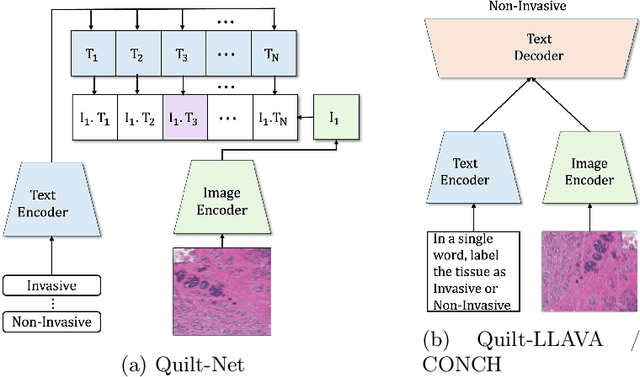
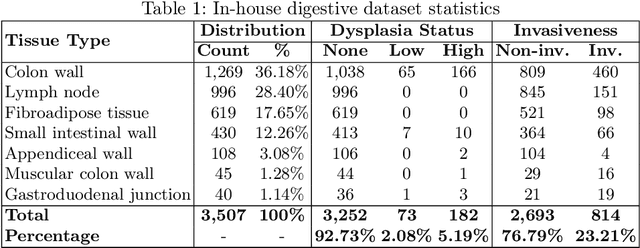
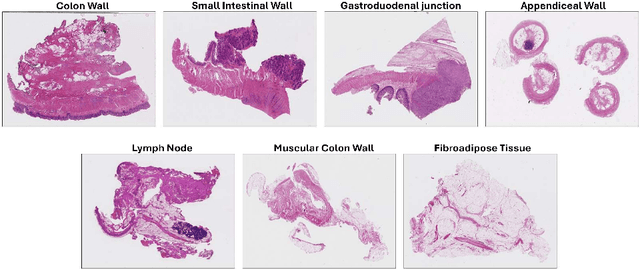
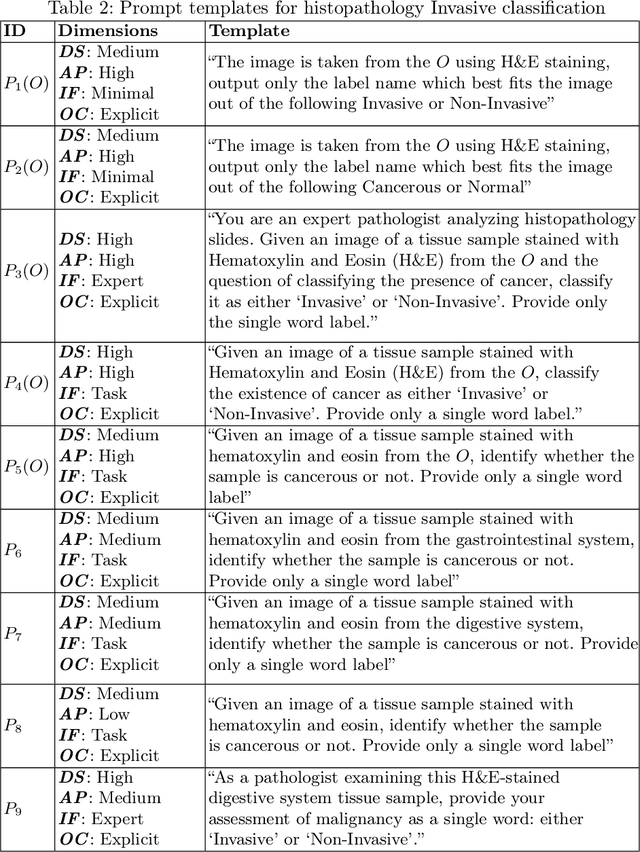
Vision-language models (VLMs) have gained significant attention in computational pathology due to their multimodal learning capabilities that enhance big-data analytics of giga-pixel whole slide image (WSI). However, their sensitivity to large-scale clinical data, task formulations, and prompt design remains an open question, particularly in terms of diagnostic accuracy. In this paper, we present a systematic investigation and analysis of three state of the art VLMs for histopathology, namely Quilt-Net, Quilt-LLAVA, and CONCH, on an in-house digestive pathology dataset comprising 3,507 WSIs, each in giga-pixel form, across distinct tissue types. Through a structured ablative study on cancer invasiveness and dysplasia status, we develop a comprehensive prompt engineering framework that systematically varies domain specificity, anatomical precision, instructional framing, and output constraints. Our findings demonstrate that prompt engineering significantly impacts model performance, with the CONCH model achieving the highest accuracy when provided with precise anatomical references. Additionally, we identify the critical importance of anatomical context in histopathological image analysis, as performance consistently degraded when reducing anatomical precision. We also show that model complexity alone does not guarantee superior performance, as effective domain alignment and domain-specific training are critical. These results establish foundational guidelines for prompt engineering in computational pathology and highlight the potential of VLMs to enhance diagnostic accuracy when properly instructed with domain-appropriate prompts.