 Add to Chrome
 Add to Firefox
 Add to Edge
QuaRK: A Quantum Reservoir Kernel for Time Series Learning
Feb 14, 2026
Quantum reservoir computing offers a promising route for time series learning by modelling sequential data via rich quantum dynamics while the only training required happens at the level of a lightweight classical readout. However, studies featuring efficient and implementable quantum reservoir architectures along with model learning guarantees remain scarce in the literature. To close this gap, we introduce QuaRK, an end-to-end framework that couples a hardware-realistic quantum reservoir featurizer with a kernel-based readout scheme. Given a sequence of sample points, the reservoir injects the points one after the other to yield a compact feature vector from efficiently measured k-local observables using classical shadow tomography, after which a classical kernel-based readout learns the target mapping with explicit regularization and fast optimization. The resulting pipeline exposes clear computational knobs -- circuit width and depth as well as the measurement budget -- while preserving the flexibility of kernel methods to model nonlinear temporal functionals and being scalable to high-dimensional data. We further provide learning-theoretic generalization guarantees for dependent temporal data, linking design and resource choices to finite-sample performance, thereby offering principled guidance for building reliable temporal learners. Empirical experiments validate QuaRK and illustrate the predicted interpolation and generalization behaviours on synthetic beta-mixing time series tasks.

LatentQGAN: A Hybrid QGAN with Classical Convolutional Autoencoder
Sep 22, 2024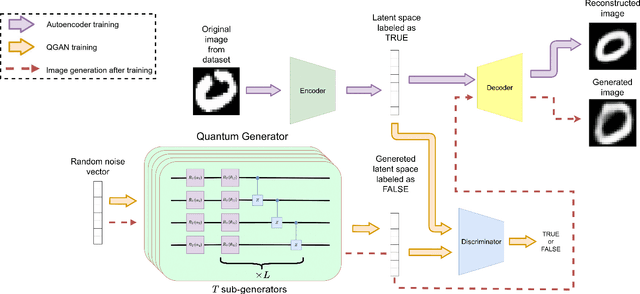
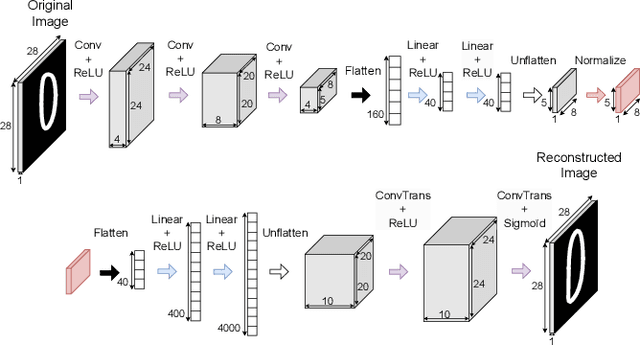
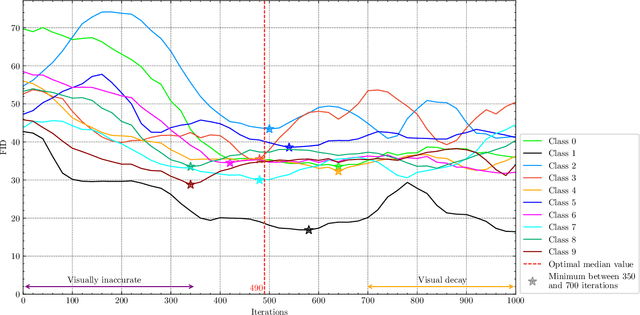
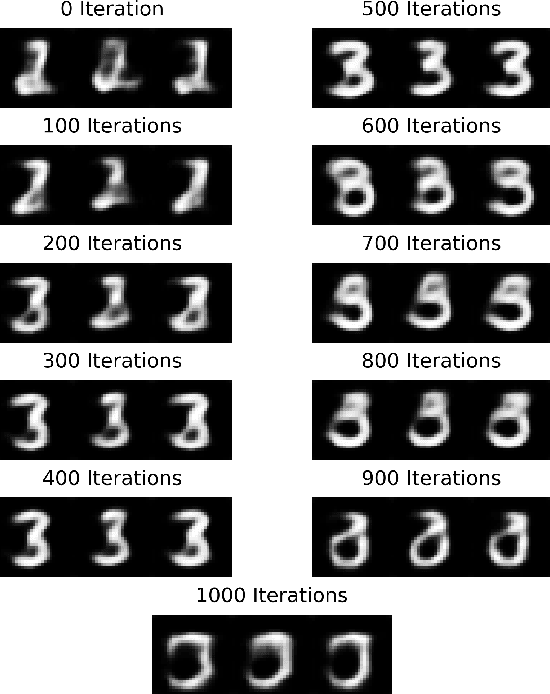
Quantum machine learning consists in taking advantage of quantum computations to generate classical data. A potential application of quantum machine learning is to harness the power of quantum computers for generating classical data, a process essential to a multitude of applications such as enriching training datasets, anomaly detection, and risk management in finance. Given the success of Generative Adversarial Networks in classical image generation, the development of its quantum versions has been actively conducted. However, existing implementations on quantum computers often face significant challenges, such as scalability and training convergence issues. To address these issues, we propose LatentQGAN, a novel quantum model that uses a hybrid quantum-classical GAN coupled with an autoencoder. Although it was initially designed for image generation, the LatentQGAN approach holds potential for broader application across various practical data generation tasks. Experimental outcomes on both classical simulators and noisy intermediate scale quantum computers have demonstrated significant performance enhancements over existing quantum methods, alongside a significant reduction in quantum resources overhead.
QuaCK-TSF: Quantum-Classical Kernelized Time Series Forecasting
Aug 21, 2024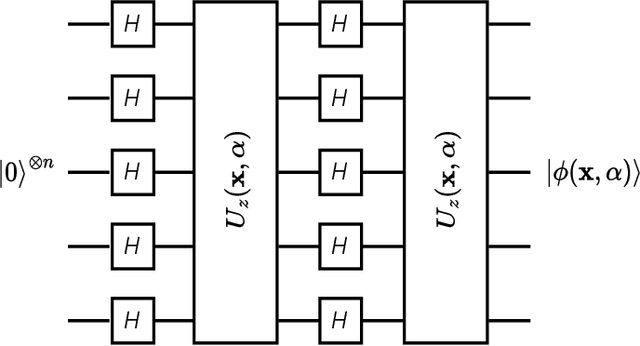
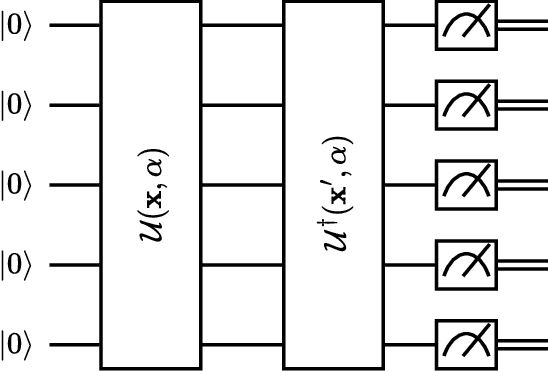
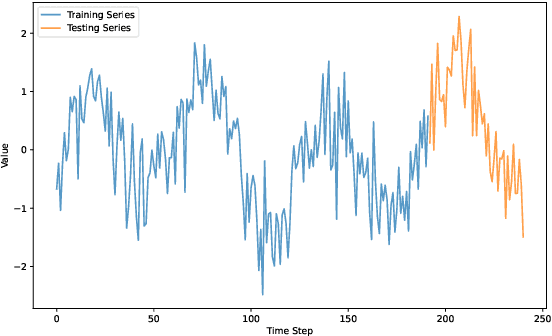
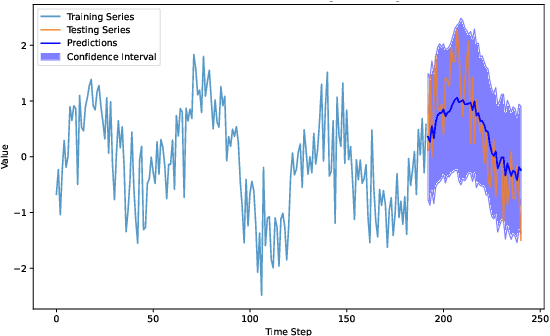
Forecasting in probabilistic time series is a complex endeavor that extends beyond predicting future values to also quantifying the uncertainty inherent in these predictions. Gaussian process regression stands out as a Bayesian machine learning technique adept at addressing this multifaceted challenge. This paper introduces a novel approach that blends the robustness of this Bayesian technique with the nuanced insights provided by the kernel perspective on quantum models, aimed at advancing quantum kernelized probabilistic forecasting. We incorporate a quantum feature map inspired by Ising interactions and demonstrate its effectiveness in capturing the temporal dependencies critical for precise forecasting. The optimization of our model's hyperparameters circumvents the need for computationally intensive gradient descent by employing gradient-free Bayesian optimization. Comparative benchmarks against established classical kernel models are provided, affirming that our quantum-enhanced approach achieves competitive performance.