 Add to Chrome
 Add to Firefox
 Add to Edge
The Average Relative Entropy and Transpilation Depth determines the noise robustness in Variational Quantum Classifiers
Mar 22, 2026
Variational Quantum Algorithms (VQAs) have been extensively researched for applications in Quantum Machine Learning (QML), Optimization, and Molecular simulations. Although designed for Noisy Intermediate-Scale Quantum (NISQ) devices, VQAs are predominantly evaluated classically due to uncertain results on noisy devices and limited resource availability. Raising concern over the reproducibility of simulated VQAs on noisy hardware. While prior studies indicate that VQAs may exhibit noise resilience in specific parameterized shallow quantum circuits, there are no definitive measures to establish what defines a shallow circuit or the optimal circuit depth for VQAs on a noisy platform. These challenges extend naturally to Variational Quantum Classification (VQC) algorithms, a subclass of VQAs for supervised learning. In this article, we propose a relative entropy-based metric to verify whether a VQC model would perform similarly on a noisy device as it does on simulations. We establish a strong correlation between the average relative entropy difference in classes, transpilation circuit depth, and their performance difference on a noisy quantum device. Our results further indicate that circuit depth alone is insufficient to characterize shallow circuits. We present empirical evidence to support these assertions across a diverse array of techniques for implementing VQC, datasets, and multiple noisy quantum devices.

Soft-Dropout: A Practical Approach for Mitigating Overfitting in Quantum Convolutional Neural Networks
Sep 04, 2023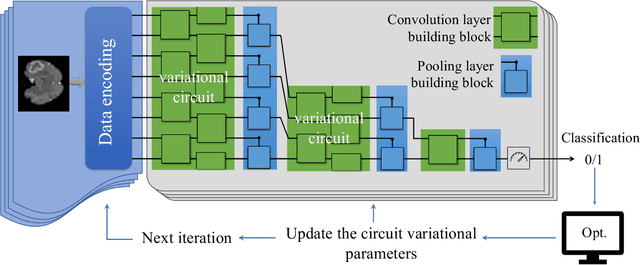
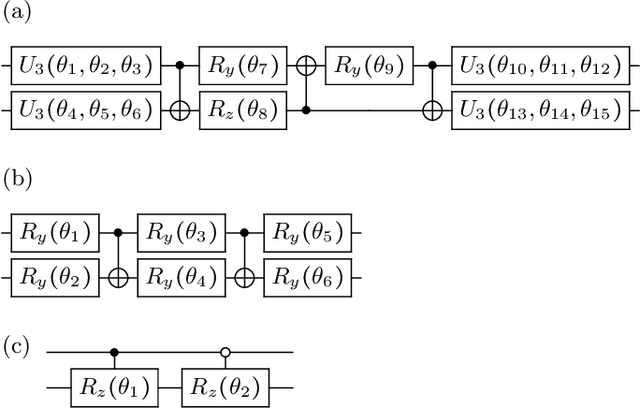
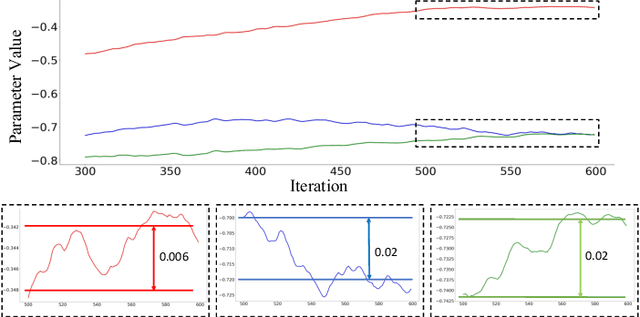
Quantum convolutional neural network (QCNN), an early application for quantum computers in the NISQ era, has been consistently proven successful as a machine learning (ML) algorithm for several tasks with significant accuracy. Derived from its classical counterpart, QCNN is prone to overfitting. Overfitting is a typical shortcoming of ML models that are trained too closely to the availed training dataset and perform relatively poorly on unseen datasets for a similar problem. In this work we study the adaptation of one of the most successful overfitting mitigation method, knows as the (post-training) dropout method, to the quantum setting. We find that a straightforward implementation of this method in the quantum setting leads to a significant and undesirable consequence: a substantial decrease in success probability of the QCNN. We argue that this effect exposes the crucial role of entanglement in QCNNs and the vulnerability of QCNNs to entanglement loss. To handle overfitting, we proposed a softer version of the dropout method. We find that the proposed method allows us to handle successfully overfitting in the test cases.