 Add to Chrome
 Add to Firefox
 Add to Edge
Intelligent Detection of Mechanical, Electrical, and Plumbing (MEP) Metrics Based on 2D Floor Plans
Aug 14, 2026
This research developed a neural network-based model to extract various information from 2D floor plans. We detect lighting symbols, identify the appropriate type of light, and extract the associated texts with lights. The study aims to enable efficient floor designing and determining the number and type of lights needed per floor, i.e., allow efficient design and estimate the power requirement of the floor plan. The model was developed using Mask RCNN as the base. The images were annotated and converted into a Coco data format for training the model. The model achieved bbox\_mAP and segm\_mAP values of 0.7596 and 0.7111, respectively. It also performed well at different IoU thresholds, i.e., with bbox\_mAP 50 and segm\_mAP 75 values of 0.9850 and 0.9219, respectively. The developed model will help various industries, such as architecture and construction, to improve design time and create efficient workflows by automatically detecting Mechanical, Electrical, and Plumbing (MEP) objects from floor plans, and it is the first step towards building tools that will help energy-efficient building design.

Towards Airborne Object Detection: A Deep Learning Analysis
Jan 17, 2026The rapid proliferation of airborne platforms, including commercial aircraft, drones, and UAVs, has intensified the need for real-time, automated threat assessment systems. Current approaches depend heavily on manual monitoring, resulting in limited scalability and operational inefficiencies. This work introduces a dual-task model based on EfficientNetB4 capable of performing airborne object classification and threat-level prediction simultaneously. To address the scarcity of clean, balanced training data, we constructed the AODTA Dataset by aggregating and refining multiple public sources. We benchmarked our approach on both the AVD Dataset and the newly developed AODTA Dataset and further compared performance against a ResNet-50 baseline, which consistently underperformed EfficientNetB4. Our EfficientNetB4 model achieved 96% accuracy in object classification and 90% accuracy in threat-level prediction, underscoring its promise for applications in surveillance, defense, and airspace management. Although the title references detection, this study focuses specifically on classification and threat-level inference using pre-localized airborne object images provided by existing datasets.
Real-Time Drivers' Drowsiness Detection and Analysis through Deep Learning
Nov 16, 2025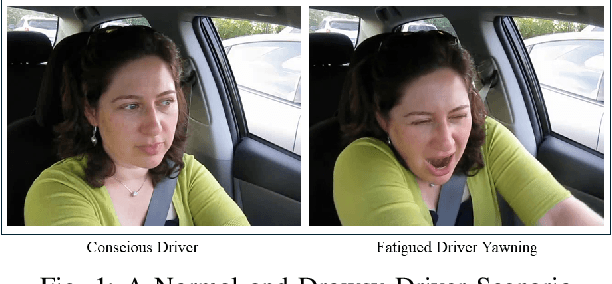
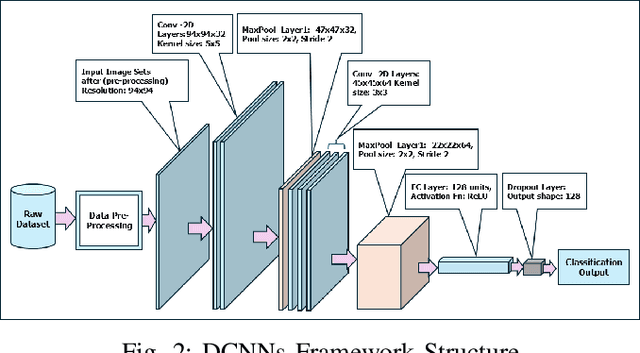
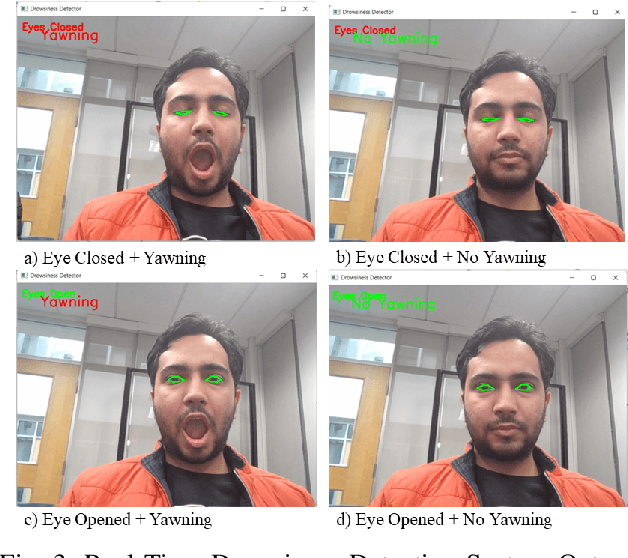
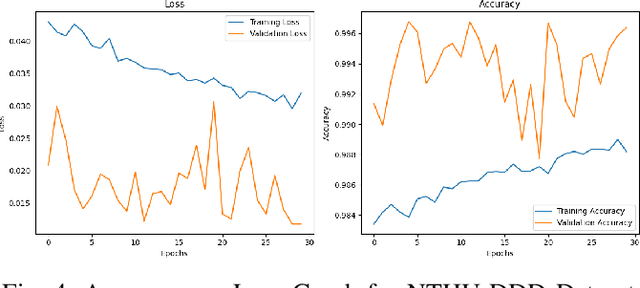
A long road trip is fun for drivers. However, a long drive for days can be tedious for a driver to accommodate stringent deadlines to reach distant destinations. Such a scenario forces drivers to drive extra miles, utilizing extra hours daily without sufficient rest and breaks. Once a driver undergoes such a scenario, it occasionally triggers drowsiness during driving. Drowsiness in driving can be life-threatening to any individual and can affect other drivers' safety; therefore, a real-time detection system is needed. To identify fatigued facial characteristics in drivers and trigger the alarm immediately, this research develops a real-time driver drowsiness detection system utilizing deep convolutional neural networks (DCNNs) and OpenCV.Our proposed and implemented model takes real- time facial images of a driver using a live camera and utilizes a Python-based library named OpenCV to examine the facial images for facial landmarks like sufficient eye openings and yawn-like mouth movements. The DCNNs framework then gathers the data and utilizes a per-trained model to detect the drowsiness of a driver using facial landmarks. If the driver is identified as drowsy, the system issues a continuous alert in real time, embedded in the Smart Car technology.By potentially saving innocent lives on the roadways, the proposed technique offers a non-invasive, inexpensive, and cost-effective way to identify drowsiness. Our proposed and implemented DCNNs embedded drowsiness detection model successfully react with NTHU-DDD dataset and Yawn-Eye-Dataset with drowsiness detection classification accuracy of 99.6% and 97% respectively.
Thermal Face Image Classification using Deep Learning Techniques
Nov 04, 2023Thermal images have various applications in security, medical and industrial domains. This paper proposes a practical deep-learning approach for thermal image classification. Accurate and efficient classification of thermal images poses a significant challenge across various fields due to the complex image content and the scarcity of annotated datasets. This work uses a convolutional neural network (CNN) architecture, specifically ResNet-50 and VGGNet-19, to extract features from thermal images. This work also applied Kalman filter on thermal input images for image denoising. The experimental results demonstrate the effectiveness of the proposed approach in terms of accuracy and efficiency.