 Add to Chrome
 Add to Firefox
 Add to Edge
Uncertainty-Guided Latent Diagnostic Trajectory Learning for Sequential Clinical Diagnosis
Apr 06, 2026
Clinical diagnosis requires sequential evidence acquisition under uncertainty. However, most Large Language Model (LLM) based diagnostic systems assume fully observed patient information and therefore do not explicitly model how clinical evidence should be sequentially acquired over time. Even when diagnosis is formulated as a sequential decision process, it is still challenging to learn effective diagnostic trajectories. This is because the space of possible evidence-acquisition paths is relatively large, while clinical datasets rarely provide explicit supervision information for desirable diagnostic paths. To this end, we formulate sequential diagnosis as a Latent Diagnostic Trajectory Learning (LDTL) framework based on a planning LLM agent and a diagnostic LLM agent. For the diagnostic LLM agent, diagnostic action sequences are treated as latent paths and we introduce a posterior distribution that prioritizes trajectories providing more diagnostic information. The planning LLM agent is then trained to follow this distribution, encouraging coherent diagnostic trajectories that progressively reduce uncertainty. Experiments on the MIMIC-CDM benchmark demonstrate that our proposed LDTL framework outperforms existing baselines in diagnostic accuracy under a sequential clinical diagnosis setting, while requiring fewer diagnostic tests. Furthermore, ablation studies highlight the critical role of trajectory-level posterior alignment in achieving these improvements.

Empowering Power Outage Prediction with Spatially Aware Hybrid Graph Neural Networks and Contrastive Learning
Apr 06, 2026Extreme weather events, such as severe storms, hurricanes, snowstorms, and ice storms, which are exacerbated by climate change, frequently cause widespread power outages. These outages halt industrial operations, impact communities, damage critical infrastructure, profoundly disrupt economies, and have far-reaching effects across various sectors. To mitigate these effects, the University of Connecticut and Eversource Energy Center have developed an outage prediction modeling (OPM) system to provide pre-emptive forecasts for electric distribution networks before such weather events occur. However, existing predictive models in the system do not incorporate the spatial effect of extreme weather events. To this end, we develop Spatially Aware Hybrid Graph Neural Networks (SA-HGNN) with contrastive learning to enhance the OPM predictions for extreme weather-induced power outages. Specifically, we first encode spatial relationships of both static features (e.g., land cover, infrastructure) and event-specific dynamic features (e.g., wind speed, precipitation) via Spatially Aware Hybrid Graph Neural Networks (SA-HGNN). Next, we leverage contrastive learning to handle the imbalance problem associated with different types of extreme weather events and generate location-specific embeddings by minimizing intra-event distances between similar locations while maximizing inter-event distances across all locations. Thorough empirical studies in four utility service territories, i.e., Connecticut, Western Massachusetts, Eastern Massachusetts, and New Hampshire, demonstrate that SA-HGNN can achieve state-of-the-art performance for power outage prediction.
Early GVHD Prediction in Liver Transplantation via Multi-Modal Deep Learning on Imbalanced EHR Data
Nov 06, 2025Graft-versus-host disease (GVHD) is a rare but often fatal complication in liver transplantation, with a very high mortality rate. By harnessing multi-modal deep learning methods to integrate heterogeneous and imbalanced electronic health records (EHR), we aim to advance early prediction of GVHD, paving the way for timely intervention and improved patient outcomes. In this study, we analyzed pre-transplant electronic health records (EHR) spanning the period before surgery for 2,100 liver transplantation patients, including 42 cases of graft-versus-host disease (GVHD), from a cohort treated at Mayo Clinic between 1992 and 2025. The dataset comprised four major modalities: patient demographics, laboratory tests, diagnoses, and medications. We developed a multi-modal deep learning framework that dynamically fuses these modalities, handles irregular records with missing values, and addresses extreme class imbalance through AUC-based optimization. The developed framework outperforms all single-modal and multi-modal machine learning baselines, achieving an AUC of 0.836, an AUPRC of 0.157, a recall of 0.768, and a specificity of 0.803. It also demonstrates the effectiveness of our approach in capturing complementary information from different modalities, leading to improved performance. Our multi-modal deep learning framework substantially improves existing approaches for early GVHD prediction. By effectively addressing the challenges of heterogeneity and extreme class imbalance in real-world EHR, it achieves accurate early prediction. Our proposed multi-modal deep learning method demonstrates promising results for early prediction of a GVHD in liver transplantation, despite the challenge of extremely imbalanced EHR data.
Multi-Modal View Enhanced Large Vision Models for Long-Term Time Series Forecasting
May 29, 2025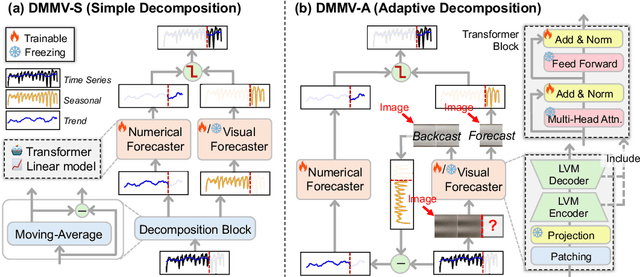

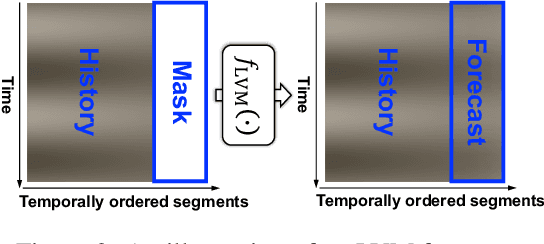

Time series, typically represented as numerical sequences, can also be transformed into images and texts, offering multi-modal views (MMVs) of the same underlying signal. These MMVs can reveal complementary patterns and enable the use of powerful pre-trained large models, such as large vision models (LVMs), for long-term time series forecasting (LTSF). However, as we identified in this work, applying LVMs to LTSF poses an inductive bias towards "forecasting periods". To harness this bias, we propose DMMV, a novel decomposition-based multi-modal view framework that leverages trend-seasonal decomposition and a novel backcast residual based adaptive decomposition to integrate MMVs for LTSF. Comparative evaluations against 14 state-of-the-art (SOTA) models across diverse datasets show that DMMV outperforms single-view and existing multi-modal baselines, achieving the best mean squared error (MSE) on 6 out of 8 benchmark datasets.
From Images to Signals: Are Large Vision Models Useful for Time Series Analysis?
May 29, 2025Transformer-based models have gained increasing attention in time series research, driving interest in Large Language Models (LLMs) and foundation models for time series analysis. As the field moves toward multi-modality, Large Vision Models (LVMs) are emerging as a promising direction. In the past, the effectiveness of Transformer and LLMs in time series has been debated. When it comes to LVMs, a similar question arises: are LVMs truely useful for time series analysis? To address it, we design and conduct the first principled study involving 4 LVMs, 8 imaging methods, 18 datasets and 26 baselines across both high-level (classification) and low-level (forecasting) tasks, with extensive ablation analysis. Our findings indicate LVMs are indeed useful for time series classification but face challenges in forecasting. Although effective, the contemporary best LVM forecasters are limited to specific types of LVMs and imaging methods, exhibit a bias toward forecasting periods, and have limited ability to utilize long look-back windows. We hope our findings could serve as a cornerstone for future research on LVM- and multimodal-based solutions to different time series tasks.
Towards Heterogeneous Continual Graph Learning via Meta-knowledge Distillation
May 23, 2025Machine learning on heterogeneous graphs has experienced rapid advancement in recent years, driven by the inherently heterogeneous nature of real-world data. However, existing studies typically assume the graphs to be static, while real-world graphs are continuously expanding. This dynamic nature requires models to adapt to new data while preserving existing knowledge. To this end, this work addresses the challenge of continual learning on heterogeneous graphs by introducing the Meta-learning based Knowledge Distillation framework (MKD), designed to mitigate catastrophic forgetting in evolving heterogeneous graph structures. MKD combines rapid task adaptation through meta-learning on limited samples with knowledge distillation to achieve an optimal balance between incorporating new information and maintaining existing knowledge. To improve the efficiency and effectiveness of sample selection, MKD incorporates a novel sampling strategy that selects a small number of target-type nodes based on node diversity and maintains fixed-size buffers for other types. The strategy retrieves first-order neighbors along metapaths and selects important neighbors based on their structural relevance, enabling the sampled subgraphs to retain key topological and semantic information. In addition, MKD introduces a semantic-level distillation module that aligns the attention distributions over different metapaths between teacher and student models, encouraging semantic consistency beyond the logit level. Comprehensive evaluations across three benchmark datasets validate MKD's effectiveness in handling continual learning scenarios on expanding heterogeneous graphs.
Multi-modal Time Series Analysis: A Tutorial and Survey
Mar 17, 2025Multi-modal time series analysis has recently emerged as a prominent research area in data mining, driven by the increasing availability of diverse data modalities, such as text, images, and structured tabular data from real-world sources. However, effective analysis of multi-modal time series is hindered by data heterogeneity, modality gap, misalignment, and inherent noise. Recent advancements in multi-modal time series methods have exploited the multi-modal context via cross-modal interactions based on deep learning methods, significantly enhancing various downstream tasks. In this tutorial and survey, we present a systematic and up-to-date overview of multi-modal time series datasets and methods. We first state the existing challenges of multi-modal time series analysis and our motivations, with a brief introduction of preliminaries. Then, we summarize the general pipeline and categorize existing methods through a unified cross-modal interaction framework encompassing fusion, alignment, and transference at different levels (\textit{i.e.}, input, intermediate, output), where key concepts and ideas are highlighted. We also discuss the real-world applications of multi-modal analysis for both standard and spatial time series, tailored to general and specific domains. Finally, we discuss future research directions to help practitioners explore and exploit multi-modal time series. The up-to-date resources are provided in the GitHub repository: https://github.com/UConn-DSIS/Multi-modal-Time-Series-Analysis
Cross-platform Prediction of Depression Treatment Outcome Using Location Sensory Data on Smartphones
Mar 10, 2025Currently, depression treatment relies on closely monitoring patients response to treatment and adjusting the treatment as needed. Using self-reported or physician-administrated questionnaires to monitor treatment response is, however, burdensome, costly and suffers from recall bias. In this paper, we explore using location sensory data collected passively on smartphones to predict treatment outcome. To address heterogeneous data collection on Android and iOS phones, the two predominant smartphone platforms, we explore using domain adaptation techniques to map their data to a common feature space, and then use the data jointly to train machine learning models. Our results show that this domain adaptation approach can lead to significantly better prediction than that with no domain adaptation. In addition, our results show that using location features and baseline self-reported questionnaire score can lead to F1 score up to 0.67, comparable to that obtained using periodic self-reported questionnaires, indicating that using location data is a promising direction for predicting depression treatment outcome.
Explainable Multi-modal Time Series Prediction with LLM-in-the-Loop
Mar 02, 2025


Time series analysis provides essential insights for real-world system dynamics and informs downstream decision-making, yet most existing methods often overlook the rich contextual signals present in auxiliary modalities. To bridge this gap, we introduce TimeXL, a multi-modal prediction framework that integrates a prototype-based time series encoder with three collaborating Large Language Models (LLMs) to deliver more accurate predictions and interpretable explanations. First, a multi-modal prototype-based encoder processes both time series and textual inputs to generate preliminary forecasts alongside case-based rationales. These outputs then feed into a prediction LLM, which refines the forecasts by reasoning over the encoder's predictions and explanations. Next, a reflection LLM compares the predicted values against the ground truth, identifying textual inconsistencies or noise. Guided by this feedback, a refinement LLM iteratively enhances text quality and triggers encoder retraining. This closed-loop workflow -- prediction, critique (reflect), and refinement -- continuously boosts the framework's performance and interpretability. Empirical evaluations on four real-world datasets demonstrate that TimeXL achieves up to 8.9\% improvement in AUC and produces human-centric, multi-modal explanations, highlighting the power of LLM-driven reasoning for time series prediction.
Harnessing Vision Models for Time Series Analysis: A Survey
Feb 13, 2025


Time series analysis has witnessed the inspiring development from traditional autoregressive models, deep learning models, to recent Transformers and Large Language Models (LLMs). Efforts in leveraging vision models for time series analysis have also been made along the way but are less visible to the community due to the predominant research on sequence modeling in this domain. However, the discrepancy between continuous time series and the discrete token space of LLMs, and the challenges in explicitly modeling the correlations of variates in multivariate time series have shifted some research attentions to the equally successful Large Vision Models (LVMs) and Vision Language Models (VLMs). To fill the blank in the existing literature, this survey discusses the advantages of vision models over LLMs in time series analysis. It provides a comprehensive and in-depth overview of the existing methods, with dual views of detailed taxonomy that answer the key research questions including how to encode time series as images and how to model the imaged time series for various tasks. Additionally, we address the challenges in the pre- and post-processing steps involved in this framework and outline future directions to further advance time series analysis with vision models.