 Add to Chrome
 Add to Firefox
 Add to Edge
Xception
Papers and Code
RetinaVision: XAI-Driven Augmented Regulation for Precise Retinal Disease Classification using deep learning framework
Feb 22, 2026
Early and accurate classification of retinal diseases is critical to counter vision loss and for guiding clinical management of retinal diseases. In this study, we proposed a deep learning method for retinal disease classification utilizing optical coherence tomography (OCT) images from the Retinal OCT Image Classification - C8 dataset (comprising 24,000 labeled images spanning eight conditions). Images were resized to 224x224 px and tested on convolutional neural network (CNN) architectures: Xception and InceptionV3. Data augmentation techniques (CutMix, MixUp) were employed to enhance model generalization. Additionally, we applied GradCAM and LIME for interpretability evaluation. We implemented this in a real-world scenario via our web application named RetinaVision. This study found that Xception was the most accurate network (95.25%), followed closely by InceptionV3 (94.82%). These results suggest that deep learning methods allow effective OCT retinal disease classification and highlight the importance of implementing accuracy and interpretability for clinical applications.

A Mobile Application for Flower Recognition System Based on Convolutional Neural Networks
Jan 22, 2026A convolutional neural network (CNN) is a deep learning algorithm that has been specifically designed for computer vision applications. The CNNs proved successful in handling the increasing amount of data in many computer vision problems, where classical machine learning algorithms were insufficient. Flowers have many uses in our daily lives, from decorating to making medicines to detoxifying the environment. Identifying flower types requires expert knowledge. However, accessing experts at any time and in any location may not always be feasible. In this study a mobile application based on CNNs was developed to recognize different types of flowers to provide non-specialists with quick and easy access to information about flower types. The study employed three distinct CNN models, namely MobileNet, DenseNet121, and Xception, to determine the most suitable model for the mobile application. The classification performances of the models were evaluated by training them with seven different optimization algorithms. The DenseNet-121 architecture, which uses the stochastic gradient descent (SGD) optimization algorithm, was the most successful, achieving 95.84 % accuracy, 96.00% precision, recall, and F1-score. This result shows that CNNs can be used for flower classification in mobile applications.
Hybrid Deep Feature Extraction and ML for Construction and Demolition Debris Classification
Jan 20, 2026The construction industry produces significant volumes of debris, making effective sorting and classification critical for sustainable waste management and resource recovery. This study presents a hybrid vision-based pipeline that integrates deep feature extraction with classical machine learning (ML) classifiers for automated construction and demolition (C\&D) debris classification. A novel dataset comprising 1,800 balanced, high-quality images representing four material categories, Ceramic/Tile, Concrete, Trash/Waste, and Wood was collected from real construction sites in the UAE, capturing diverse real-world conditions. Deep features were extracted using a pre-trained Xception network, and multiple ML classifiers, including SVM, kNN, Bagged Trees, LDA, and Logistic Regression, were systematically evaluated. The results demonstrate that hybrid pipelines using Xception features with simple classifiers such as Linear SVM, kNN, and Bagged Trees achieve state-of-the-art performance, with up to 99.5\% accuracy and macro-F1 scores, surpassing more complex or end-to-end deep learning approaches. The analysis highlights the operational benefits of this approach for robust, field-deployable debris identification and provides pathways for future integration with robotics and onsite automation systems.
RCDN: Real-Centered Detection Network for Robust Face Forgery Identification
Jan 17, 2026Image forgery has become a critical threat with the rapid proliferation of AI-based generation tools, which make it increasingly easy to synthesize realistic but fraudulent facial content. Existing detection methods achieve near-perfect performance when training and testing are conducted within the same domain, yet their effectiveness deteriorates substantially in crossdomain scenarios. This limitation is problematic, as new forgery techniques continuously emerge and detectors must remain reliable against unseen manipulations. To address this challenge, we propose the Real-Centered Detection Network (RCDN), a frequency spatial convolutional neural networks(CNN) framework with an Xception backbone that anchors its representation space around authentic facial images. Instead of modeling the diverse and evolving patterns of forgeries, RCDN emphasizes the consistency of real images, leveraging a dual-branch architecture and a real centered loss design to enhance robustness under distribution shifts. Extensive experiments on the DiFF dataset, focusing on three representative forgery types (FE, I2I, T2I), demonstrate that RCDN achieves both state-of-the-art in-domain accuracy and significantly stronger cross-domain generalization. Notably, RCDN reduces the generalization gap compared to leading baselines and achieves the highest cross/in-domain stability ratio, highlighting its potential as a practical solution for defending against evolving and unseen image forgery techniques.
Deepfake detectors are DUMB: A benchmark to assess adversarial training robustness under transferability constraints
Jan 09, 2026Deepfake detection systems deployed in real-world environments are subject to adversaries capable of crafting imperceptible perturbations that degrade model performance. While adversarial training is a widely adopted defense, its effectiveness under realistic conditions -- where attackers operate with limited knowledge and mismatched data distributions - remains underexplored. In this work, we extend the DUMB -- Dataset soUrces, Model architecture and Balance - and DUMBer methodology to deepfake detection. We evaluate detectors robustness against adversarial attacks under transferability constraints and cross-dataset configuration to extract real-world insights. Our study spans five state-of-the-art detectors (RECCE, SRM, XCeption, UCF, SPSL), three attacks (PGD, FGSM, FPBA), and two datasets (FaceForensics++ and Celeb-DF-V2). We analyze both attacker and defender perspectives mapping results to mismatch scenarios. Experiments show that adversarial training strategies reinforce robustness in the in-distribution cases but can also degrade it under cross-dataset configuration depending on the strategy adopted. These findings highlight the need for case-aware defense strategies in real-world applications exposed to adversarial attacks.
LeafLife: An Explainable Deep Learning Framework with Robustness for Grape Leaf Disease Recognition
Jan 06, 2026Plant disease diagnosis is essential to farmers' management choices because plant diseases frequently lower crop yield and product quality. For harvests to flourish and agricultural productivity to boost, grape leaf disease detection is important. The plant disease dataset contains grape leaf diseases total of 9,032 images of four classes, among them three classes are leaf diseases, and the other one is healthy leaves. After rigorous pre-processing dataset was split (70% training, 20% validation, 10% testing), and two pre-trained models were deployed: InceptionV3 and Xception. Xception shows a promising result of 96.23% accuracy, which is remarkable than InceptionV3. Adversarial Training is used for robustness, along with more transparency. Grad-CAM is integrated to confirm the leaf disease. Finally deployed a web application using Streamlit with a heatmap visualization and prediction with confidence level for robust grape leaf disease classification.
MCD-Net: A Lightweight Deep Learning Baseline for Optical-Only Moraine Segmentation
Jan 06, 2026Glacial segmentation is essential for reconstructing past glacier dynamics and evaluating climate-driven landscape change. However, weak optical contrast and the limited availability of high-resolution DEMs hinder automated mapping. This study introduces the first large-scale optical-only moraine segmentation dataset, comprising 3,340 manually annotated high-resolution images from Google Earth covering glaciated regions of Sichuan and Yunnan, China. We develop MCD-Net, a lightweight baseline that integrates a MobileNetV2 encoder, a Convolutional Block Attention Module (CBAM), and a DeepLabV3+ decoder. Benchmarking against deeper backbones (ResNet152, Xception) shows that MCD-Net achieves 62.3% mean Intersection over Union (mIoU) and 72.8% Dice coefficient while reducing computational cost by more than 60%. Although ridge delineation remains constrained by sub-pixel width and spectral ambiguity, the results demonstrate that optical imagery alone can provide reliable moraine-body segmentation. The dataset and code are publicly available at https://github.com/Lyra-alpha/MCD-Net, establishing a reproducible benchmark for moraine-specific segmentation and offering a deployable baseline for high-altitude glacial monitoring.
ShrimpXNet: A Transfer Learning Framework for Shrimp Disease Classification with Augmented Regularization, Adversarial Training, and Explainable AI
Dec 25, 2025Shrimp is one of the most widely consumed aquatic species globally, valued for both its nutritional content and economic importance. Shrimp farming represents a significant source of income in many regions; however, like other forms of aquaculture, it is severely impacted by disease outbreaks. These diseases pose a major challenge to sustainable shrimp production. To address this issue, automated disease classification methods can offer timely and accurate detection. This research proposes a deep learning-based approach for the automated classification of shrimp diseases. A dataset comprising 1,149 images across four disease classes was utilized. Six pretrained deep learning models, ResNet50, EfficientNet, DenseNet201, MobileNet, ConvNeXt-Tiny, and Xception were deployed and evaluated for performance. The images background was removed, followed by standardized preprocessing through the Keras image pipeline. Fast Gradient Sign Method (FGSM) was used for enhancing the model robustness through adversarial training. While advanced augmentation strategies, including CutMix and MixUp, were implemented to mitigate overfitting and improve generalization. To support interpretability, and to visualize regions of model attention, post-hoc explanation methods such as Grad-CAM, Grad-CAM++, and XGrad-CAM were applied. Exploratory results demonstrated that ConvNeXt-Tiny achieved the highest performance, attaining a 96.88% accuracy on the test dataset. After 1000 iterations, the 99% confidence interval for the model is [0.953,0.971].
Plug to Place: Indoor Multimedia Geolocation from Electrical Sockets for Digital Investigation
Dec 18, 2025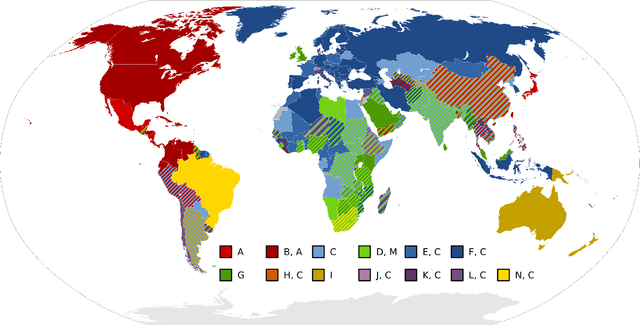
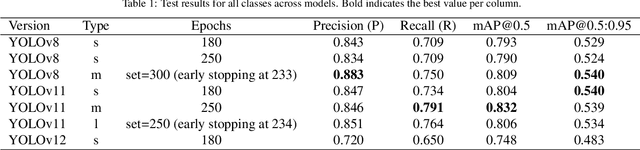
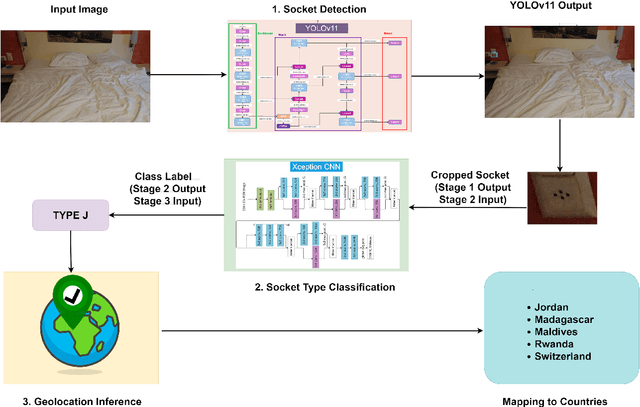

Computer vision is a rapidly evolving field, giving rise to powerful new tools and techniques in digital forensic investigation, and shows great promise for novel digital forensic applications. One such application, indoor multimedia geolocation, has the potential to become a crucial aid for law enforcement in the fight against human trafficking, child exploitation, and other serious crimes. While outdoor multimedia geolocation has been widely explored, its indoor counterpart remains underdeveloped due to challenges such as similar room layouts, frequent renovations, visual ambiguity, indoor lighting variability, unreliable GPS signals, and limited datasets in sensitive domains. This paper introduces a pipeline that uses electric sockets as consistent indoor markers for geolocation, since plug socket types are standardised by country or region. The three-stage deep learning pipeline detects plug sockets (YOLOv11, mAP@0.5 = 0.843), classifies them into one of 12 plug socket types (Xception, accuracy = 0.912), and maps the detected socket types to countries (accuracy = 0.96 at >90% threshold confidence). To address data scarcity, two dedicated datasets were created: socket detection dataset of 2,328 annotated images expanded to 4,072 through augmentation, and a classification dataset of 3,187 images across 12 plug socket classes. The pipeline was evaluated on the Hotels-50K dataset, focusing on the TraffickCam subset of crowd-sourced hotel images, which capture real-world conditions such as poor lighting and amateur angles. This dataset provides a more realistic evaluation than using professional, well-lit, often wide-angle images from travel websites. This framework demonstrates a practical step toward real-world digital forensic applications. The code, trained models, and the data for this paper are available open source.
From Code to Field: Evaluating the Robustness of Convolutional Neural Networks for Disease Diagnosis in Mango Leaves
Dec 15, 2025The validation and verification of artificial intelligence (AI) models through robustness assessment are essential to guarantee the reliable performance of intelligent systems facing real-world challenges, such as image corruptions including noise, blurring, and weather variations. Despite the global importance of mango (Mangifera indica L.), there is a lack of studies on the robustness of models for the diagnosis of disease in its leaves. This paper proposes a methodology to evaluate convolutional neural networks (CNNs) under adverse conditions. We adapted the MangoLeafDB dataset, generating MangoLeafDB-C with 19 types of artificial corruptions at five severity levels. We conducted a benchmark comparing five architectures: ResNet-50, ResNet-101, VGG-16, Xception, and LCNN (the latter being a lightweight architecture designed specifically for mango leaf diagnosis). The metrics include the F1 score, the corruption error (CE) and the relative mean corruption error (relative mCE). The results show that LCNN outperformed complex models in corruptions that can be present in real-world scenarios such as Defocus Blur, Motion Blur, while also achieving the lowest mCE. Modern architectures (e.g., ResNet-101) exhibited significant performance degradation in corrupted scenarios, despite their high accuracy under ideal conditions. These findings suggest that lightweight and specialized models may be more suitable for real-world applications in edge devices, where robustness and efficiency are critical. The study highlights the need to incorporate robustness assessments in the development of intelligent systems for agriculture, particularly in regions with technological limitations.