 Add to Chrome
 Add to Firefox
 Add to Edge
Vietnamese Visual Question Answering
Papers and Code
AutoViVQA: A Large-Scale Automatically Constructed Dataset for Vietnamese Visual Question Answering
Mar 11, 2026
Visual Question Answering (VQA) is a fundamental multimodal task that requires models to jointly understand visual and textual information. Early VQA systems relied heavily on language biases, motivating subsequent work to emphasize visual grounding and balanced datasets. With the success of large-scale pre-trained transformers for both text and vision domains -- such as PhoBERT for Vietnamese language understanding and Vision Transformers (ViT) for image representation learning -- multimodal fusion has achieved remarkable progress. For Vietnamese VQA, several datasets have been introduced to promote research in low-resource multimodal learning, including ViVQA, OpenViVQA, and the recently proposed ViTextVQA. These resources enable benchmarking of models that integrate linguistic and visual features in the Vietnamese context. Evaluation of VQA systems often employs automatic metrics originally designed for image captioning or machine translation, such as BLEU, METEOR, CIDEr, Recall, Precision, and F1-score. However, recent research suggests that large language models can further improve the alignment between automatic evaluation and human judgment in VQA tasks. In this work, we explore Vietnamese Visual Question Answering using transformer-based architectures, leveraging both textual and visual pre-training while systematically comparing automatic evaluation metrics under multilingual settings.

ViInfographicVQA: A Benchmark for Single and Multi-image Visual Question Answering on Vietnamese Infographics
Dec 13, 2025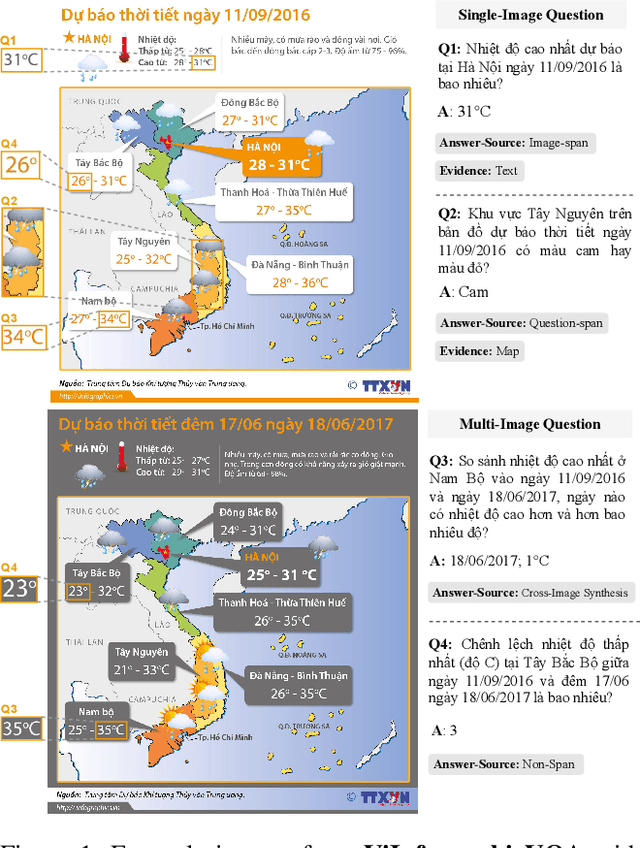
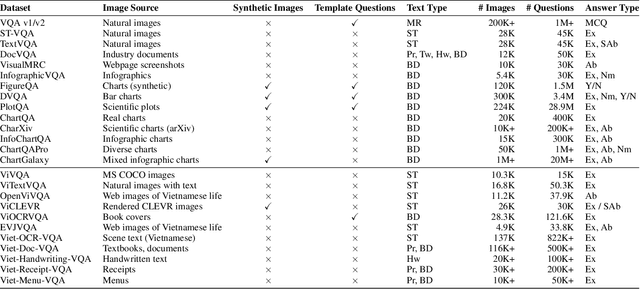
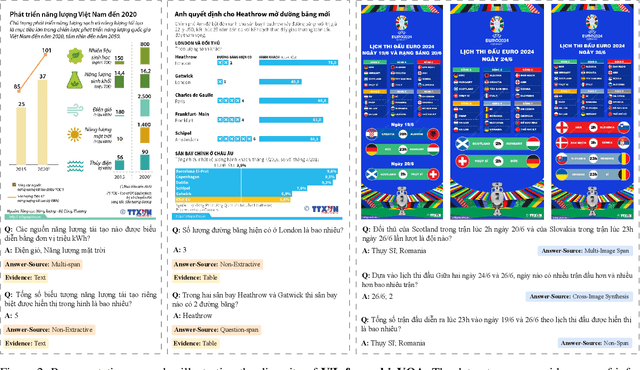
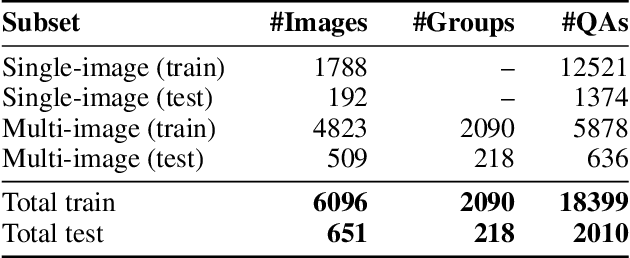
Infographic Visual Question Answering (InfographicVQA) evaluates a model's ability to read and reason over data-rich, layout-heavy visuals that combine text, charts, icons, and design elements. Compared with scene-text or natural-image VQA, infographics require stronger integration of OCR, layout understanding, and numerical and semantic reasoning. We introduce ViInfographicVQA, the first benchmark for Vietnamese InfographicVQA, comprising over 6747 real-world infographics and 20409 human-verified question-answer pairs across economics, healthcare, education, and more. The benchmark includes two evaluation settings. The Single-image task follows the traditional setup in which each question is answered using a single infographic. The Multi-image task requires synthesizing evidence across multiple semantically related infographics and is, to our knowledge, the first Vietnamese evaluation of cross-image reasoning in VQA. We evaluate a range of recent vision-language models on this benchmark, revealing substantial performance disparities, with the most significant errors occurring on Multi-image questions that involve cross-image integration and non-span reasoning. ViInfographicVQA contributes benchmark results for Vietnamese InfographicVQA and sheds light on the limitations of current multimodal models in low-resource contexts, encouraging future exploration of layout-aware and cross-image reasoning methods.
Towards Signboard-Oriented Visual Question Answering: ViSignVQA Dataset, Method and Benchmark
Dec 22, 2025Understanding signboard text in natural scenes is essential for real-world applications of Visual Question Answering (VQA), yet remains underexplored, particularly in low-resource languages. We introduce ViSignVQA, the first large-scale Vietnamese dataset designed for signboard-oriented VQA, which comprises 10,762 images and 25,573 question-answer pairs. The dataset captures the diverse linguistic, cultural, and visual characteristics of Vietnamese signboards, including bilingual text, informal phrasing, and visual elements such as color and layout. To benchmark this task, we adapted state-of-the-art VQA models (e.g., BLIP-2, LaTr, PreSTU, and SaL) by integrating a Vietnamese OCR model (SwinTextSpotter) and a Vietnamese pretrained language model (ViT5). The experimental results highlight the significant role of the OCR-enhanced context, with F1-score improvements of up to 209% when the OCR text is appended to questions. Additionally, we propose a multi-agent VQA framework combining perception and reasoning agents with GPT-4, achieving 75.98% accuracy via majority voting. Our study presents the first large-scale multimodal dataset for Vietnamese signboard understanding. This underscores the importance of domain-specific resources in enhancing text-based VQA for low-resource languages. ViSignVQA serves as a benchmark capturing real-world scene text characteristics and supporting the development and evaluation of OCR-integrated VQA models in Vietnamese.
VietMEAgent: Culturally-Aware Few-Shot Multimodal Explanation for Vietnamese Visual Question Answering
Nov 12, 2025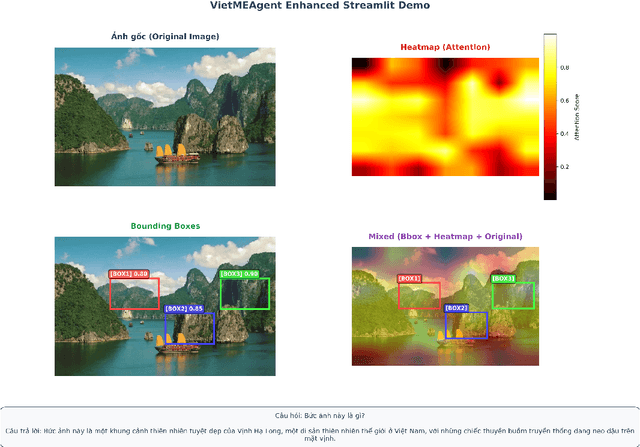
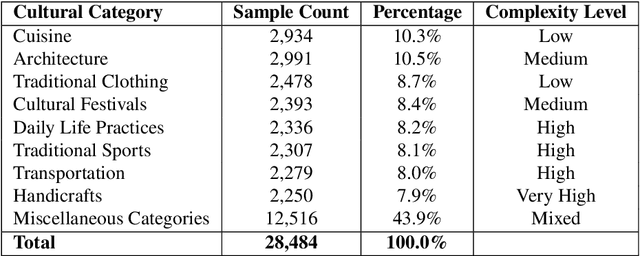
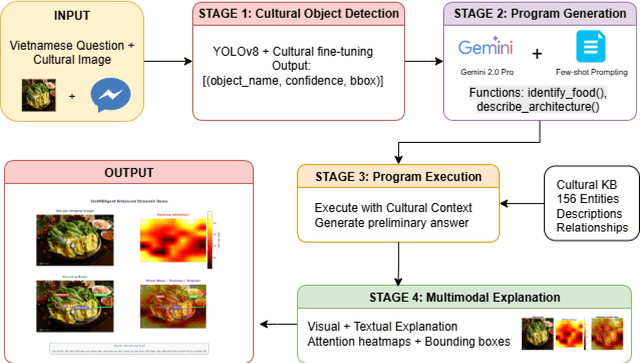
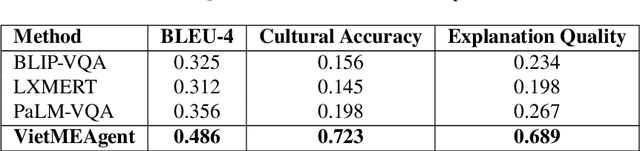
Contemporary Visual Question Answering (VQA) systems remain constrained when confronted with culturally specific content, largely because cultural knowledge is under-represented in training corpora and the reasoning process is not rendered interpretable to end users. This paper introduces VietMEAgent, a multimodal explainable framework engineered for Vietnamese cultural understanding. The method integrates a cultural object detection backbone with a structured program generation layer, yielding a pipeline in which answer prediction and explanation are tightly coupled. A curated knowledge base of Vietnamese cultural entities serves as an explicit source of background information, while a dual-modality explanation module combines attention-based visual evidence with structured, human-readable textual rationales. We further construct a Vietnamese Cultural VQA dataset sourced from public repositories and use it to demonstrate the practicality of programming-based methodologies for cultural AI. The resulting system provides transparent explanations that disclose both the computational rationale and the underlying cultural context, supporting education and cultural preservation with an emphasis on interpretability and cultural sensitivity.
LiGT: Layout-infused Generative Transformer for Visual Question Answering on Vietnamese Receipts
Feb 26, 2025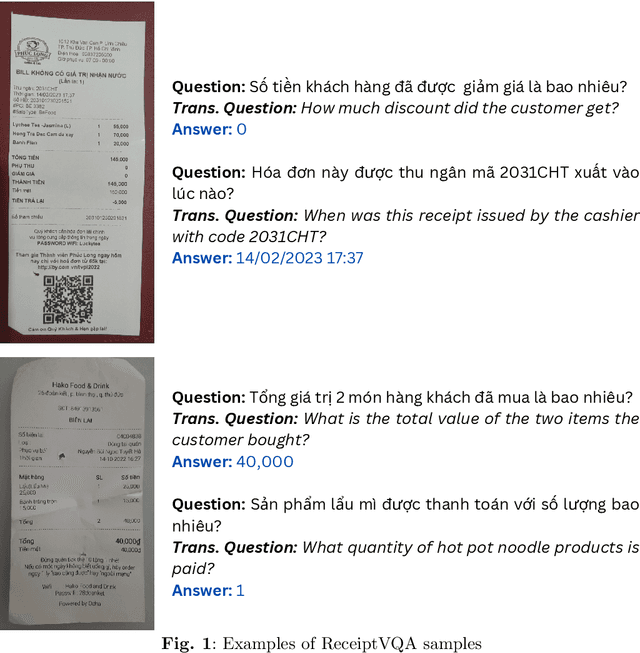
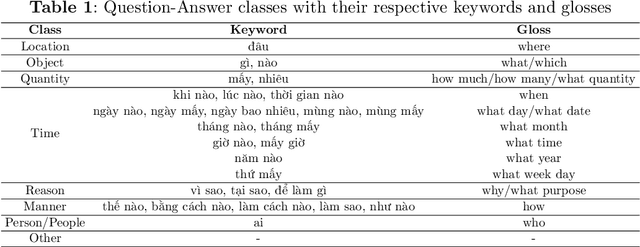
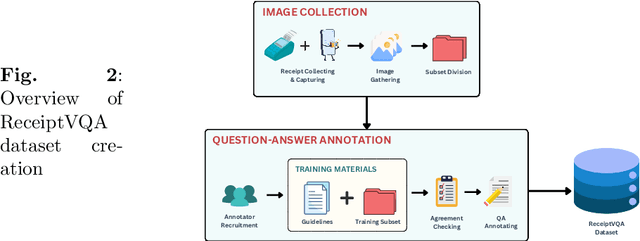

\textbf{Purpose:} Document Visual Question Answering (document VQA) challenges multimodal systems to holistically handle textual, layout, and visual modalities to provide appropriate answers. Document VQA has gained popularity in recent years due to the increasing amount of documents and the high demand for digitization. Nonetheless, most of document VQA datasets are developed in high-resource languages such as English. \textbf{Methods:} In this paper, we present ReceiptVQA (\textbf{Receipt} \textbf{V}isual \textbf{Q}uestion \textbf{A}nswering), the initial large-scale document VQA dataset in Vietnamese dedicated to receipts, a document kind with high commercial potentials. The dataset encompasses \textbf{9,000+} receipt images and \textbf{60,000+} manually annotated question-answer pairs. In addition to our study, we introduce LiGT (\textbf{L}ayout-\textbf{i}nfused \textbf{G}enerative \textbf{T}ransformer), a layout-aware encoder-decoder architecture designed to leverage embedding layers of language models to operate layout embeddings, minimizing the use of additional neural modules. \textbf{Results:} Experiments on ReceiptVQA show that our architecture yielded promising performance, achieving competitive results compared with outstanding baselines. Furthermore, throughout analyzing experimental results, we found evident patterns that employing encoder-only model architectures has considerable disadvantages in comparison to architectures that can generate answers. We also observed that it is necessary to combine multiple modalities to tackle our dataset, despite the critical role of semantic understanding from language models. \textbf{Conclusion:} We hope that our work will encourage and facilitate future development in Vietnamese document VQA, contributing to a diverse multimodal research community in the Vietnamese language.
Enhancing Vietnamese VQA through Curriculum Learning on Raw and Augmented Text Representations
Mar 05, 2025Visual Question Answering (VQA) is a multimodal task requiring reasoning across textual and visual inputs, which becomes particularly challenging in low-resource languages like Vietnamese due to linguistic variability and the lack of high-quality datasets. Traditional methods often rely heavily on extensive annotated datasets, computationally expensive pipelines, and large pre-trained models, specifically in the domain of Vietnamese VQA, limiting their applicability in such scenarios. To address these limitations, we propose a training framework that combines a paraphrase-based feature augmentation module with a dynamic curriculum learning strategy. Explicitly, augmented samples are considered "easy" while raw samples are regarded as "hard". The framework then utilizes a mechanism that dynamically adjusts the ratio of easy to hard samples during training, progressively modifying the same dataset to increase its difficulty level. By enabling gradual adaptation to task complexity, this approach helps the Vietnamese VQA model generalize well, thus improving overall performance. Experimental results show consistent improvements on the OpenViVQA dataset and mixed outcomes on the ViVQA dataset, highlighting both the potential and challenges of our approach in advancing VQA for Vietnamese language.
ViConsFormer: Constituting Meaningful Phrases of Scene Texts using Transformer-based Method in Vietnamese Text-based Visual Question Answering
Oct 24, 2024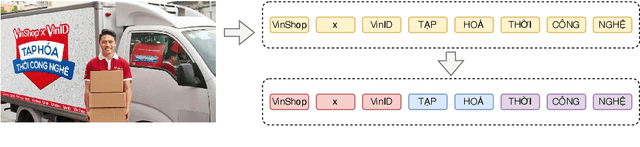
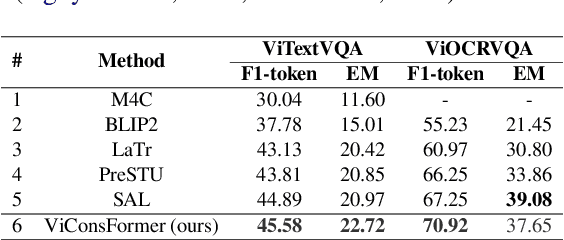
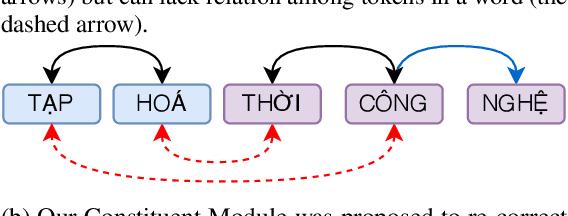
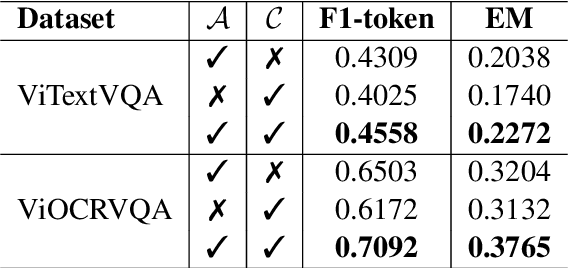
Text-based VQA is a challenging task that requires machines to use scene texts in given images to yield the most appropriate answer for the given question. The main challenge of text-based VQA is exploiting the meaning and information from scene texts. Recent studies tackled this challenge by considering the spatial information of scene texts in images via embedding 2D coordinates of their bounding boxes. In this study, we follow the definition of meaning from linguistics to introduce a novel method that effectively exploits the information from scene texts written in Vietnamese. Experimental results show that our proposed method obtains state-of-the-art results on two large-scale Vietnamese Text-based VQA datasets. The implementation can be found at this link.
Advancing Vietnamese Visual Question Answering with Transformer and Convolutional Integration
Jul 30, 2024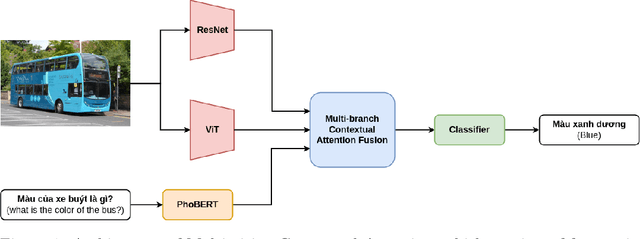
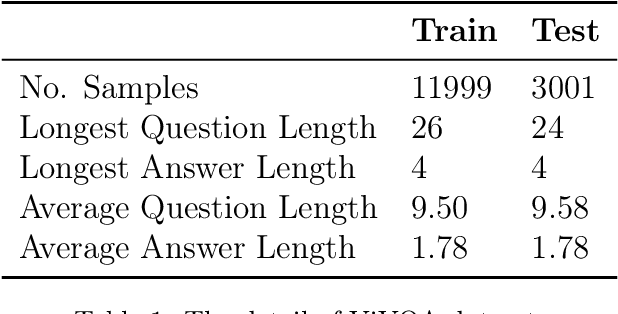
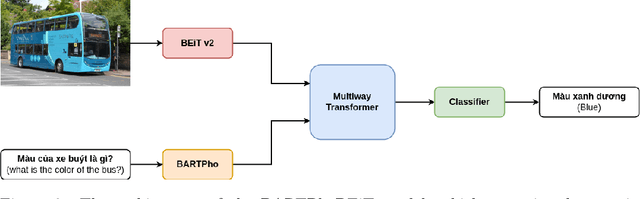
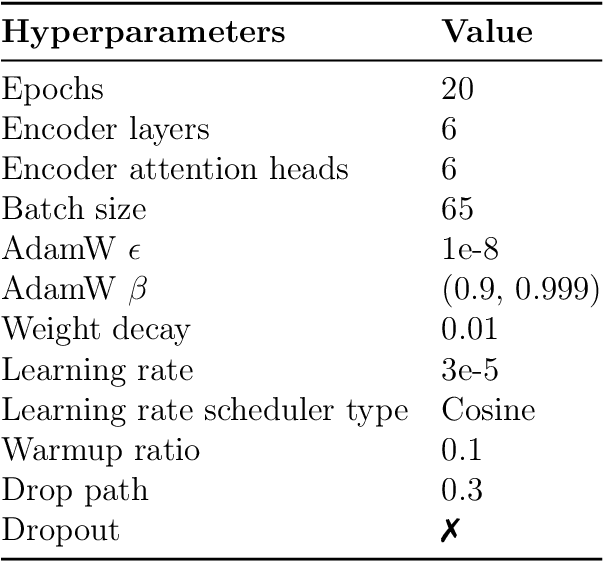
Visual Question Answering (VQA) has recently emerged as a potential research domain, captivating the interest of many in the field of artificial intelligence and computer vision. Despite the prevalence of approaches in English, there is a notable lack of systems specifically developed for certain languages, particularly Vietnamese. This study aims to bridge this gap by conducting comprehensive experiments on the Vietnamese Visual Question Answering (ViVQA) dataset, demonstrating the effectiveness of our proposed model. In response to community interest, we have developed a model that enhances image representation capabilities, thereby improving overall performance in the ViVQA system. Specifically, our model integrates the Bootstrapping Language-Image Pre-training with frozen unimodal models (BLIP-2) and the convolutional neural network EfficientNet to extract and process both local and global features from images. This integration leverages the strengths of transformer-based architectures for capturing comprehensive contextual information and convolutional networks for detailed local features. By freezing the parameters of these pre-trained models, we significantly reduce the computational cost and training time, while maintaining high performance. This approach significantly improves image representation and enhances the performance of existing VQA systems. We then leverage a multi-modal fusion module based on a general-purpose multi-modal foundation model (BEiT-3) to fuse the information between visual and textual features. Our experimental findings demonstrate that our model surpasses competing baselines, achieving promising performance. This is particularly evident in its accuracy of $71.04\%$ on the test set of the ViVQA dataset, marking a significant advancement in our research area. The code is available at https://github.com/nngocson2002/ViVQA.
* Accepted at the journal of Computers & Electrical Engineering (Received 8 March 2024, Revised 8 June 2024, Accepted 10 July 2024)
ViOCRVQA: Novel Benchmark Dataset and Vision Reader for Visual Question Answering by Understanding Vietnamese Text in Images
Apr 29, 2024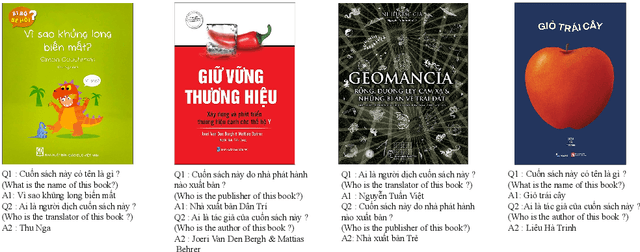
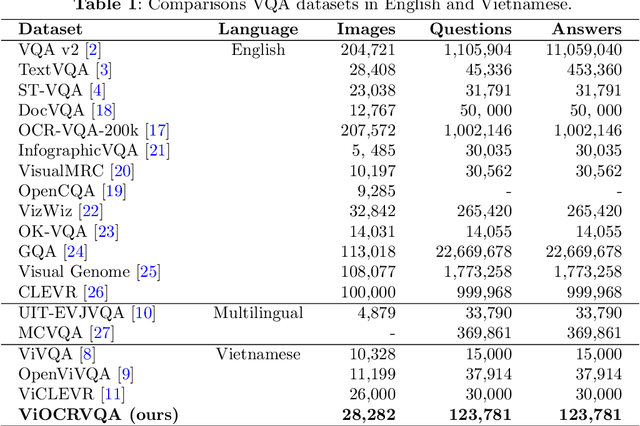
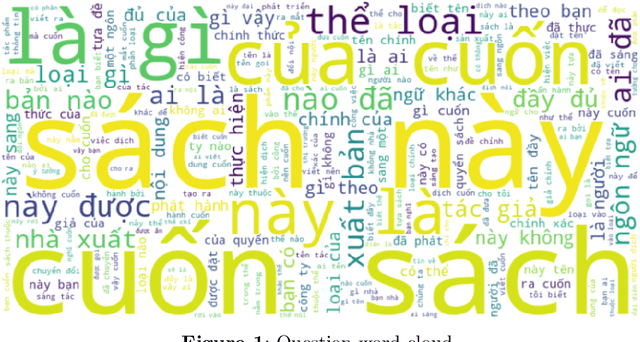
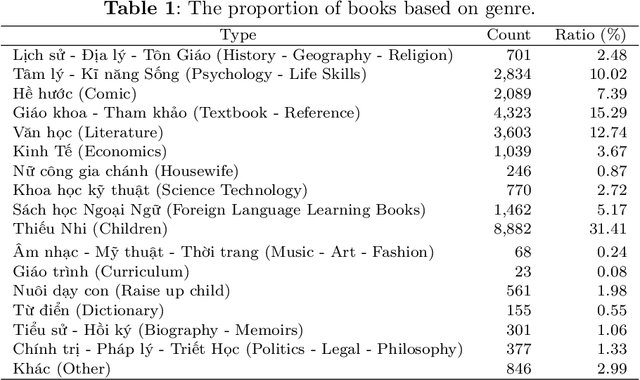
Optical Character Recognition - Visual Question Answering (OCR-VQA) is the task of answering text information contained in images that have just been significantly developed in the English language in recent years. However, there are limited studies of this task in low-resource languages such as Vietnamese. To this end, we introduce a novel dataset, ViOCRVQA (Vietnamese Optical Character Recognition - Visual Question Answering dataset), consisting of 28,000+ images and 120,000+ question-answer pairs. In this dataset, all the images contain text and questions about the information relevant to the text in the images. We deploy ideas from state-of-the-art methods proposed for English to conduct experiments on our dataset, revealing the challenges and difficulties inherent in a Vietnamese dataset. Furthermore, we introduce a novel approach, called VisionReader, which achieved 0.4116 in EM and 0.6990 in the F1-score on the test set. Through the results, we found that the OCR system plays a very important role in VQA models on the ViOCRVQA dataset. In addition, the objects in the image also play a role in improving model performance. We open access to our dataset at link (https://github.com/qhnhynmm/ViOCRVQA.git) for further research in OCR-VQA task in Vietnamese.
Vintern-1B: An Efficient Multimodal Large Language Model for Vietnamese
Aug 22, 2024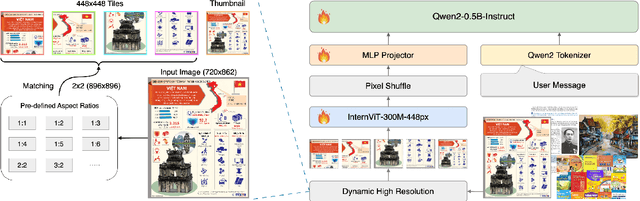
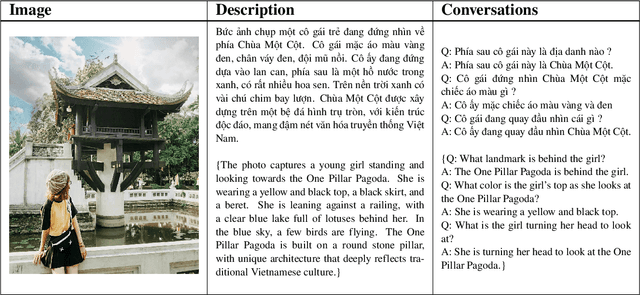
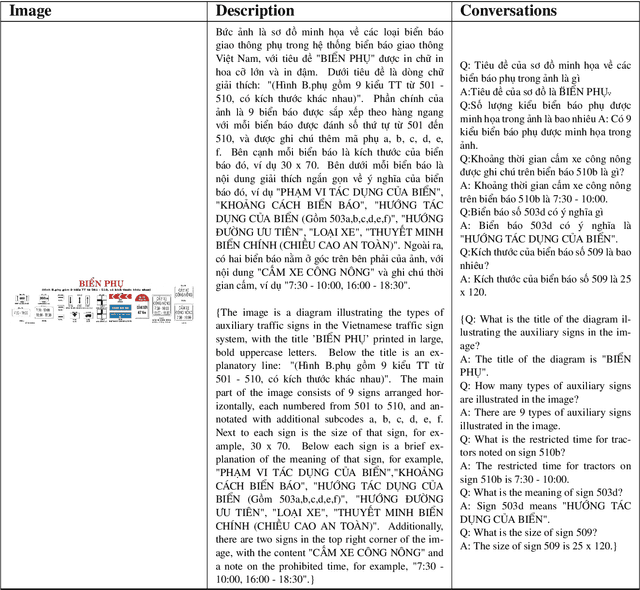
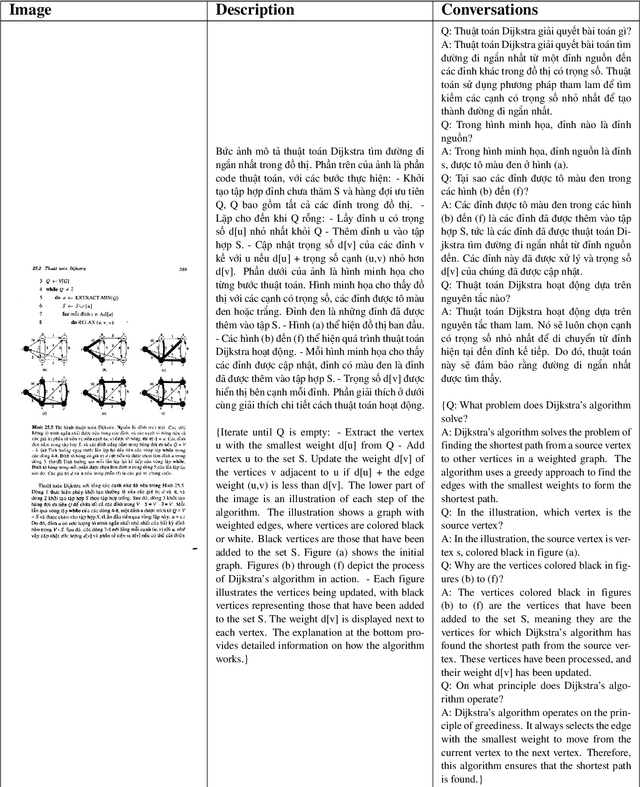
In this report, we introduce Vintern-1B, a reliable 1-billion-parameters multimodal large language model (MLLM) for Vietnamese language tasks. By integrating the Qwen2-0.5B-Instruct language model with the InternViT-300M-448px visual model, Vintern-1B is optimized for a range of applications, including optical character recognition (OCR), document extraction, and general question-answering in Vietnamese context. The model is fine-tuned on an extensive dataset of over 3 million image-question-answer pairs, achieving robust performance and reliable results across multiple Vietnamese language benchmarks like OpenViVQA and ViTextVQA. Vintern-1B is small enough to fit into various on-device applications easily. Additionally, we have open-sourced several Vietnamese vision question answering (VQA) datasets for text and diagrams, created with Gemini 1.5 Flash. Our models are available at: https://huggingface.co/5CD-AI/Vintern-1B-v2.