 Add to Chrome
 Add to Firefox
 Add to Edge
Uit Viquad
Papers and Code
VLSP 2021 - ViMRC Challenge: Vietnamese Machine Reading Comprehension
Apr 04, 2022
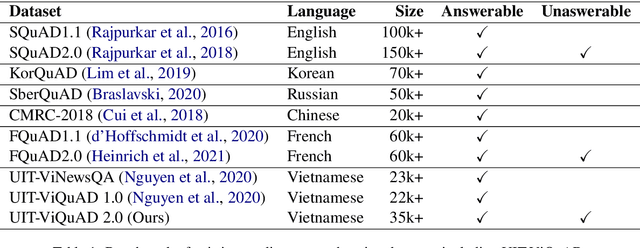
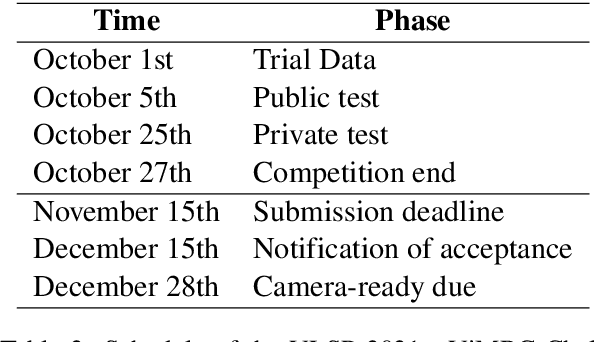
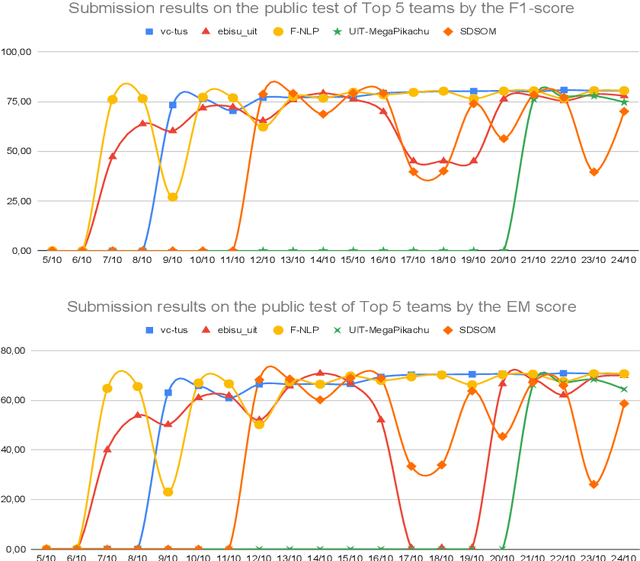
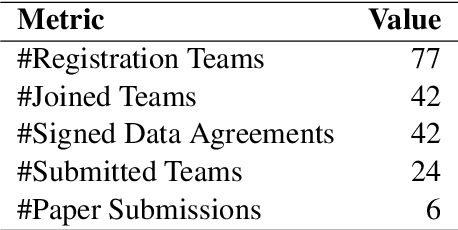
One of the emerging research trends in natural language understanding is machine reading comprehension (MRC) which is the task to find answers to human questions based on textual data. Existing Vietnamese datasets for MRC research concentrate solely on answerable questions. However, in reality, questions can be unanswerable for which the correct answer is not stated in the given textual data. To address the weakness, we provide the research community with a benchmark dataset named UIT-ViQuAD 2.0 for evaluating the MRC task and question answering systems for the Vietnamese language. We use UIT-ViQuAD 2.0 as a benchmark dataset for the challenge on Vietnamese MRC at the Eighth Workshop on Vietnamese Language and Speech Processing (VLSP 2021). This task attracted 77 participant teams from 34 universities and other organizations. In this article, we present details of the organization of the challenge, an overview of the methods employed by shared-task participants, and the results. The highest performances are 77.24% in F1-score and 67.43% in Exact Match on the private test set. The Vietnamese MRC systems proposed by the top 3 teams use XLM-RoBERTa, a powerful pre-trained language model based on the transformer architecture. The UIT-ViQuAD 2.0 dataset motivates researchers to further explore the Vietnamese machine reading comprehension task and related tasks such as question answering, question generation, and natural language inference.

XLMRQA: Open-Domain Question Answering on Vietnamese Wikipedia-based Textual Knowledge Source
Apr 14, 2022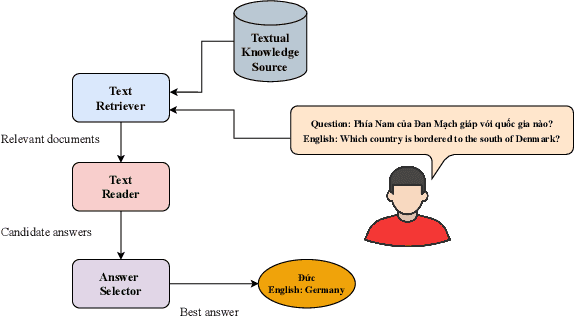
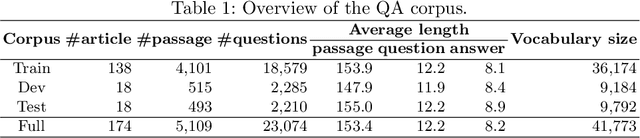
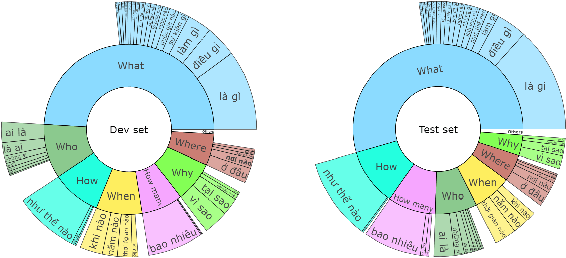
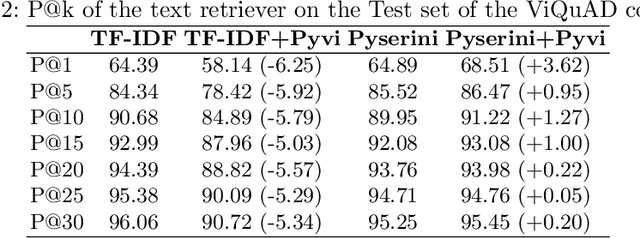
Question answering (QA) is a natural language understanding task within the fields of information retrieval and information extraction that has attracted much attention from the computational linguistics and artificial intelligence research community in recent years because of the strong development of machine reading comprehension-based models. A reader-based QA system is a high-level search engine that can find correct answers to queries or questions in open-domain or domain-specific texts using machine reading comprehension (MRC) techniques. The majority of advancements in data resources and machine-learning approaches in the MRC and QA systems, on the other hand, especially in two resource-rich languages such as English and Chinese. A low-resource language like Vietnamese has witnessed a scarcity of research on QA systems. This paper presents XLMRQA, the first Vietnamese QA system using a supervised transformer-based reader on the Wikipedia-based textual knowledge source (using the UIT-ViQuAD corpus), outperforming the two robust QA systems using deep neural network models: DrQA and BERTserini with 24.46% and 6.28%, respectively. From the results obtained on the three systems, we analyze the influence of question types on the performance of the QA systems.
Sentence Extraction-Based Machine Reading Comprehension for Vietnamese
Jun 11, 2021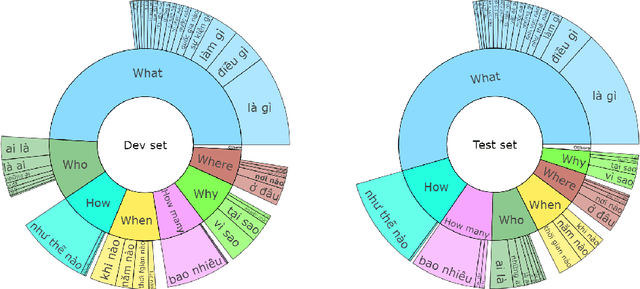
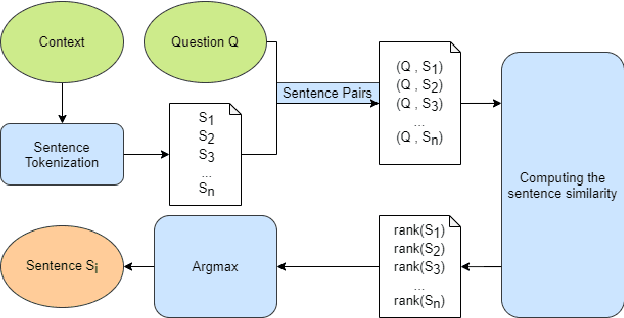
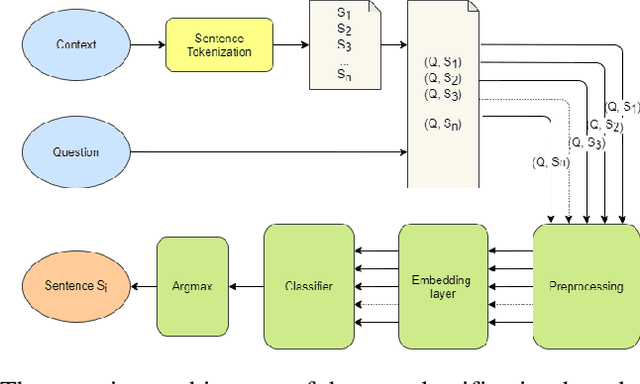
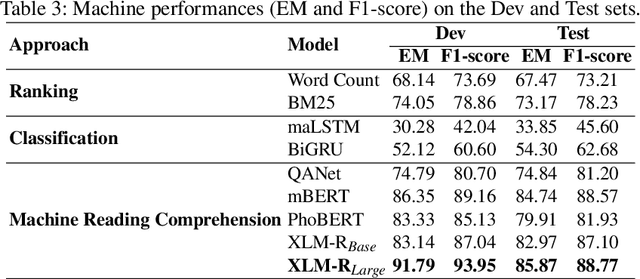
The development of natural language processing (NLP) in general and machine reading comprehension in particular has attracted the great attention of the research community. In recent years, there are a few datasets for machine reading comprehension tasks in Vietnamese with large sizes, such as UIT-ViQuAD and UIT-ViNewsQA. However, the datasets are not diverse in answers to serve the research. In this paper, we introduce UIT-ViWikiQA, the first dataset for evaluating sentence extraction-based machine reading comprehension in the Vietnamese language. The UIT-ViWikiQA dataset is converted from the UIT-ViQuAD dataset, consisting of comprises 23.074 question-answers based on 5.109 passages of 174 Wikipedia Vietnamese articles. We propose a conversion algorithm to create the dataset for sentence extraction-based machine reading comprehension and three types of approaches for sentence extraction-based machine reading comprehension in Vietnamese. Our experiments show that the best machine model is XLM-R_Large, which achieves an exact match (EM) of 85.97% and an F1-score of 88.77% on our dataset. Besides, we analyze experimental results in terms of the question type in Vietnamese and the effect of context on the performance of the MRC models, thereby showing the challenges from the UIT-ViWikiQA dataset that we propose to the language processing community.