 Add to Chrome
 Add to Firefox
 Add to Edge
Lung Nodule Classification
Papers and Code
A Comparative Analysis of CT Degradation for LDCT Nodule Classification using Radiomics
May 12, 2026
Low-dose computed tomography (LDCT) is the standard modality for lung cancer screening, known for its low radiation dose but high noise levels. While existing literature focuses on denoising LDCT images, comparative research on simulating LDCT characteristics to directly use these images for model development is lacking. This study shifts the focus from denoising images to degrading available standard-dose CT (SDCT) data, generating synthetic images for data augmentation to train classifiers for screening-detected nodules. We compare three degradation methods: (1) a sinogram domain statistical noise insertion; (2) replicate a validated physics-based simulation using Pix2Pix; and (3) unpaired CycleGAN. The generated images were utilized to simulate LDCT screening scenario replacing 695 SDCT cases from the LIDC-IDRI dataset, from which radiomic features were extracted to train machine learning models for lung nodule classification. Regarding image quality, CycleGAN achieved the best Fréchet inception distance (0.1734) and kernel inception distance (0.0813; 0.1002) scores, indicating distributional alignment with the target low-dose domain. In the nodule classification task, results confirmed the necessity of domain adaptation since a baseline model trained on non-degraded SDCT data failed to generalize to the real LDCT set (AUC 0.789) with a low sensitivity (0.571). Degraded images generated using CycleGAN approach led to the most balanced performance on the classification task using Adam Booster classifier, achieving an AUC of 0.861, sensitivity of 0.743 and specificity of 0.858 in the independent test. Our findings confirm that generating synthetic LDCT data from standard-dose scans is a viable strategy for training robust nodule classifiers for screening detected nodules.

M3Net: A Macro-to-Meso-to-Micro Clinical-inspired Hierarchical 3D Network for Pulmonary Nodule Classification
May 12, 2026The accurate classification of benign and malignant pulmonary nodules in CT scans is critical for early lung cancer screening, yet remains challenging due to the multi-scale and heterogeneous nature of pulmonary nodules. While deep learning offers potential for auxiliary diagnosis, most existing models act as "black boxes", lacking the transparency and explainability required for trustworthy clinical integration. To address this issue, we propose M3Net, a novel 3D network for pulmonary nodule classification inspired by the hierarchical diagnostic workflow of radiologists, which integrates multi-scale contextual information from fine-grained structures to global anatomical relationships. Our framework constructs a progressive multi-scale input, from fine-grained nodule structures to local semantics and global spatial relationships. M3Net employs scale-specific encoders and ensures cross-scale semantic consistency through latent space projection and mutual information maximization. Extensive experiments on the public LIDC-IDRI dataset and a self-collected clinical dataset (USTC-FHLN) demonstrate that our method achieves state-of-the-art performance, with accuracies of 86.96% and 84.24% respectively, outperforming the best baseline by 3.26% and 2.17%. The results validate that M3Net provides a more robust and clinically relevant solution for pulmonary nodule classification. The code is available at https://github.com/jylEcho/M3-Net.
* Published in Information Fusion (2026), 15 pages, 5 figures
Co-distilled attention guided masked image modeling with noisy teacher for self-supervised learning on medical images
Apr 16, 2026Masked image modeling (MIM) is a highly effective self-supervised learning (SSL) approach to extract useful feature representations from unannotated data. Predominantly used random masking methods make SSL less effective for medical images due to the contextual similarity of neighboring patches, leading to information leakage and SSL simplification. Hierarchical shifted window (Swin) transformer, a highly effective approach for medical images cannot use advanced masking methods as it lacks a global [CLS] token. Hence, we introduced an attention guided masking mechanism for Swin within a co-distillation learning framework to selectively mask semantically co-occurring and discriminative patches, to reduce information leakage and increase the difficulty of SSL pretraining. However, attention guided masking inevitably reduces the diversity of attention heads, which negatively impacts downstream task performance. To address this, we for the first time, integrate a noisy teacher into the co-distillation framework (termed DAGMaN) that performs attentive masking while preserving high attention head diversity. We demonstrate the capability of DAGMaN on multiple tasks including full- and few-shot lung nodule classification, immunotherapy outcome prediction, tumor segmentation, and unsupervised organs clustering.
VIVID-Med: LLM-Supervised Structured Pretraining for Deployable Medical ViTs
Mar 11, 2026Vision-language pretraining has driven significant progress in medical image analysis. However, current methods typically supervise visual encoders using one-hot labels or free-form text, neither of which effectively captures the complex semantic relationships among clinical findings. In this study, we introduce VIVID-Med, a novel framework that leverages a frozen large language model (LLM) as a structured semantic teacher to pretrain medical vision transformers (ViTs). VIVID-Med translates clinical findings into verifiable JSON field-state pairs via a Unified Medical Schema (UMS), utilizing answerability-aware masking to focus optimization. It then employs Structured Prediction Decomposition (SPD) to partition cross-attention into orthogonality-regularized query groups, extracting complementary visual aspects. Crucially, the LLM is discarded post-training, yielding a lightweight, deployable ViT-only backbone. We evaluated VIVID-Med across multiple settings: on CheXpert linear probing, it achieves a macro-AUC of 0.8588, outperforming BiomedCLIP by +6.65 points while using 500x less data. It also demonstrates robust zero-shot cross-domain transfer to NIH ChestX-ray14 (0.7225 macro-AUC) and strong cross-modality generalization to CT, achieving 0.8413 AUC on LIDC-IDRI lung nodule classification and 0.9969 macro-AUC on OrganAMNIST 11-organ classification. VIVID-Med offers a highly efficient, scalable alternative to deploying resource-heavy vision-language models in clinical settings.
Lung nodule classification on CT scan patches using 3D convolutional neural networks
Feb 13, 2026Lung cancer remains one of the most common and deadliest forms of cancer worldwide. The likelihood of successful treatment depends strongly on the stage at which the disease is diagnosed. Therefore, early detection of lung cancer represents a critical medical challenge. However, this task poses significant difficulties for thoracic radiologists due to the large number of studies to review, the presence of multiple nodules within the lungs, and the small size of many nodules, which complicates visual assessment. Consequently, the development of automated systems that incorporate highly accurate and computationally efficient lung nodule detection and classification modules is essential. This study introduces three methodological improvements for lung nodule classification: (1) an advanced CT scan cropping strategy that focuses the model on the target nodule while reducing computational cost; (2) target filtering techniques for removing noisy labels; (3) novel augmentation methods to improve model robustness. The integration of these techniques enables the development of a robust classification subsystem within a comprehensive Clinical Decision Support System for lung cancer detection, capable of operating across diverse acquisition protocols, scanner types, and upstream models (segmentation or detection). The multiclass model achieved a Macro ROC AUC of 0.9176 and a Macro F1-score of 0.7658, while the binary model reached a Binary ROC AUC of 0.9383 and a Binary F1-score of 0.8668 on the LIDC-IDRI dataset. These results outperform several previously reported approaches and demonstrate state-of-the-art performance for this task.
Tri-Reader: An Open-Access, Multi-Stage AI Pipeline for First-Pass Lung Nodule Annotation in Screening CT
Jan 27, 2026Using multiple open-access models trained on public datasets, we developed Tri-Reader, a comprehensive, freely available pipeline that integrates lung segmentation, nodule detection, and malignancy classification into a unified tri-stage workflow. The pipeline is designed to prioritize sensitivity while reducing the candidate burden for annotators. To ensure accuracy and generalizability across diverse practices, we evaluated Tri-Reader on multiple internal and external datasets as compared with expert annotations and dataset-provided reference standards.
MedSAM-based lung masking for multi-label chest X-ray classification
Dec 28, 2025Chest X-ray (CXR) imaging is widely used for screening and diagnosing pulmonary abnormalities, yet automated interpretation remains challenging due to weak disease signals, dataset bias, and limited spatial supervision. Foundation models for medical image segmentation (MedSAM) provide an opportunity to introduce anatomically grounded priors that may improve robustness and interpretability in CXR analysis. We propose a segmentation-guided CXR classification pipeline that integrates MedSAM as a lung region extraction module prior to multi-label abnormality classification. MedSAM is fine-tuned using a public image-mask dataset from Airlangga University Hospital. We then apply it to a curated subset of the public NIH CXR dataset to train and evaluate deep convolutional neural networks for multi-label prediction of five abnormalities (Mass, Nodule, Pneumonia, Edema, and Fibrosis), with the normal case (No Finding) evaluated via a derived score. Experiments show that MedSAM produces anatomically plausible lung masks across diverse imaging conditions. We find that masking effects are both task-dependent and architecture-dependent. ResNet50 trained on original images achieves the strongest overall abnormality discrimination, while loose lung masking yields comparable macro AUROC but significantly improves No Finding discrimination, indicating a trade-off between abnormality-specific classification and normal case screening. Tight masking consistently reduces abnormality level performance but improves training efficiency. Loose masking partially mitigates this degradation by preserving perihilar and peripheral context. These results suggest that lung masking should be treated as a controllable spatial prior selected to match the backbone and clinical objective, rather than applied uniformly.
NodMAISI: Nodule-Oriented Medical AI for Synthetic Imaging
Dec 19, 2025Objective: Although medical imaging datasets are increasingly available, abnormal and annotation-intensive findings critical to lung cancer screening, particularly small pulmonary nodules, remain underrepresented and inconsistently curated. Methods: We introduce NodMAISI, an anatomically constrained, nodule-oriented CT synthesis and augmentation framework trained on a unified multi-source cohort (7,042 patients, 8,841 CTs, 14,444 nodules). The framework integrates: (i) a standardized curation and annotation pipeline linking each CT with organ masks and nodule-level annotations, (ii) a ControlNet-conditioned rectified-flow generator built on MAISI-v2's foundational blocks to enforce anatomy- and lesion-consistent synthesis, and (iii) lesion-aware augmentation that perturbs nodule masks (controlled shrinkage) while preserving surrounding anatomy to generate paired CT variants. Results: Across six public test datasets, NodMAISI improved distributional fidelity relative to MAISI-v2 (real-to-synthetic FID range 1.18 to 2.99 vs 1.69 to 5.21). In lesion detectability analysis using a MONAI nodule detector, NodMAISI substantially increased average sensitivity and more closely matched clinical scans (IMD-CT: 0.69 vs 0.39; DLCS24: 0.63 vs 0.20), with the largest gains for sub-centimeter nodules where MAISI-v2 frequently failed to reproduce the conditioned lesion. In downstream nodule-level malignancy classification trained on LUNA25 and externally evaluated on LUNA16, LNDbv4, and DLCS24, NodMAISI augmentation improved AUC by 0.07 to 0.11 at <=20% clinical data and by 0.12 to 0.21 at 10%, consistently narrowing the performance gap under data scarcity.
Minimum Data, Maximum Impact: 20 annotated samples for explainable lung nodule classification
Aug 01, 2025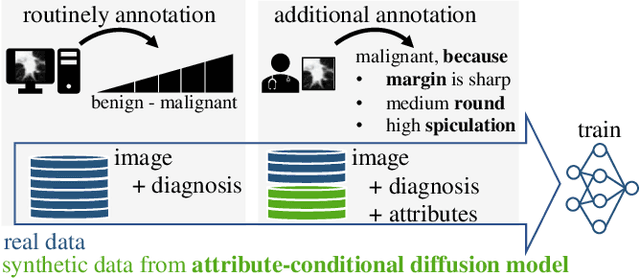
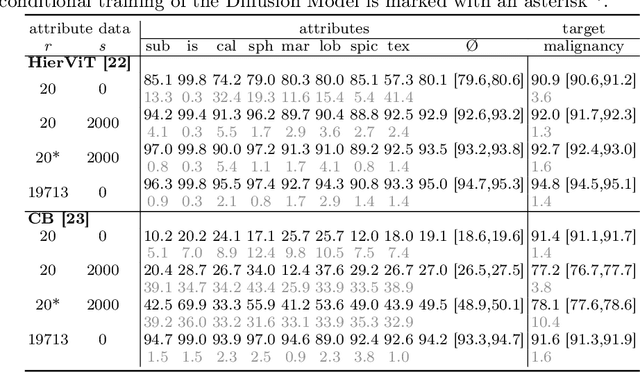
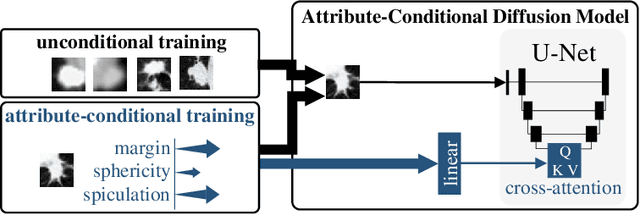
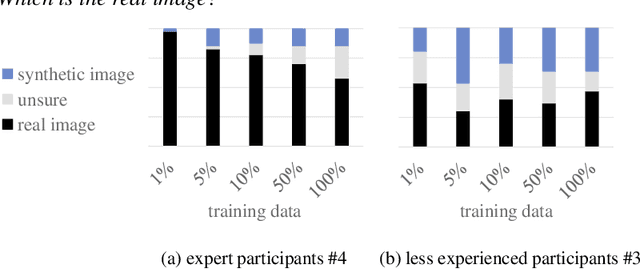
Classification models that provide human-interpretable explanations enhance clinicians' trust and usability in medical image diagnosis. One research focus is the integration and prediction of pathology-related visual attributes used by radiologists alongside the diagnosis, aligning AI decision-making with clinical reasoning. Radiologists use attributes like shape and texture as established diagnostic criteria and mirroring these in AI decision-making both enhances transparency and enables explicit validation of model outputs. However, the adoption of such models is limited by the scarcity of large-scale medical image datasets annotated with these attributes. To address this challenge, we propose synthesizing attribute-annotated data using a generative model. We enhance the Diffusion Model with attribute conditioning and train it using only 20 attribute-labeled lung nodule samples from the LIDC-IDRI dataset. Incorporating its generated images into the training of an explainable model boosts performance, increasing attribute prediction accuracy by 13.4% and target prediction accuracy by 1.8% compared to training with only the small real attribute-annotated dataset. This work highlights the potential of synthetic data to overcome dataset limitations, enhancing the applicability of explainable models in medical image analysis.
Multi-Attention Stacked Ensemble for Lung Cancer Detection in CT Scans
Jul 27, 2025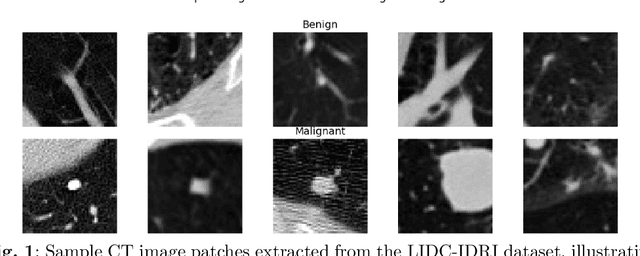
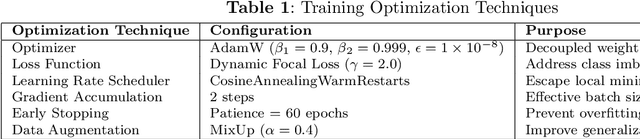
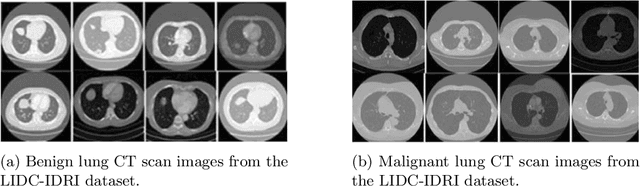

In this work, we address the challenge of binary lung nodule classification (benign vs malignant) using CT images by proposing a multi-level attention stacked ensemble of deep neural networks. Three pretrained backbones - EfficientNet V2 S, MobileViT XXS, and DenseNet201 - are each adapted with a custom classification head tailored to 96 x 96 pixel inputs. A two-stage attention mechanism learns both model-wise and class-wise importance scores from concatenated logits, and a lightweight meta-learner refines the final prediction. To mitigate class imbalance and improve generalization, we employ dynamic focal loss with empirically calculated class weights, MixUp augmentation during training, and test-time augmentation at inference. Experiments on the LIDC-IDRI dataset demonstrate exceptional performance, achieving 98.09 accuracy and 0.9961 AUC, representing a 35 percent reduction in error rate compared to state-of-the-art methods. The model exhibits balanced performance across sensitivity (98.73) and specificity (98.96), with particularly strong results on challenging cases where radiologist disagreement was high. Statistical significance testing confirms the robustness of these improvements across multiple experimental runs. Our approach can serve as a robust, automated aid for radiologists in lung cancer screening.