 Add to Chrome
 Add to Firefox
 Add to Edge
SRNN: Spatiotemporal Relational Neural Network for Intuitive Physics Understanding
Paper and Code
Nov 19, 2025
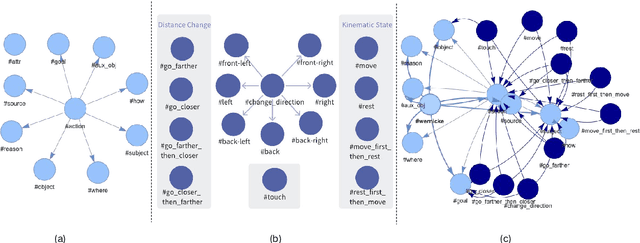
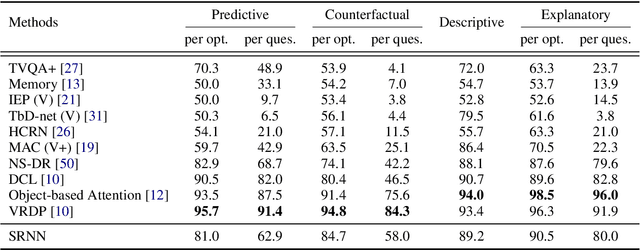
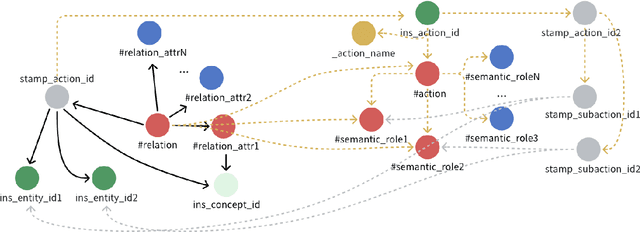
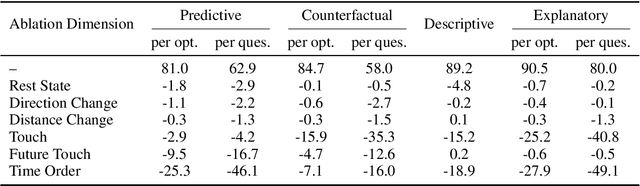
Human prowess in intuitive physics remains unmatched by machines. To bridge this gap, we argue for a fundamental shift towards brain-inspired computational principles. This paper introduces the Spatiotemporal Relational Neural Network (SRNN), a model that establishes a unified neural representation for object attributes, relations, and timeline, with computations governed by a Hebbian ``Fire Together, Wire Together'' mechanism across dedicated \textit{What} and \textit{How} pathways. This unified representation is directly used to generate structured linguistic descriptions of the visual scene, bridging perception and language within a shared neural substrate. On the CLEVRER benchmark, SRNN achieves competitive performance, thereby confirming its capability to represent essential spatiotemporal relations from the visual stream. Cognitive ablation analysis further reveals a benchmark bias, outlining a path for a more holistic evaluation. Finally, the white-box nature of SRNN enables precise pinpointing of error root causes. Our work provides a proof-of-concept that confirms the viability of translating key principles of biological intelligence into engineered systems for intuitive physics understanding in constrained environments.
