 Add to Chrome
 Add to Firefox
 Add to Edge
Near-Field Position and Orientation Tracking With Hybrid ELAA Architecture
Paper and Code
Dec 19, 2025
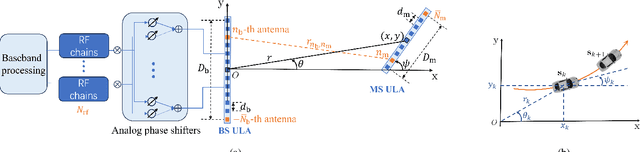
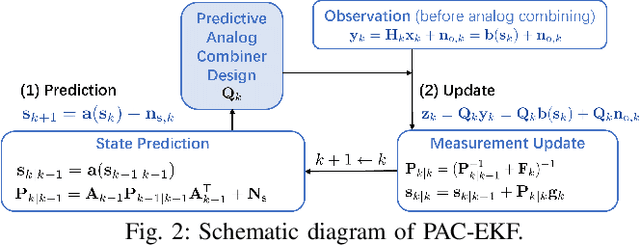
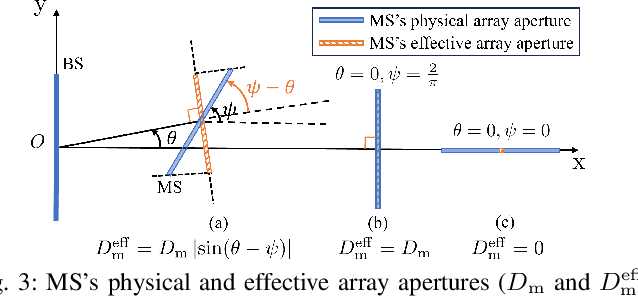
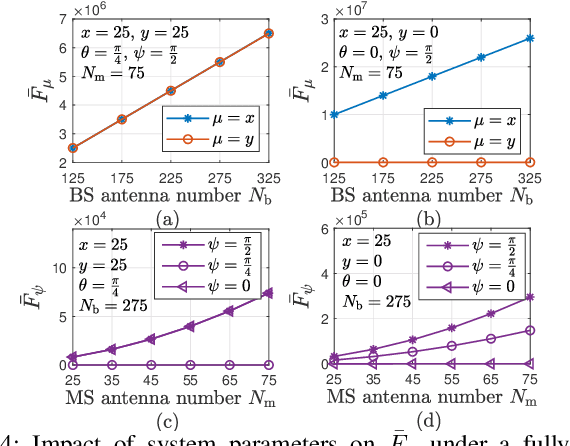
This paper investigates near-field (NF) position and orientation tracking of a multi-antenna mobile station (MS) using an extremely large antenna array (ELAA)-equipped base station (BS) with a limited number of radio frequency (RF) chains. Under this hybrid array architecture, the received uplink pilot signal at the BS is first combined by analog phase shifters, producing a low-dimensional observation before digital processing. Such analog compression provides only partial access to the ELAA measurement, making it essential to design an analog combiner that can preserve pose-relevant signal components despite channel uncertainty and unit-modulus hardware constraints. To address this, we propose a predictive analog combining-assisted extended Kalman filter (PAC-EKF) framework, where the analog combiner can leverage the temporal correlation in the MS pose variation to capture the most informative signal components predictively. We then analyze fundamental performance limits via Bayesian Cramér-Rao bound and Fisher information matrix, explicitly quantifying how the analog combiner, array size, signal-to-noise ratio, and MS pose influence the pose information contained in the uplink observation. Building on these insights, we develop two methods for designing a low-complexity analog combiner. Numerical results show that the proposed predictive analog combining approach significantly improves tracking accuracy, even with fewer RF chains and lower transmit power.
