 Add to Chrome
 Add to Firefox
 Add to Edge
Navigating the Reality Gap: Privacy-Preserving Adaptation of ASR for Challenging Low-Resource Domains
Paper and Code
Dec 22, 2025
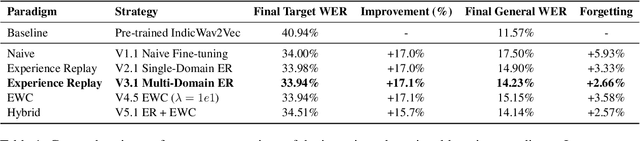
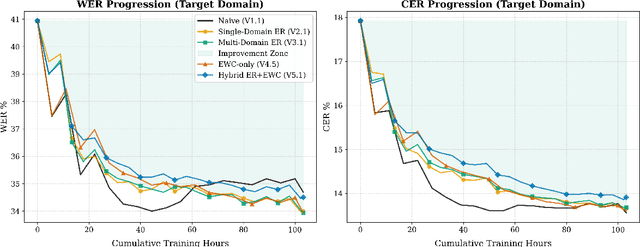
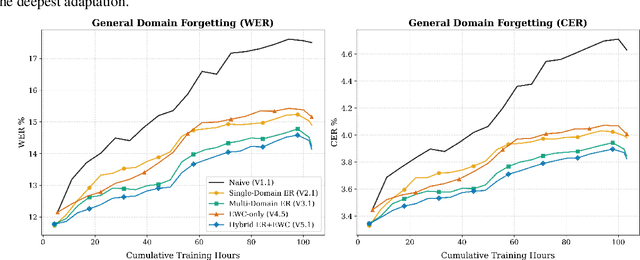
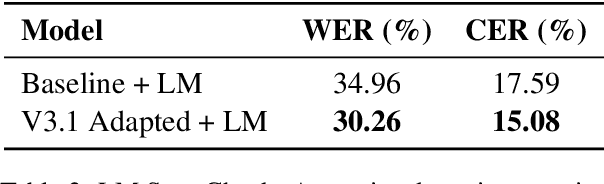
Automatic Speech Recognition (ASR) holds immense potential to assist in clinical documentation and patient report generation, particularly in resource-constrained regions. However, deployment is currently hindered by a technical deadlock: a severe "Reality Gap" between laboratory performance and noisy, real-world clinical audio, coupled with strict privacy and resource constraints. We quantify this gap, showing that a robust multilingual model (IndicWav2Vec) degrades to a 40.94% WER on rural clinical data from India, rendering it unusable. To address this, we explore a zero-data-exfiltration framework enabling localized, continual adaptation via Low-Rank Adaptation (LoRA). We conduct a rigorous investigative study of continual learning strategies, characterizing the trade-offs between data-driven and parameter-driven stability. Our results demonstrate that multi-domain Experience Replay (ER) yields the primary performance gains, achieving a 17.1% relative improvement in target WER and reducing catastrophic forgetting by 55% compared to naive adaptation. Furthermore, we observed that standard Elastic Weight Consolidation (EWC) faced numerical stability challenges when applied to LoRA in noisy environments. Our experiments show that a stabilized, linearized formulation effectively controls gradient magnitudes and enables stable convergence. Finally, we verify via a domain-specific spot check that acoustic adaptation is a fundamental prerequisite for usability which cannot be bypassed by language models alone.
