 Add to Chrome
 Add to Firefox
 Add to Edge
Fail Fast, Win Big: Rethinking the Drafting Strategy in Speculative Decoding via Diffusion LLMs
Paper and Code

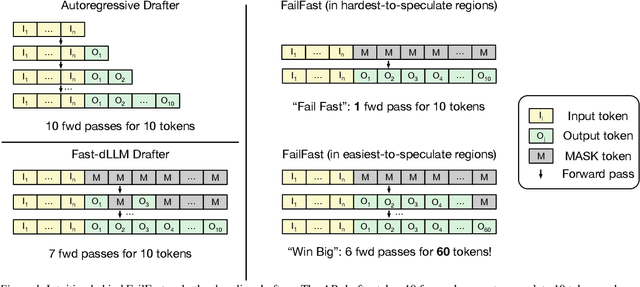
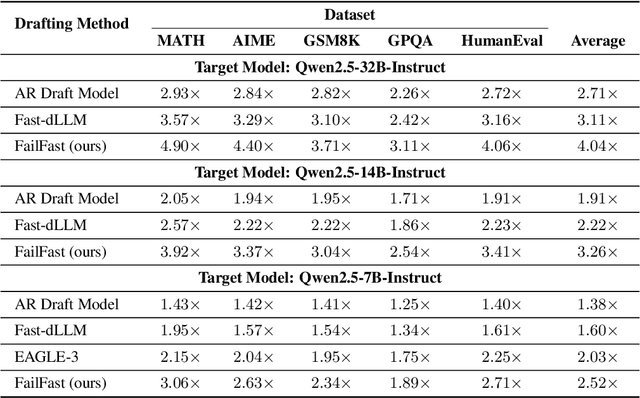
Diffusion Large Language Models (dLLMs) offer fast, parallel token generation, but their standalone use is plagued by an inherent efficiency-quality tradeoff. We show that, if carefully applied, the attributes of dLLMs can actually be a strength for drafters in speculative decoding with autoregressive (AR) verifiers. Our core insight is that dLLM's speed from parallel decoding drastically lowers the risk of costly rejections, providing a practical mechanism to effectively realize the (elusive) lengthy drafts that lead to large speedups with speculative decoding. We present FailFast, a dLLM-based speculative decoding framework that realizes this approach by dynamically adapting its speculation length. It "fails fast" by spending minimal compute in hard-to-speculate regions to shrink speculation latency and "wins big" by aggressively extending draft lengths in easier regions to reduce verification latency (in many cases, speculating and accepting 70 tokens at a time!). Without any fine-tuning, FailFast delivers lossless acceleration of AR LLMs and achieves up to 4.9$\times$ speedup over vanilla decoding, 1.7$\times$ over the best naive dLLM drafter, and 1.4$\times$ over EAGLE-3 across diverse models and workloads. We open-source FailFast at https://github.com/ruipeterpan/failfast.
