 Add to Chrome
 Add to Firefox
 Add to Edge
Enhancing Physical Layer Security in MIMO Systems Assisted by Beyond-Diagonal Reconfigurable Intelligent Surfaces
Paper and Code
Nov 19, 2025
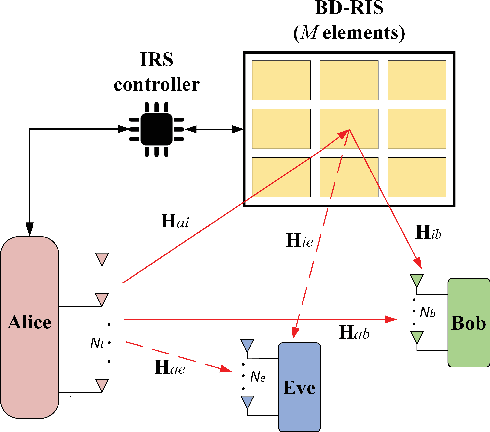
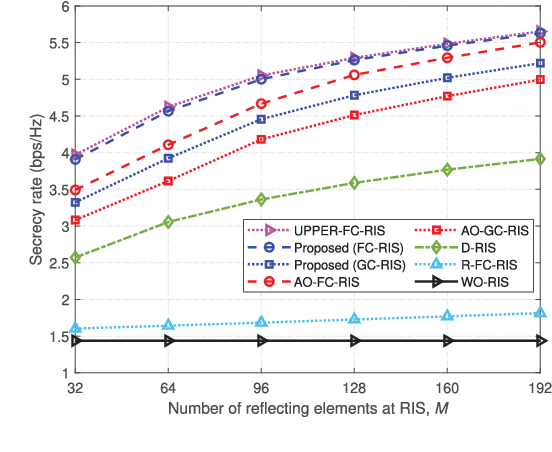
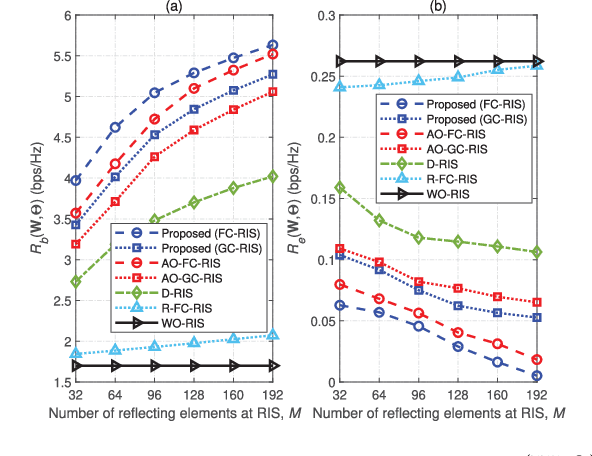
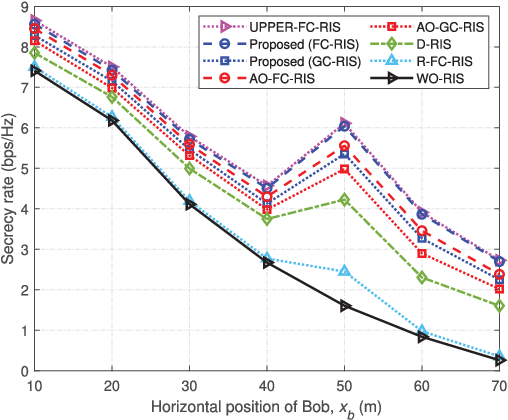
Reconfigurable intelligent surfaces (RISs) hold significant promise for enhancing physical layer security (PLS). However, conventional RISs are typically modeled using diagonal scattering matrices, capturing only independent reflections from each reflecting element, which limits their flexibility in channel manipulation. In contrast, beyond-diagonal RISs (BD-RISs) employ non-diagonal scattering matrices enabled by active and tunable inter-element connections through a shared impedance network. This architecture significantly enhances channel shaping capabilities, creating new opportunities for advanced PLS techniques. This paper investigates PLS in a multiple-input multiple-output (MIMO) system assisted by BD-RISs, where a multi-antenna transmitter sends confidential information to a multi-antenna legitimate user while a multi-antenna eavesdropper attempts interception. To maximize the secrecy rate (SR), we formulate it as a non-convex optimization problem by jointly optimizing the transmit beamforming and BD-RIS REs under power and structural constraints. To solve this problem, we first introduce an auxiliary variable to decouple BD-RIS constraints. We then propose a low-complexity penalty product Riemannian conjugate gradient descent (P-PRCGD) method, which combines the augmented Lagrangian (AL) approach with the product manifold gradient descent (PMGD) method to obtain a Karush-Kuhn-Tucker (KKT) solution. Simulation results confirm that BD-RIS-assisted systems significantly outperform conventional RIS-assisted systems in PLS performance.
