 Add to Chrome
 Add to Firefox
 Add to Edge
Channel-Adaptive Robust Resource Allocation for Highly Reliable IRS-Assisted V2X Communications
Paper and Code
Apr 16, 2025
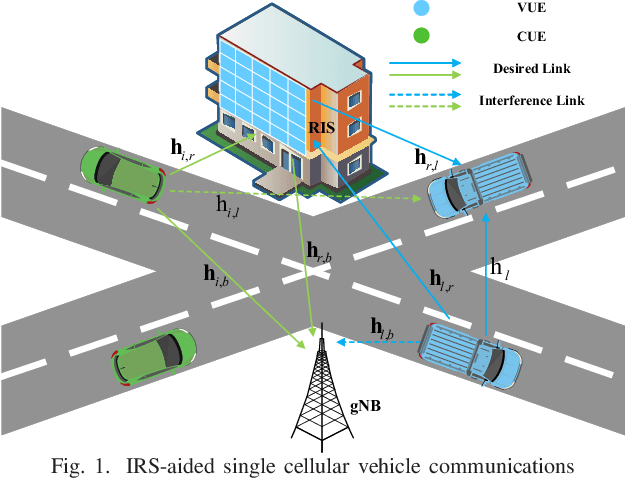
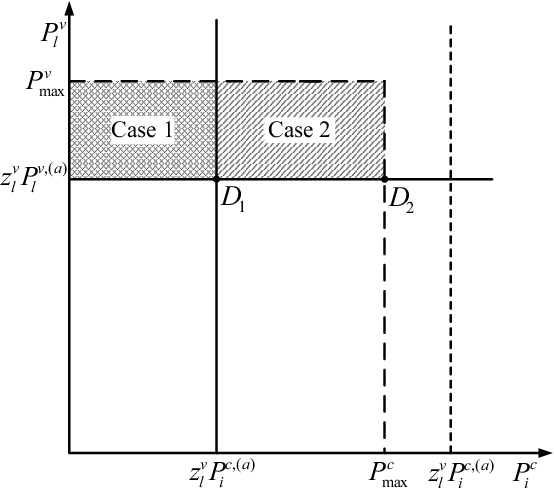
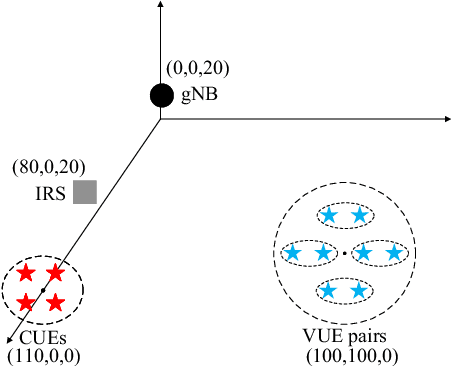
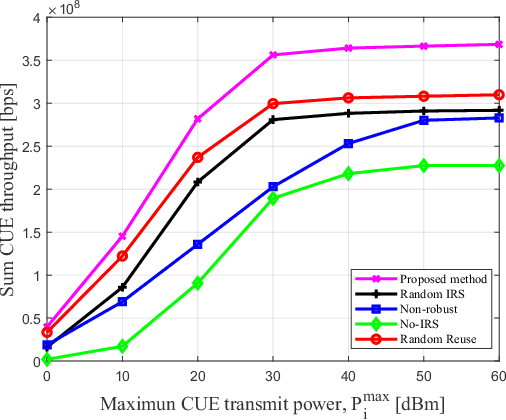
This paper addresses the challenges of resource allocation in vehicular networks enhanced by Intelligent Reflecting Surfaces (IRS), considering the uncertain Channel State Information (CSI) typical of vehicular environments due to the Doppler shift. Leveraging the 3GPP's Mode 1 cellular V2X architecture, our system model facilitates efficient subcarrier usage and interference reduction through coordinated V2I and V2V communications. Each Cellular User Equipment (CUE) shares its spectrum with at most one Vehicular User Equipment (VUE) in a one-to-one reuse pattern. We formulate a joint optimization problem for vehicular transmit power, Multi-User Detection (MUD) matrices, V2V link spectrum reuse, and IRS reflection coefficients in IRS-aided V2X communication with imperfect CSI. To tackle this, a novel robust resource allocation algorithm is developed by first decomposing the problem into manageable sub-problems such as power allocation, MUD matrices optimization and IRS phase shifts, and then using the Block Coordinate Descent (BCD) method to alternately optimize these subproblems for optimal resource allocation. Our contributions include efficient approaches for self-learning based power allocation and phase shift optimization that adapt to CSI uncertainties, significantly enhancing the reliability and efficiency of vehicular communications. Simulation results validate the effectiveness of the proposed solutions in improving the Quality of Service (QoS) and managing the complex interference inherent in dense vehicular networks.
