 Add to Chrome
 Add to Firefox
 Add to Edge
Affine Frequency Division Multiplexing: From Communication to Sensing
Paper and Code
Nov 06, 2025
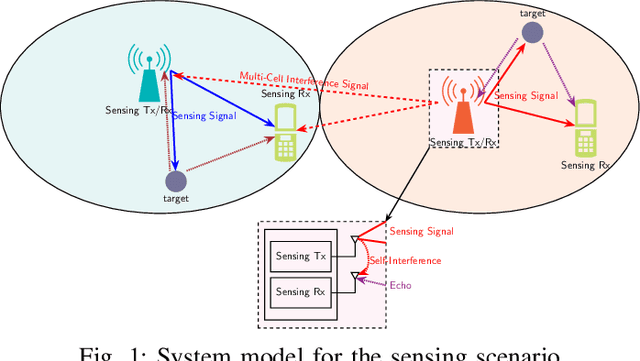
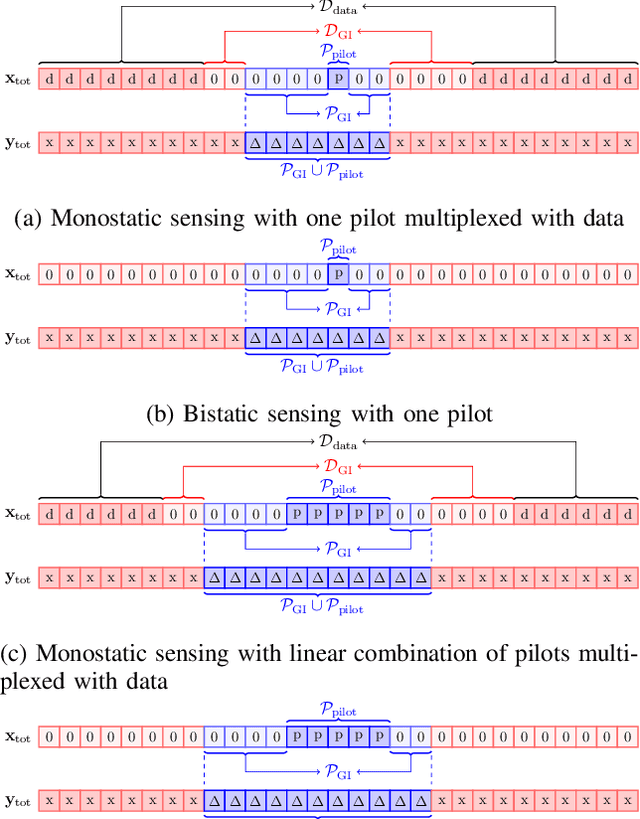
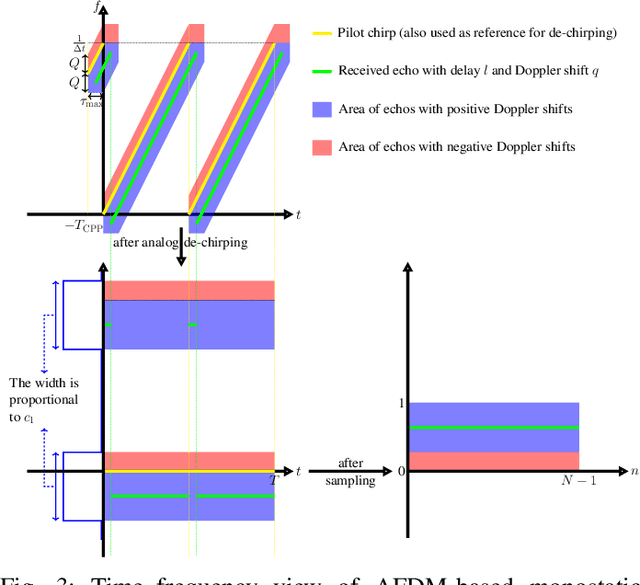
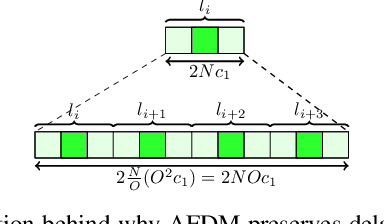
Affine Frequency Division Multiplexing (AFDM) has been proposed as an effective waveform for achieving the full diversity of doubly-dispersive (delay-Doppler) channels. While this property is closely related to range and velocity estimation in sensing, this article focuses on other AFDM features that are particularly relevant for addressing two challenges in integrated sensing and communication (ISAC) systems: (1) maintaining receiver complexity and energy consumption at acceptable levels while supporting the large bandwidths required for high delay/range resolution, and (2) mitigating interference in multiradar environments. In monostatic sensing, where direct transmitter-receiver leakage is a major impairment, we show that AFDM-based ISAC receivers can address the first challenge through their compatibility with low-complexity self-interference cancellation (SIC) schemes and reduced sampling rates via analog dechirping. In bistatic sensing, where such analog solutions may not be feasible, we demonstrate that AFDM supports sub-Nyquist sampling without requiring hardware modifications while preserving delay resolution. Finally, we show that the second challenge can be addressed by leveraging the resource-assignment flexibility of the discrete affine Fourier transform (DAFT) underlying the AFDM waveform.
