 Add to Chrome
 Add to Firefox
 Add to Edge
Transparent and Resilient Activity Recognition via Attention-Based Distributed Radar Sensing
Jan 06, 2026
Distributed radar sensors enable robust human activity recognition. However, scaling the number of coordinated nodes introduces challenges in feature extraction from large datasets, and transparent data fusion. We propose an end-to-end framework that operates directly on raw radar data. Each radar node employs a lightweight 2D Convolutional Neural Network (CNN) to extract local features. A self-attention fusion block then models inter-node relationships and performs adaptive information fusion. Local feature extraction reduces the input dimensionality by up to 480x. This significantly lowers communication overhead and latency. The attention mechanism provides inherent interpretability by quantifying the contribution of each radar node. A hybrid supervised contrastive loss further improves feature separability, especially for fine-grained and imbalanced activity classes. Experiments on real-world distributed Ultra Wide Band (UWB) radar data demonstrate that the proposed method reduces model complexity by 70.8\%, while achieving higher average accuracy than baseline approaches. Overall, the framework enables transparent, efficient, and low-overhead distributed radar sensing.

Single Antenna Tracking and Localization of RIS-enabled Vehicular Users
Nov 23, 2024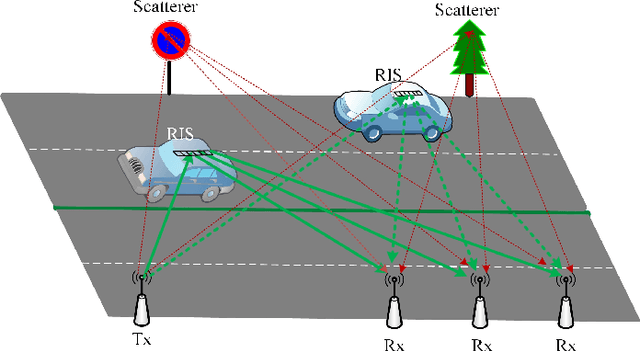


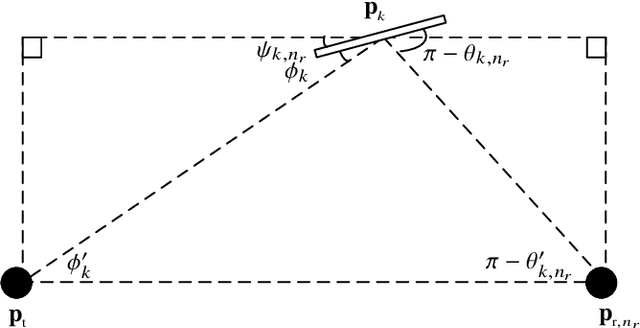
Reconfigurable Intelligent Surfaces (RISs) are envisioned to be employed in next generation wireless networks to enhance the communication and radio localization services. In this paper, we propose novel localization and tracking algorithms exploiting reflections through RISs at multiple receivers. We utilize a single antenna transmitter (Tx) and multiple single antenna receivers (Rxs) to estimate the position and the velocity of users (e.g. vehicles) equipped with RISs. Then, we design the RIS phase shifts to separate the signals from different users. The proposed algorithms exploit the geometry information of the signal at the RISs to localize and track the users. We also conduct a comprehensive analysis of the Cramer-Rao lower bound (CRLB) of the localization system. Compared to the time of arrival (ToA)-based localization approach, the proposed method reduces the localization error by a factor up to three. Also, the simulation results show the accuracy of the proposed tracking approach.
MU-Massive MIMO with Multiple RISs: SINR Maximization and Asymptotic Analysis
Mar 07, 2023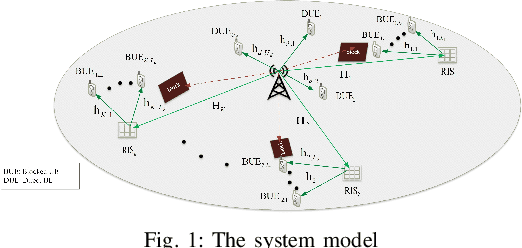
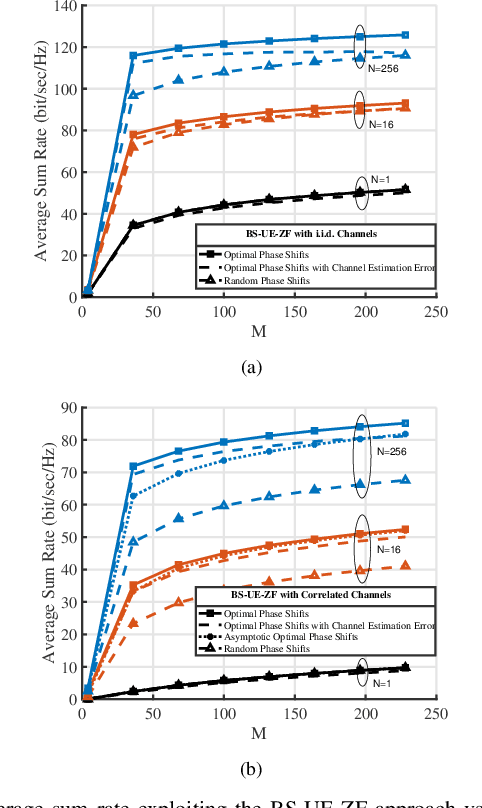

In this letter, we investigate the signal-to-interference-plus-noise-ratio (SINR) maximization problem in a multi-user massive multiple-input-multiple-output (massive MIMO) system enabled with multiple reconfigurable intelligent surfaces (RISs). We examine two zero-forcing (ZF) beamforming approaches for interference management namely BS-UE-ZF and BS-RIS-ZF that enforce the interference to zero at the users (UEs) and the RISs, respectively.Then, for each case, we resolve the SINR maximization problem to find the optimal phase shifts of the elements of the RISs. Also, we evaluate the asymptotic expressions for the optimal phase shifts and the maximum SINRs when the number of the base station (BS) antennas tends to infinity. We show that if the channels of the RIS elements are independent and the number of the BS antennas tends to infinity, random phase shifts achieve the maximum SINR using the BS-UE-ZF beamforming approach. The simulation results illustrate that by employing the BS-RIS-ZF beamforming approach, the asymptotic expressions of the phase shifts and maximum SINRs achieve the rate obtained by the optimal phase shifts even for a small number of the BS antennas.