 Add to Chrome
 Add to Firefox
 Add to Edge
Alignment has a Fantasia Problem
Apr 23, 2026
Modern AI assistants are trained to follow instructions, implicitly assuming that users can clearly articulate their goals and the kind of assistance they need. Decades of behavioral research, however, show that people often engage with AI systems before their goals are fully formed. When AI systems treat prompts as complete expressions of intent, they can appear to be useful or convenient, but not necessarily aligned with the users' needs. We call these failures Fantasia interactions. We argue that Fantasia interactions demand a rethinking of alignment research: rather than treating users as rational oracles, AI should provide cognitive support by actively helping users form and refine their intent through time. This requires an interdisciplinary approach that bridges machine learning, interface design, and behavioral science. We synthesize insights from these fields to characterize the mechanisms and failures of Fantasia interactions. We then show why existing interventions are insufficient, and propose a research agenda for designing and evaluating AI systems that better help humans navigate uncertainty in their tasks.
* 9 pages, 2 figures

Creo: From One-Shot Image Generation to Progressive, Co-Creative Ideation
Apr 15, 2026Text-to-image (T2I) systems enable rapid generation of high-fidelity imagery but are misaligned with how visual ideas develop. T2I systems generate outputs that make implicit visual decisions on behalf of the user, often introduce fine-grained details that can anchor users prematurely and limit their ability to keep options open early on, and cause unintended changes during editing that are difficult to correct and reduce users' sense of control. To address these concerns, we present Creo, a multi-stage T2I system that scaffolds image generation by progressing from rough sketches to high-resolution outputs, exposing intermediary abstractions where users can make incremental changes. Sketch-like abstractions invite user editing and allow users to keep design options open when ideas are still forming due to their provisional nature. Each stage in Creo can be modified with manual changes and AI-assisted operations, enabling fine-grained, step-wise control through a locking mechanism that preserves prior decisions so subsequent edits affect only specified regions or attributes. Users remain in the loop, making and verifying decisions across stages, while the system applies diffs instead of regenerating full images, reducing drift as fidelity increases. A comparative study with a one-shot baseline shows that participants felt stronger ownership over Creo outputs, as they were able to trace their decisions in building up the image. Furthermore, embedding-based analysis indicates that Creo outputs are less homogeneous than one-shot results. These findings suggest that multi-stage generation, combined with intermediate control and decision locking, is a key design principle for improving controllability, user agency, creativity, and output diversity in generative systems.
Window to Wall Ratio Detection using SegFormer
Jun 04, 2024
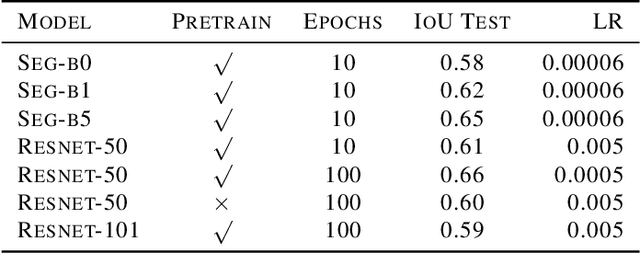

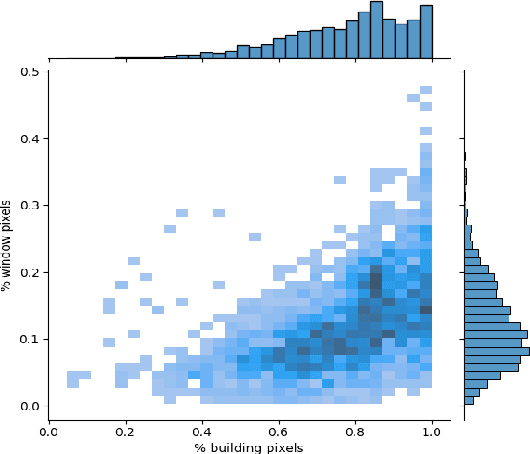
Window to Wall Ratios (WWR) are key to assessing the energy, daylight and ventilation performance of buildings. Studies have shown that window area has a large impact on building performance and simulation. However, data to set up these environmental models and simulations is typically not available. Instead, a standard 40% WWR is typically assumed for all buildings. This paper leverages existing computer vision window detection methods to predict WWR of buildings from external street view images using semantic segmentation, demonstrating the potential for adapting established computer vision technique in architectural applications
What is a Fair Diffusion Model? Designing Generative Text-To-Image Models to Incorporate Various Worldviews
Sep 18, 2023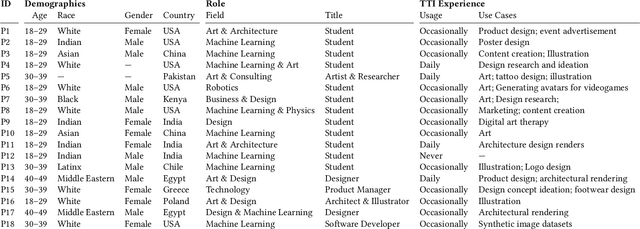
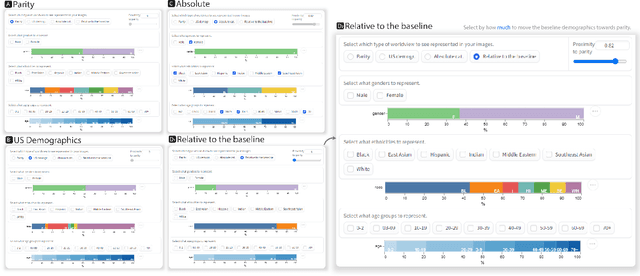
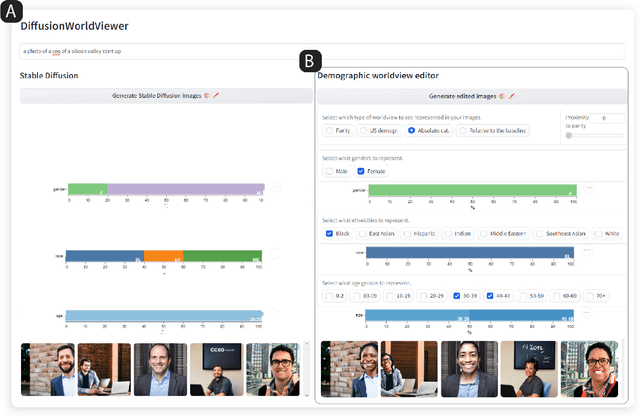
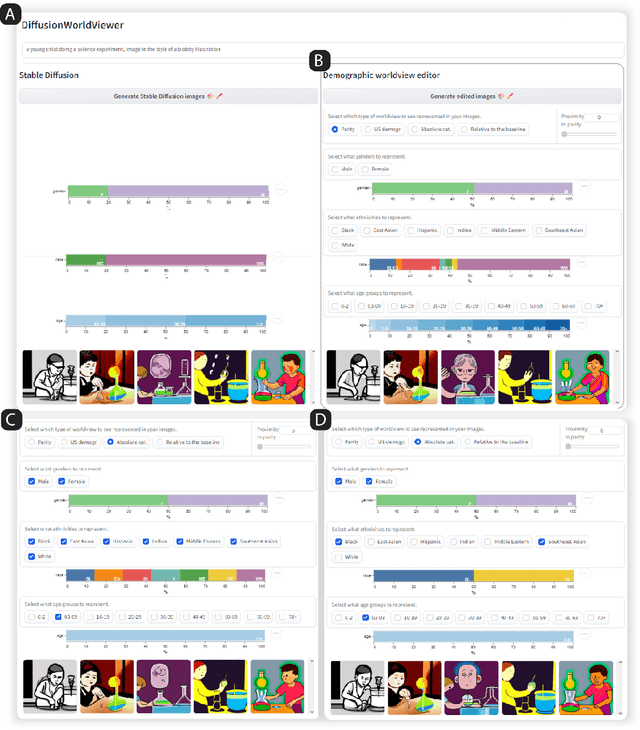
Generative text-to-image (GTI) models produce high-quality images from short textual descriptions and are widely used in academic and creative domains. However, GTI models frequently amplify biases from their training data, often producing prejudiced or stereotypical images. Yet, current bias mitigation strategies are limited and primarily focus on enforcing gender parity across occupations. To enhance GTI bias mitigation, we introduce DiffusionWorldViewer, a tool to analyze and manipulate GTI models' attitudes, values, stories, and expectations of the world that impact its generated images. Through an interactive interface deployed as a web-based GUI and Jupyter Notebook plugin, DiffusionWorldViewer categorizes existing demographics of GTI-generated images and provides interactive methods to align image demographics with user worldviews. In a study with 13 GTI users, we find that DiffusionWorldViewer allows users to represent their varied viewpoints about what GTI outputs are fair and, in doing so, challenges current notions of fairness that assume a universal worldview.