 Add to Chrome
 Add to Firefox
 Add to Edge
ALADIN:Attribute-Language Distillation Network for Person Re-Identification
Mar 23, 2026
Recent vision-language models such as CLIP provide strong cross-modal alignment, but current CLIP-guided ReID pipelines rely on global features and fixed prompts. This limits their ability to capture fine-grained attribute cues and adapt to diverse appearances. We propose ALADIN, an attribute-language distillation network that distills knowledge from a frozen CLIP teacher to a lightweight ReID student. ALADIN introduces fine-grained attribute-local alignment to establish adaptive text-visual correspondence and robust representation learning. A Scene-Aware Prompt Generator produces image-specific soft prompts to facilitate adaptive alignment. Attribute-local distillation enforces consistency between textual attributes and local visual features, significantly enhancing robustness under occlusions. Furthermore, we employ cross-modal contrastive and relation distillation to preserve the inherent structural relationships among attributes. To provide precise supervision, we leverage Multimodal LLMs to generate structured attribute descriptions, which are then converted into localized attention maps via CLIP. At inference, only the student is used. Experiments on Market-1501, DukeMTMC-reID, and MSMT17 show improvements over CNN-, Transformer-, and CLIP-based methods, with better generalization and interpretability.

MetaMath: Integrating Natural Language and Code for Enhanced Mathematical Reasoning in Large Language Models
Sep 28, 2024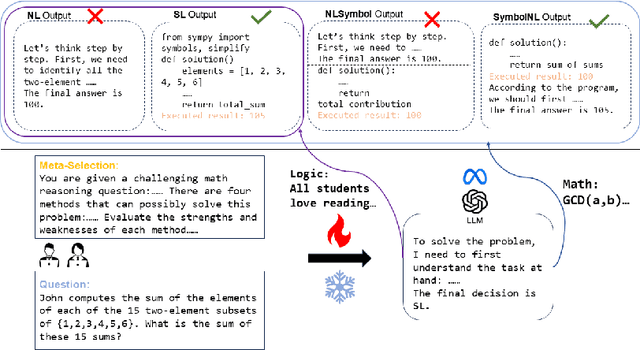
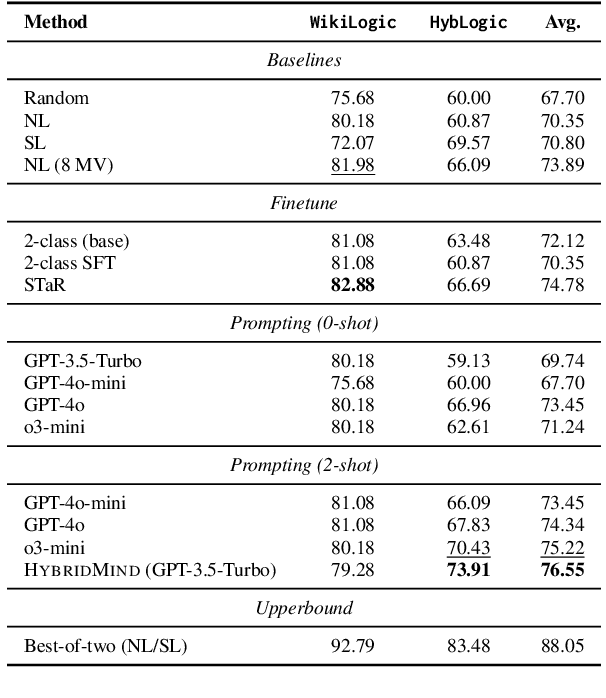
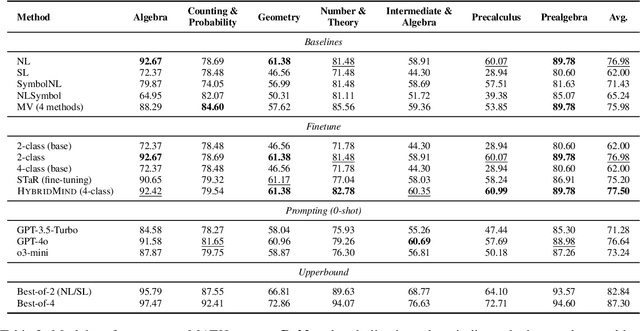
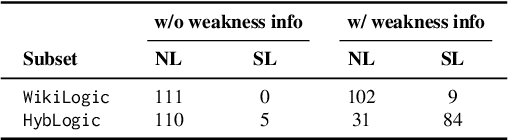
Large Language Models (LLMs) are commonly used to generate solutions for mathematical reasoning problems in the following formats: natural language, code, or a combination of both. In this paper, we explore fundamental questions related to solving mathematical reasoning problems using natural language and code with state-of-the-art LLMs, including GPT-4o-mini and LLama-3.1-8b-Turbo. Our findings show that LLMs are better at reasoning in natural language compared to code. Additionally, although natural language and code serve as complementary forms of reasoning, they can affect each other in a negative way in certain scenarios. These insights motivate our development of a new prompting method, MetaMath, which leverages an LLM to dynamically select the most appropriate reasoning form, resulting in improved performance over comparable baselines with GPT-4o-mini.