 Add to Chrome
 Add to Firefox
 Add to Edge
DP-BOA: Dirichlet-Process Birth-or-Assign for On-the-Fly Category Discovery
Jul 15, 2026
On-the-fly category discovery requires deciding for each incoming test sample whether to assign it to an existing category or spawn a new one. Existing methods typically implement this decision through matching-based heuristics, such as radius- or hash-based rules. While effective in practice, these methods usually treat category birth implicitly as a fallback when no existing category matches confidently, rather than as an explicit alternative supported by its own statistical evidence. To address this, we propose DP-BOA, a posterior-predictive decision framework based on an online Dirichlet-process Gaussian mixture model with a Normal-Inverse-Wishart prior. During training, we use labeled data to calibrate a shared NIW prior over category Gaussians and warm-start the known-category posteriors. At test time, for each incoming sample, DP-BOA compares the posterior predictive evidence for assignment to existing categories against the evidence for spawning a new category induced by the DP prior, and then updates category statistics online after the decision. The method captures anisotropic category geometry and naturally adapts decision confidence as evidence accumulates. Across standard OCD benchmarks, DP-BOA consistently outperforms strong baselines and delivers particularly strong novel-class discovery performance while maintaining competitive known-class accuracy.

Performance evaluation of Reddit Comments using Machine Learning and Natural Language Processing methods in Sentiment Analysis
May 28, 2024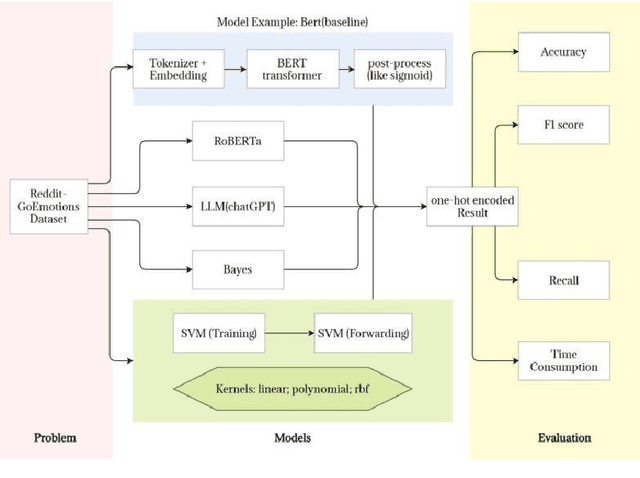

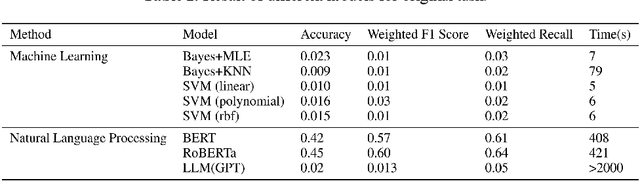
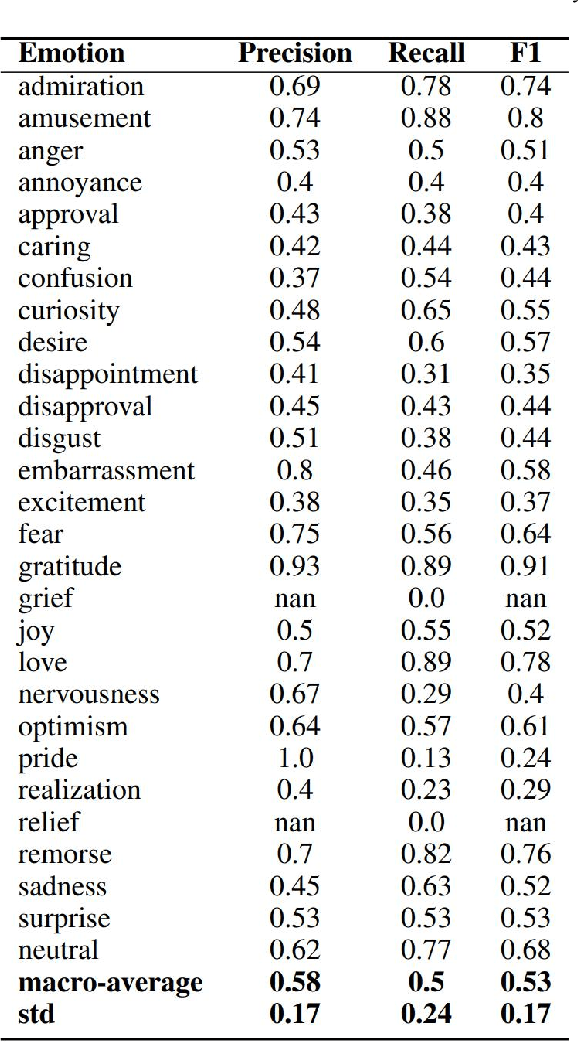
Sentiment analysis, an increasingly vital field in both academia and industry, plays a pivotal role in machine learning applications, particularly on social media platforms like Reddit. However, the efficacy of sentiment analysis models is hindered by the lack of expansive and fine-grained emotion datasets. To address this gap, our study leverages the GoEmotions dataset, comprising a diverse range of emotions, to evaluate sentiment analysis methods across a substantial corpus of 58,000 comments. Distinguished from prior studies by the Google team, which limited their analysis to only two models, our research expands the scope by evaluating a diverse array of models. We investigate the performance of traditional classifiers such as Naive Bayes and Support Vector Machines (SVM), as well as state-of-the-art transformer-based models including BERT, RoBERTa, and GPT. Furthermore, our evaluation criteria extend beyond accuracy to encompass nuanced assessments, including hierarchical classification based on varying levels of granularity in emotion categorization. Additionally, considerations such as computational efficiency are incorporated to provide a comprehensive evaluation framework. Our findings reveal that the RoBERTa model consistently outperforms the baseline models, demonstrating superior accuracy in fine-grained sentiment classification tasks. This underscores the substantial potential and significance of the RoBERTa model in advancing sentiment analysis capabilities.