 Add to Chrome
 Add to Firefox
 Add to Edge
DeepPAAC: A New Deep Galerkin Method for Principal-Agent Problems
Nov 06, 2025
We consider numerical resolution of principal-agent (PA) problems in continuous time. We formulate a generic PA model with continuous and lump payments and a multi-dimensional strategy of the agent. To tackle the resulting Hamilton-Jacobi-Bellman equation with an implicit Hamiltonian we develop a novel deep learning method: the Deep Principal-Agent Actor Critic (DeepPAAC) Actor-Critic algorithm. DeepPAAC is able to handle multi-dimensional states and controls, as well as constraints. We investigate the role of the neural network architecture, training designs, loss functions, etc. on the convergence of the solver, presenting five different case studies.

Convergence of the Backward Deep BSDE Method with Applications to Optimal Stopping Problems
Oct 08, 2022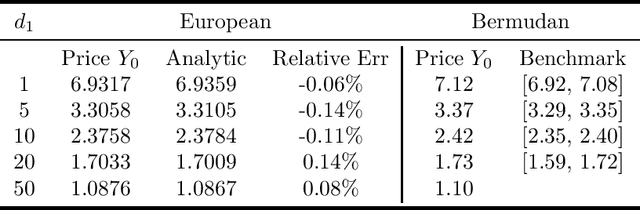
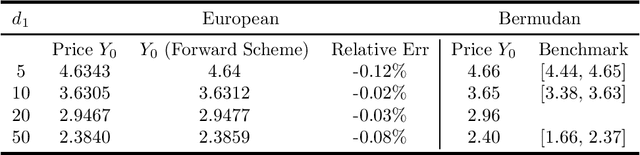
The optimal stopping problem is one of the core problems in financial markets, with broad applications such as pricing American and Bermudan options. The deep BSDE method [Han, Jentzen and E, PNAS, 115(34):8505-8510, 2018] has shown great power in solving high-dimensional forward-backward stochastic differential equations (FBSDEs), and inspired many applications. However, the method solves backward stochastic differential equations (BSDEs) in a forward manner, which can not be used for optimal stopping problems that in general require running BSDE backwardly. To overcome this difficulty, a recent paper [Wang, Chen, Sudjianto, Liu and Shen, arXiv:1807.06622, 2018] proposed the backward deep BSDE method to solve the optimal stopping problem. In this paper, we provide the rigorous theory for the backward deep BSDE method. Specifically, 1. We derive the a posteriori error estimation, i.e., the error of the numerical solution can be bounded by the training loss function; and; 2. We give an upper bound of the loss function, which can be sufficiently small subject to universal approximations. We give two numerical examples, which present consistent performance with the proved theory.