 Add to Chrome
 Add to Firefox
 Add to Edge
Lagrange: An Open-Vocabulary, Energy-Based Sparse Framework for Generalized End-to-End Driving
Jun 18, 2026
Scaling end-to-end autonomous driving to complex, open-world environments requires perceptual models that generalize to anomalous scenarios and planners that produce kinematically valid trajectories. Existing paradigms face a distinct dichotomy between representational efficiency and generalization capacity. Dense models (e.g., occupancy networks), while geometrically robust, incur critical computational bottlenecks and struggle with high-level semantic reasoning. Conversely, sparse, query-based planners are efficient but reliant on closed-set definitions, rendering them vulnerable to out-of-distribution (OOD) events. Although recent Vision-Language-Action (VLA) models offer open-vocabulary reasoning, their autoregressive, discrete token generation fundamentally conflicts with the continuous, high-frequency control requirements of vehicle dynamics. To address this, we propose Lagrange, an open-vocabulary, computationally sparse driving framework based on Masked Latent Fields (MLF). Rather than relying on dense volumetric reconstructions or closed-set query mechanisms, Lagrange exploits Vision-Language Models (VLMs) to encode class-agnostic object proposals into continuous semantic visual tokens. We introduce an intent-driven masked cross-attention module that temporally filters irrelevant entities, decoding the attended tokens into an implicit continuous energy field defined over spatial coordinates. By framing decision-making as a Lagrangian action minimization problem spanning this energy field, we enforce strict compliance with vehicle kinematics while executing collision avoidance. Extensive offline evaluations on both standard (nuScenes) and long-tail (CODA) benchmarks demonstrate that Lagrange establishes a promising framework for robust, interpretable, and kinematically feasible open-world autonomy.

Expected Value Alignment for Generative Reward Modeling in Formal Mathematics Verification
May 31, 2026Large Language Models (LLMs) are increasingly used with formal interactive theorem provers such as Lean 4. Scaling these systems with reinforcement learning or search methods requires process reward models (PRMs) that can evaluate intermediate reasoning steps. Existing reward-model designs expose a practical trade-off. Value-head models provide continuous scores but modify the generative model interface, while generative reward models preserve textual rationales but are poorly matched to continuous floating-point regression because numeric values are split across tokens. We introduce Expected Value Alignment (EVA), a reward-modeling procedure that keeps the surface output discrete while extracting continuous scores from the model's token distribution. The model emits integer scores in a structured JSON format, and EVA computes a continuous score as the expectation over the logits of the corresponding anchor tokens. Training combines the causal language modeling objective with an auxiliary mean squared error loss on these expected values. We instantiate EVA in \textit{Leibniz}, a reward model for Lean 4 formal verification, and evaluate it against zero-shot and reward-modeling baselines. The evaluation demonstrates that continuous logit-based scoring significantly reduces discretization artifacts while retaining the interpretability of generative critiques.
Soft-NBCE: Entropy-Weighted Chunk Fusion for Long-Context
May 31, 2026The quadratic complexity of self-attention remains a bottleneck for Large Language Models (LLMs) processing ultra-long contexts. The Naive Bayes Cognitive Engine (NBCE) parallelizes long-context inference by chunking documents and routing to the lowest-entropy chunk at each decoding step. This hard-selection strategy causes semantic fragmentation during cross-chunk reasoning, as abrupt routing changes between adjacent tokens disrupt the model's contextual grounding. We present Soft-NBCE, a lightweight extension that replaces discrete chunk selection with soft entropy-weighted chunk fusion. A temperature-scaled Softmax over predictive entropies assigns continuous weights to all chunks, enabling log-space aggregation across chunk-conditioned distributions. To partially compensate for the conditional independence assumption introduced by chunking, we propose Consistency Distillation, a LoRA-based self-distillation that constrains the chunked logit distribution toward a full-context teacher via KL-divergence. On LongBench multi-hop benchmarks, Soft-NBCE with Consistency Distillation improves consistently over NBCE-style baselines (MuSiQue F1: 0.310 vs.\ 0.275 for Vanilla NBCE; HotpotQA F1: 0.479 vs.\ 0.427) while maintaining retrieval accuracy (NIAH-32K: 0.909) at O(L^2/n) peak memory.
OpenGrok: Enhancing SNS Data Processing with Distilled Knowledge and Mask-like Mechanisms
Feb 11, 2025This report details Lumen Labs' novel approach to processing Social Networking Service (SNS) data. We leverage knowledge distillation, specifically a simple distillation method inspired by DeepSeek-R1's CoT acquisition, combined with prompt hacking, to extract valuable training data from the Grok model. This data is then used to fine-tune a Phi-3-mini model, augmented with a mask-like mechanism specifically designed for handling the nuances of SNS data. Our method demonstrates state-of-the-art (SOTA) performance on several SNS data processing tasks, outperforming existing models like Grok, Phi-3, and GPT-4. We provide a comprehensive analysis of our approach, including mathematical formulations, engineering details, ablation studies, and comparative evaluations.
Enhancing Large Language Model Efficiencyvia Symbolic Compression: A Formal Approach Towards Interpretability
Jan 30, 2025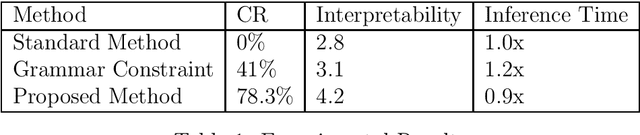
Large language models (LLMs) face significant token efficiency bottlenecks in code generation and logical reasoning tasks, a challenge that directly impacts inference cost and model interpretability. This paper proposes a formal framework based on symbolic compression,integrating combinatory logic, information-theoretic optimal encoding, and context-aware inference techniques to achieve a step-change improvement in token efficiency while preserving semantic integrity. We establish a mathematical framework within a functional programming paradigm, derive the quantitative relationship between symbolic density and model interpretability, and propose a differentiable compression factor metric to evaluate encoding efficiency. Furthermore, we leverage parameter-efficient fine-tuning (PEFT) techniques to achieve a low-cost application of the GAEL language. Experimental results show that this method achieves a 78.3% token compression rate in code generation tasks while improving logical traceability by 62% through structural explicitness. This research provides new theoretical tools for efficient inference in LLMs and opens a symbolic path for modelinterpretability research.
Chinese Stock Prediction Based on a Multi-Modal Transformer Framework: Macro-Micro Information Fusion
Jan 28, 2025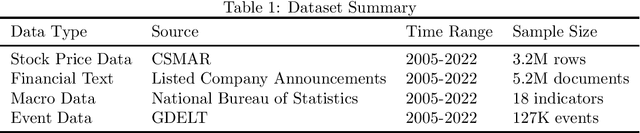
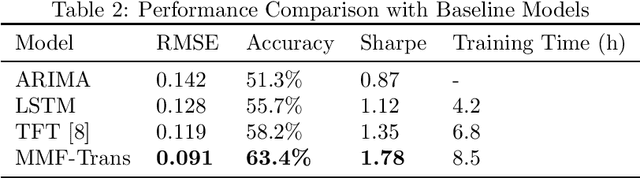
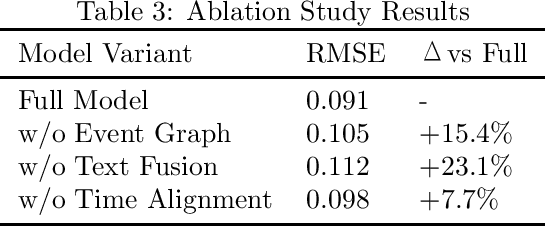
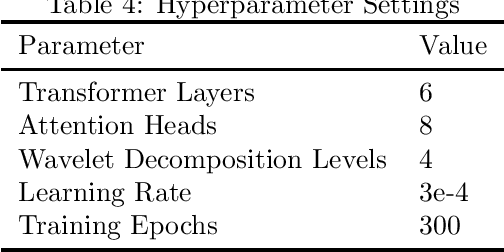
This paper proposes an innovative Multi-Modal Transformer framework (MMF-Trans) designed to significantly improve the prediction accuracy of the Chinese stock market by integrating multi-source heterogeneous information including macroeconomy, micro-market, financial text, and event knowledge. The framework consists of four core modules: (1) A four-channel parallel encoder that processes technical indicators, financial text, macro data, and event knowledge graph respectively for independent feature extraction of multi-modal data; (2) A dynamic gated cross-modal fusion mechanism that adaptively learns the importance of different modalities through differentiable weight allocation for effective information integration; (3) A time-aligned mixed-frequency processing layer that uses an innovative position encoding method to effectively fuse data of different time frequencies and solves the time alignment problem of heterogeneous data; (4) A graph attention-based event impact quantification module that captures the dynamic impact of events on the market through event knowledge graph and quantifies the event impact coefficient. We introduce a hybrid-frequency Transformer and Event2Vec algorithm to effectively fuse data of different frequencies and quantify the event impact. Experimental results show that in the prediction task of CSI 300 constituent stocks, the root mean square error (RMSE) of the MMF-Trans framework is reduced by 23.7% compared to the baseline model, the event response prediction accuracy is improved by 41.2%, and the Sharpe ratio is improved by 32.6%.