 Add to Chrome
 Add to Firefox
 Add to Edge
Fast Trainable Multilinear Bases for Image Compression
Jul 26, 2026
The Discrete Fourier Transform, the Discrete Cosine Transform, and their block-wise variants underpin most deployed image and video codecs. Their effectiveness rests on three properties: they run in near-linear time (linear up to a polylogarithmic factor), they are exactly invertible, and they carry few to no parameters. In this work, we generalize these bases to isometric multilinear bases, allowing a small number of extra parameters, polylogarithmic in the image size, while preserving all three properties. Given an image dataset, we develop a systematic framework that searches this family for the basis compressing the dataset most effectively: the basis is parameterized as an isometric tensor network, inspired by quantum many-body theory, and trained with Riemannian optimization on the manifold of unitary matrices. Across natural photographs and line drawings, the trained bases consistently improve on their fixed, non-parametric counterparts. On Quick Draw line-drawing compression, they store images in roughly $20\%$ fewer bytes than JPEG's $8 \times 8$ block cosine transform at the same reconstruction quality.

Sampling of Correlated Bandlimited Continuous Signals by Joint Time-vertex Graph Fourier Transform
Oct 10, 2022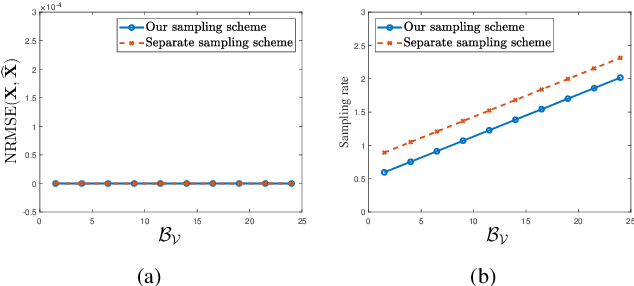
When sampling multiple signals, the correlation between the signals can be exploited to reduce the overall number of samples. In this paper, we study the sampling theory of multiple correlated signals, using correlation to sample them at the lowest sampling rate. Based on the correlation between signal sources, we model multiple continuous-time signals as continuous time-vertex graph signals. The graph signals are projected onto orthogonal bases to remove spatial correlation and reduce dimensions by graph Fourier transform. When the bandwidths of the original signals and the reduced dimension signals are given, we prove the minimum sampling rate required for recovery of the original signals, and propose a feasible sampling scheme.