 Add to Chrome
 Add to Firefox
 Add to Edge
A Unified Backbone--Expert Framework with Relation-Token and Residual--Classifier Interfaces for Automatic Modulation Recognition
Aug 15, 2026
Automatic modulation recognition (AMR) faces distinct representation bottlenecks under varying observation lengths, where a single model architecture often fails to excel. To address this, we propose a unified backbone-expert framework with a common convolutional state-space backbone and two specialized interfaces. For short sequences, we inject explicit lag-aware complex-plane descriptors as relation tokens before encoding to compensate for information loss. For long sequences, we design a gated multi-scale residual refinement module to correct the feature map, combined with a fixed-averaging classifier collaboration to harness complementary evidence. Our framework achieves overall average accuracies of 67.28 \pm 0.14% on RML2016.10b and 87.19 \pm 0.77% on HisarMod2019 (mean \pm sample standard deviation over three runs), respectively. The framework's efficacy is further validated through three-seed ablations, native-length cross-configuration tests, and controlled window studies, confirming the benefit of expert-interface decoupling over one-size-fits-all architectures.

MASF-YOLO: An Improved YOLOv11 Network for Small Object Detection on Drone View
Apr 25, 2025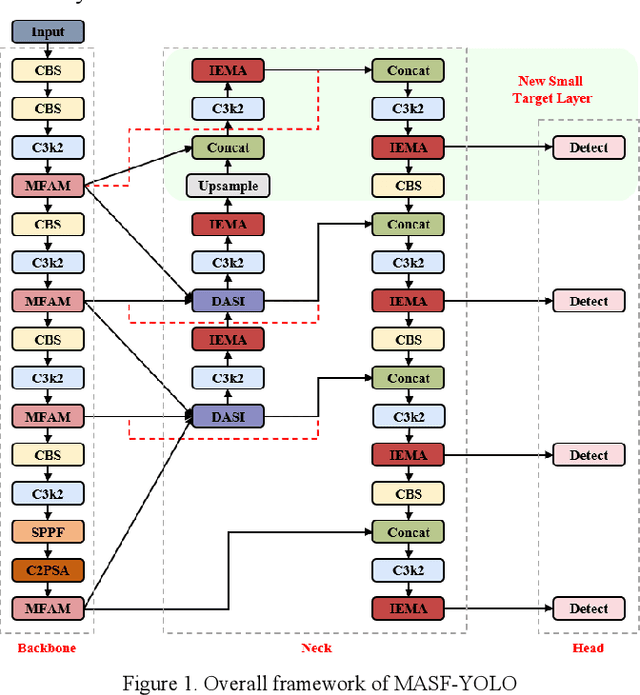

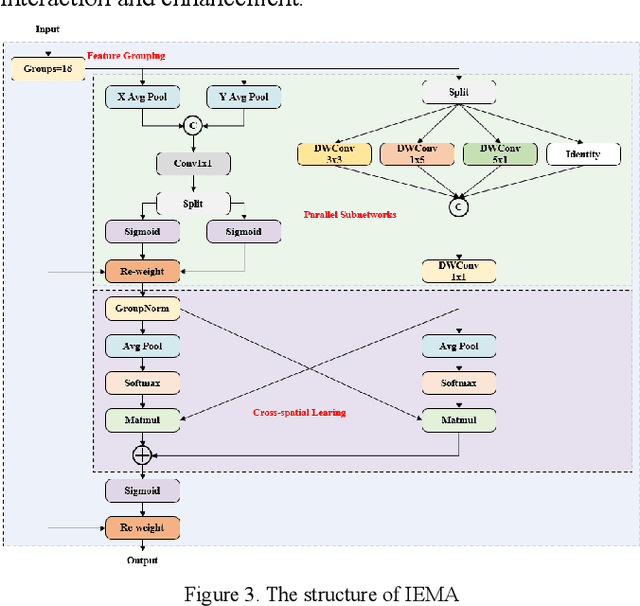
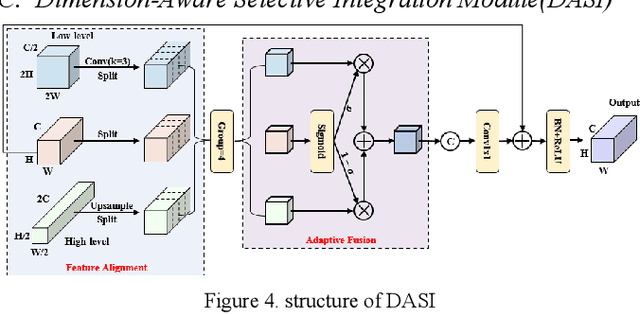
With the rapid advancement of Unmanned Aerial Vehicle (UAV) and computer vision technologies, object detection from UAV perspectives has emerged as a prominent research area. However, challenges for detection brought by the extremely small proportion of target pixels, significant scale variations of objects, and complex background information in UAV images have greatly limited the practical applications of UAV. To address these challenges, we propose a novel object detection network Multi-scale Context Aggregation and Scale-adaptive Fusion YOLO (MASF-YOLO), which is developed based on YOLOv11. Firstly, to tackle the difficulty of detecting small objects in UAV images, we design a Multi-scale Feature Aggregation Module (MFAM), which significantly improves the detection accuracy of small objects through parallel multi-scale convolutions and feature fusion. Secondly, to mitigate the interference of background noise, we propose an Improved Efficient Multi-scale Attention Module (IEMA), which enhances the focus on target regions through feature grouping, parallel sub-networks, and cross-spatial learning. Thirdly, we introduce a Dimension-Aware Selective Integration Module (DASI), which further enhances multi-scale feature fusion capabilities by adaptively weighting and fusing low-dimensional features and high-dimensional features. Finally, we conducted extensive performance evaluations of our proposed method on the VisDrone2019 dataset. Compared to YOLOv11-s, MASFYOLO-s achieves improvements of 4.6% in mAP@0.5 and 3.5% in mAP@0.5:0.95 on the VisDrone2019 validation set. Remarkably, MASF-YOLO-s outperforms YOLOv11-m while requiring only approximately 60% of its parameters and 65% of its computational cost. Furthermore, comparative experiments with state-of-the-art detectors confirm that MASF-YOLO-s maintains a clear competitive advantage in both detection accuracy and model efficiency.