 Add to Chrome
 Add to Firefox
 Add to Edge
Hi-LOAM: Hierarchical Implicit Neural Fields for LiDAR Odometry and Mapping
Apr 02, 2026
LiDAR Odometry and Mapping (LOAM) is a pivotal technique for embodied-AI applications such as autonomous driving and robot navigation. Most existing LOAM frameworks are either contingent on the supervision signal, or lack of the reconstruction fidelity, which are deficient in depicting details of large-scale complex scenes. To overcome these limitations, we propose a multi-scale implicit neural localization and mapping framework using LiDAR sensor, called Hi-LOAM. Hi-LOAM receives LiDAR point cloud as the input data modality, learns and stores hierarchical latent features in multiple levels of hash tables based on an octree structure, then these multi-scale latent features are decoded into signed distance value through shallow Multilayer Perceptrons (MLPs) in the mapping procedure. For pose estimation procedure, we rely on a correspondence-free, scan-to-implicit matching paradigm to estimate optimal pose and register current scan into the submap. The entire training process is conducted in a self-supervised manner, which waives the model pre-training and manifests its generalizability when applied to diverse environments. Extensive experiments on multiple real-world and synthetic datasets demonstrate the superior performance, in terms of the effectiveness and generalization capabilities, of our Hi-LOAM compared to existing state-of-the-art methods.

SPORTS: Simultaneous Panoptic Odometry, Rendering, Tracking and Segmentation for Urban Scenes Understanding
Oct 14, 2025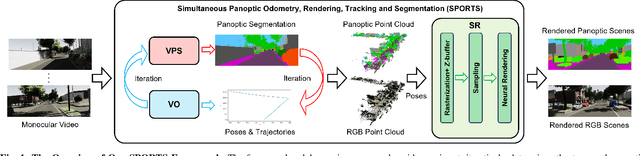
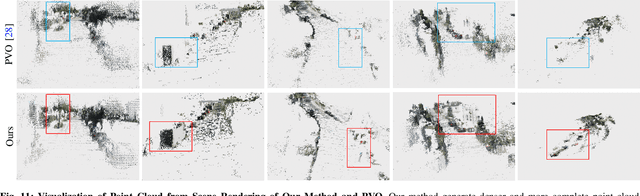
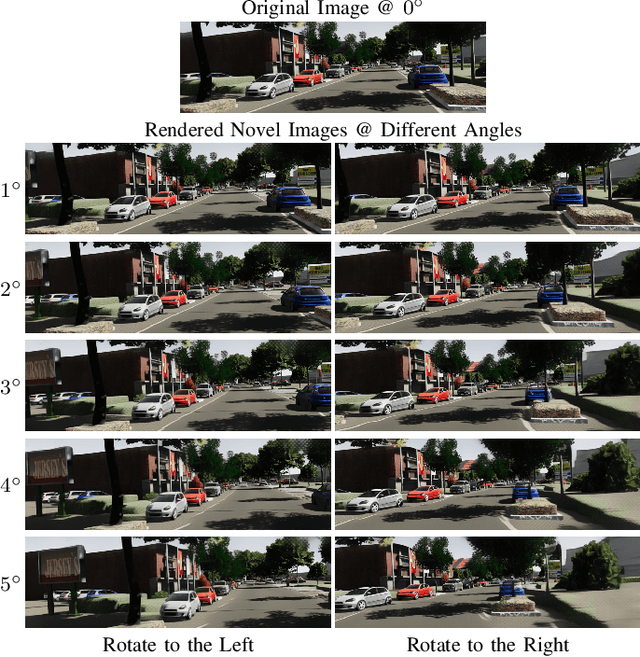
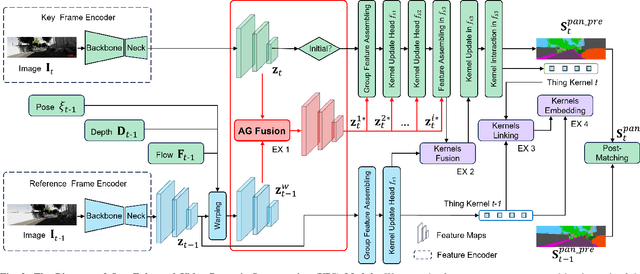
The scene perception, understanding, and simulation are fundamental techniques for embodied-AI agents, while existing solutions are still prone to segmentation deficiency, dynamic objects' interference, sensor data sparsity, and view-limitation problems. This paper proposes a novel framework, named SPORTS, for holistic scene understanding via tightly integrating Video Panoptic Segmentation (VPS), Visual Odometry (VO), and Scene Rendering (SR) tasks into an iterative and unified perspective. Firstly, VPS designs an adaptive attention-based geometric fusion mechanism to align cross-frame features via enrolling the pose, depth, and optical flow modality, which automatically adjust feature maps for different decoding stages. And a post-matching strategy is integrated to improve identities tracking. In VO, panoptic segmentation results from VPS are combined with the optical flow map to improve the confidence estimation of dynamic objects, which enhances the accuracy of the camera pose estimation and completeness of the depth map generation via the learning-based paradigm. Furthermore, the point-based rendering of SR is beneficial from VO, transforming sparse point clouds into neural fields to synthesize high-fidelity RGB views and twin panoptic views. Extensive experiments on three public datasets demonstrate that our attention-based feature fusion outperforms most existing state-of-the-art methods on the odometry, tracking, segmentation, and novel view synthesis tasks.
LISNeRF Mapping: LiDAR-based Implicit Mapping via Semantic Neural Fields for Large-Scale 3D Scenes
Nov 04, 2023Large-scale semantic mapping is crucial for outdoor autonomous agents to fulfill high-level tasks such as planning and navigation. This paper proposes a novel method for large-scale 3D semantic reconstruction through implicit representations from LiDAR measurements alone. We firstly leverages an octree-based and hierarchical structure to store implicit features, then these implicit features are decoded to semantic information and signed distance value through shallow Multilayer Perceptrons (MLPs). We adopt off-the-shelf algorithms to predict the semantic labels and instance IDs of point cloud. Then we jointly optimize the implicit features and MLPs parameters with self-supervision paradigm for point cloud geometry and pseudo-supervision pradigm for semantic and panoptic labels. Subsequently, Marching Cubes algorithm is exploited to subdivide and visualize the scenes in the inferring stage. For scenarios with memory constraints, a map stitching strategy is also developed to merge sub-maps into a complete map. As far as we know, our method is the first work to reconstruct semantic implicit scenes from LiDAR-only input. Experiments on three real-world datasets, SemanticKITTI, SemanticPOSS and nuScenes, demonstrate the effectiveness and efficiency of our framework compared to current state-of-the-art 3D mapping methods.
TiV-NeRF: Tracking and Mapping via Time-Varying Representation with Dynamic Neural Radiance Fields
Nov 04, 2023Previous attempts to integrate Neural Radiance Fields (NeRF) into Simultaneous Localization and Mapping (SLAM) framework either rely on the assumption of static scenes or treat dynamic objects as outliers. However, most of real-world scenarios is dynamic. In this paper, we propose a time-varying representation to track and reconstruct the dynamic scenes. Our system simultaneously maintains two processes, tracking process and mapping process. For tracking process, the entire input images are uniformly sampled and training of the RGB images are self-supervised. For mapping process, we leverage know masks to differentiate dynamic objects and static backgrounds, and we apply distinct sampling strategies for two types of areas. The parameters optimization for both processes are made up by two stages, the first stage associates time with 3D positions to convert the deformation field to the canonical field. And the second associates time with 3D positions in canonical field to obtain colors and Signed Distance Function (SDF). Besides, We propose a novel keyframe selection strategy based on the overlapping rate. We evaluate our approach on two publicly available synthetic datasets and validate that our method is more effective compared to current state-of-the-art dynamic mapping methods.