 Add to Chrome
 Add to Firefox
 Add to Edge
PMIScore: An Unsupervised Approach to Quantify Dialogue Engagement
Mar 14, 2026
High dialogue engagement is a crucial indicator of an effective conversation. A reliable measure of engagement could help benchmark large language models, enhance the effectiveness of human-computer interactions, or improve personal communication skills. However, quantifying engagement is challenging, since it is subjective and lacks a "gold standard". This paper proposes PMIScore, an efficient unsupervised approach to quantify dialogue engagement. It uses pointwise mutual information (PMI), which is the probability of generating a response conditioning on the conversation history. Thus, PMIScore offers a clear interpretation of engagement. As directly computing PMI is intractable due to the complexity of dialogues, PMIScore learned it through a dual form of divergence. The algorithm includes generating positive and negative dialogue pairs, extracting embeddings by large language models (LLMs), and training a small neural network using a mutual information loss function. We validated PMIScore on both synthetic and real-world datasets. Our results demonstrate the effectiveness of PMIScore in PMI estimation and the reasonableness of the PMI metric itself.

Algorithmic Robust Forecast Aggregation
Jan 31, 2024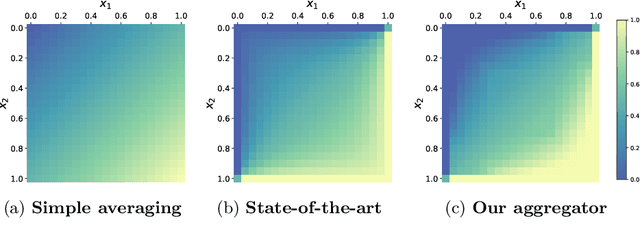
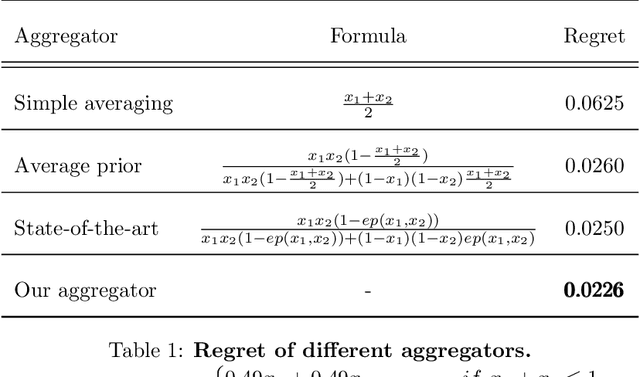
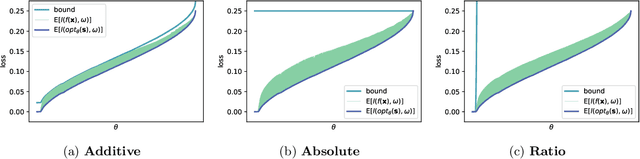
Forecast aggregation combines the predictions of multiple forecasters to improve accuracy. However, the lack of knowledge about forecasters' information structure hinders optimal aggregation. Given a family of information structures, robust forecast aggregation aims to find the aggregator with minimal worst-case regret compared to the omniscient aggregator. Previous approaches for robust forecast aggregation rely on heuristic observations and parameter tuning. We propose an algorithmic framework for robust forecast aggregation. Our framework provides efficient approximation schemes for general information aggregation with a finite family of possible information structures. In the setting considered by Arieli et al. (2018) where two agents receive independent signals conditioned on a binary state, our framework also provides efficient approximation schemes by imposing Lipschitz conditions on the aggregator or discrete conditions on agents' reports. Numerical experiments demonstrate the effectiveness of our method by providing a nearly optimal aggregator in the setting considered by Arieli et al. (2018).