 Add to Chrome
 Add to Firefox
 Add to Edge
Real-Time and Scalable Zak-OTFS Receiver Processing on GPUs
Apr 02, 2026
Orthogonal time frequency space (OTFS) modulation offers superior robustness to high-mobility channels compared to conventional orthogonal frequency-division multiplexing (OFDM) waveforms. However, its explicit delay-Doppler (DD) domain representation incurs substantial signal processing complexity, especially with increased DD domain grid sizes. To address this challenge, we present a scalable, real-time Zak-OTFS receiver architecture on GPUs through hardware--algorithm co-design that exploits DD-domain channel sparsity. Our design leverages compact matrix operations for key processing stages, a branchless iterative equalizer, and a structured sparse channel matrix of the DD domain channel matrix to significantly reduce computational and memory overhead. These optimizations enable low-latency processing that consistently meets the 99.9-th percentile real-time processing deadline. The proposed system achieves up to 906.52 Mbps throughput with a DD grid size of (16384,32) using 16QAM modulation over 245.76 MHz bandwidth. Extensive evaluations under a Vehicular-A channel model demonstrate strong scalability and robust performance across CPU (Intel Xeon) and multiple GPU platforms (NVIDIA Jetson Orin, RTX 6000 Ada, A100, and H200), highlighting the effectiveness of compute-aware Zak-OTFS receiver design for next-generation (NextG) high-mobility communication systems.

MadRadar: A Black-Box Physical Layer Attack Framework on mmWave Automotive FMCW Radars
Nov 27, 2023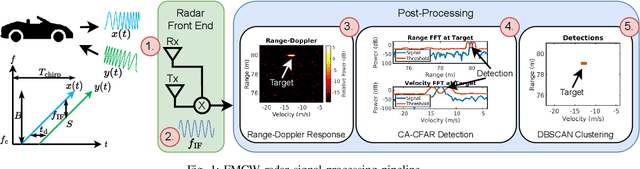

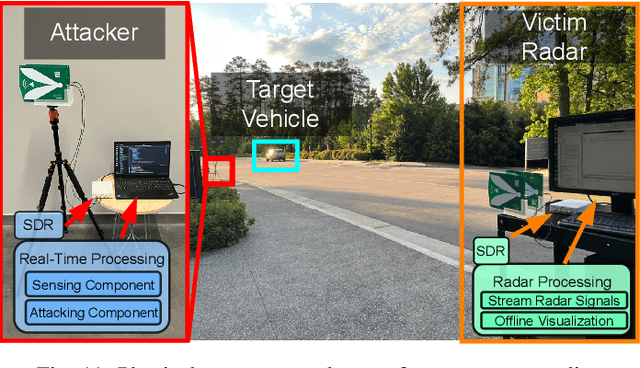
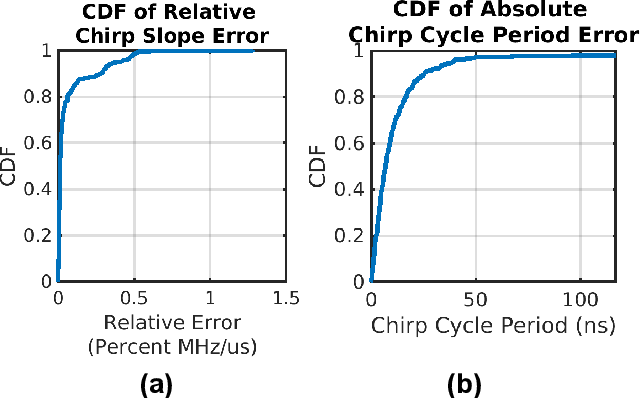
Frequency modulated continuous wave (FMCW) millimeter-wave (mmWave) radars play a critical role in many of the advanced driver assistance systems (ADAS) featured on today's vehicles. While previous works have demonstrated (only) successful false-positive spoofing attacks against these sensors, all but one assumed that an attacker had the runtime knowledge of the victim radar's configuration. In this work, we introduce MadRadar, a general black-box radar attack framework for automotive mmWave FMCW radars capable of estimating the victim radar's configuration in real-time, and then executing an attack based on the estimates. We evaluate the impact of such attacks maliciously manipulating a victim radar's point cloud, and show the novel ability to effectively `add' (i.e., false positive attacks), `remove' (i.e., false negative attacks), or `move' (i.e., translation attacks) object detections from a victim vehicle's scene. Finally, we experimentally demonstrate the feasibility of our attacks on real-world case studies performed using a real-time physical prototype on a software-defined radio platform.